
A farmer digging an irrigation ditch near Guanghan in Sichuan. Under his shovel lie fragments of jade and pottery he cannot identify. It was 1929, and no one suspected that this rural corner of China would, decades later, yield one of the most confounding archaeological treasures of the 20th century: bronze masks with eyes that bulge, a metallic tree nearly four meters tall, and an entire civilization that official Chinese history had never mentioned.
Key takeaways
- Underground pits have safeguarded for three millennia objects of unfathomable splendor
- The masks uncovered defy human proportions: the largest measures 1.32 m in width
- An entire civilization appears to have deliberately destroyed and buried its treasures — but why?
1986, the day everything changed
It would take nearly six decades for the site to reveal its true face. In 1986, systematic excavations uncovered two sacrificial pits packed with objects unrelated to what had been known about Bronze Age Sichuan. The discovery of pits filled with animal bones, elephant tusks, jades, broken and burned bronzes stunned the archaeological community. Why were these precious objects deliberately shattered, charred, and then buried with such care? The question continues to divide researchers, between a catastrophe endured and a deliberate funeral rite.
The loot, however, left little doubt about the scale of the find. More than 1,000 national treasures, including gold masks, bronze objects, jade tablets, ivory pieces, and a sacred tree, were unearthed in 1986 in two sacrificial pits at the ruins. The figure is staggering when one considers that most sites from this period offer, at most, a few dozen isolated pieces. At Sanxingdui, an entire world seemed to rebound from the earth all at once, frozen for three millennia.
Masks larger than life, a tree to connect heaven and earth
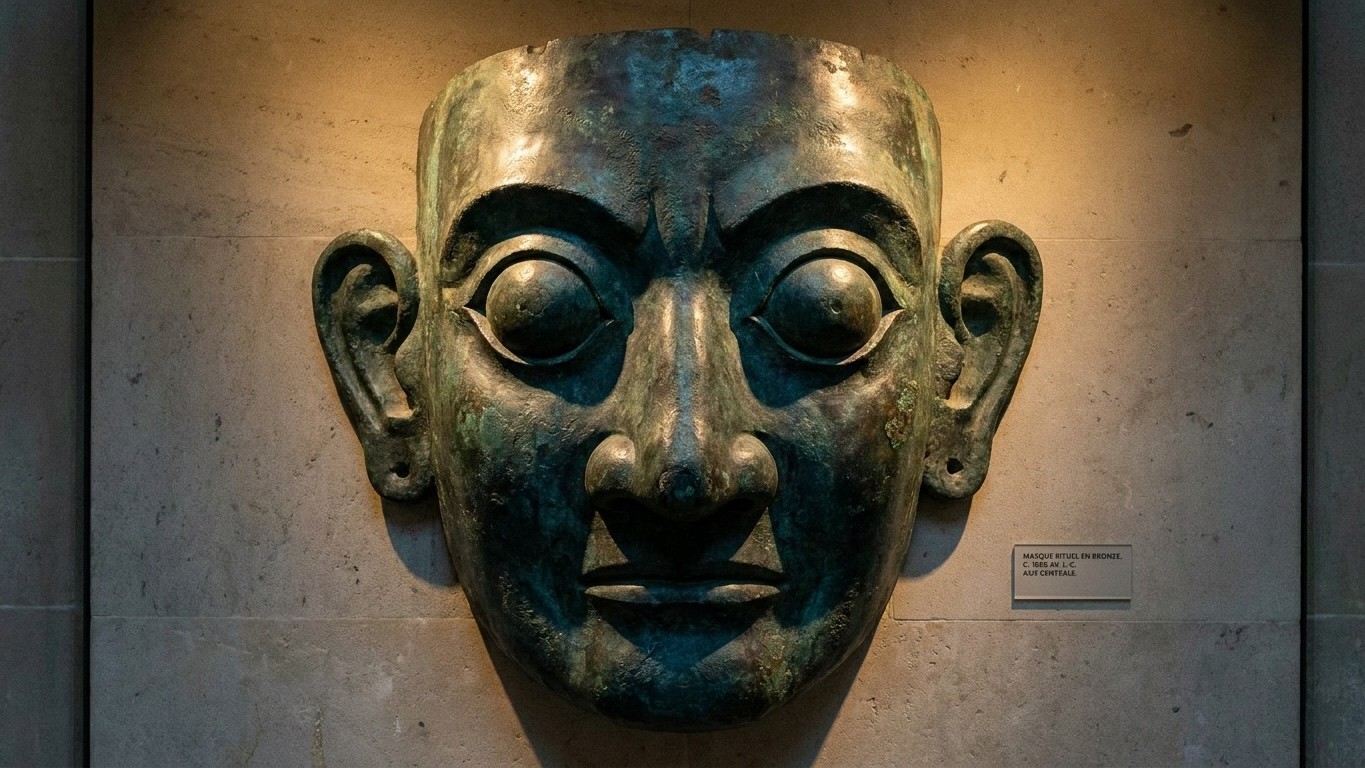
What strikes first are the faces. Bronze masks of a scale that far exceeds human proportions, with oversized ears, eyes that bulge several centimeters from the face. Some masks measure an astonishing 1.32 m in width and 0.72 m in height—the largest bronze mask ever found—featuring ears reminiscent of animal lugs and eyes protruding monstrously. It is hard to imagine, when studying them, that they date from a time when artisans in the rest of China cast mainly simple, geometric ritual vases.
Then there is the tree. A piece reconstructed from shattered fragments, rising to almost four meters once restored. A broken bronze spirit-tree, that when fully rebuilt could reach about four meters in height, telling of sun worship and standing as the centerpiece of a vanished cosmological cult, perhaps designed as an axis linking the world of the living to that of the gods. The archaeologists who restored it describe it as a remains rarely seen in East Asia, such as sacred trees, bronze altars, large human figures and gold masks: nothing comparable exists elsewhere in ancient China.
The technical feat is as impressive as the aesthetics. These objects were created using a remarkably advanced bronze-casting technology, achieved by adding lead to a copper-tin alloy, an alloy capable of supporting massive pieces without cracking during casting. For Bronze Age artisans, sculpting a four-meter tree was a pure technical triumph, at a time when even a slight change in temperature could ruin months of labor.
A phantom civilization, absent from all texts
The most troubling aspect is not the size of the objects but their silences. No ancient Chinese text mentions this culture. Researchers were surprised to find an artistic style entirely unfamiliar in the history of Chinese art, whose reference until then lay with the civilizations of the Yellow River. Sanxingdui would belong to the Shu kingdom, a political entity that flourished on the margins of the classic dynasties, leaving behind not a single decipherable line of writing.
The story does not end in 1986. In 2021, six new sacrificial pits surfaced, revealing more than 500 items dating back about 3,000 years, including gold masks, sheets of gold, and new bronze trees. A Sichuan Cultural Heritage Research Institute official stated at the time: “Surprisingly, we have unearthed bronze artifacts never heard of before.” Among these recent finds, a giant mask excavated from Pit No. 3 stands out as the largest piece discovered at the site: this bronze mask measures 71 cm high by 131 cm wide and dates to approximately 1300–1100 BCE. Traces of silk were even detected near an eye, suggesting that these masks were mounted on structures now disappeared, perhaps made of wood or fabric.
One question remains to this day for archaeologists: why smash everything before burying it? Some see the signs of an internal conflict or a forced exodus, while others view it as a deliberate ritual of destruction intended to “release” the sacred power of the objects before returning them to the earth. The site, for its part, continues to yield its secrets drop by drop, pit after pit, as if the kingdom of Shu took care to stagger its revelations across generations of archaeologists.
Sources: chine-magazine.com | french.peopledaily.com.cn
