
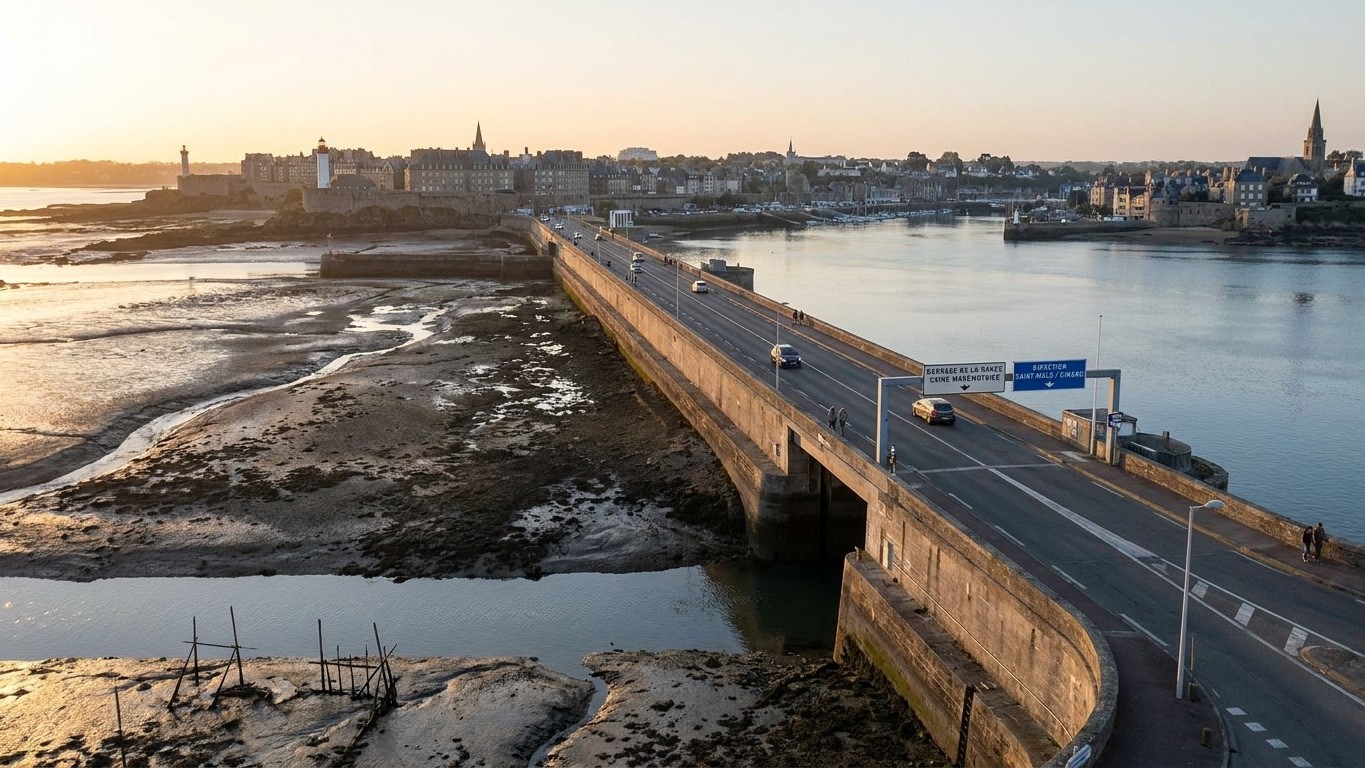
In the Rance estuary, between Dinard and Saint-Malo, a remarkable plant has been operating since 1966. A 750-meter dam seals off the mouth of the coastal river, and beneath the road linking the two banks, twenty-four turbines convert the rise and fall of the tide into electricity. Six decades later, the installation continues to run, day and night, paced by the Moon.
Key takeaways
- A plant inaugurated by de Gaulle that held an unmatched record for decades
- 24 turbines spinning in two directions, capable of producing electricity at every tide
- A pharaonic project that required draining an estuary completely for three years
A World First Born in the 1960s
The idea did not spring from nowhere. The notion of building a tidal power plant on the Rance dates back to 1921, proposed by Gérard Boisnoer, with initial studies in 1943. Yet it was only in the postwar era that the project gained momentum: EDF envisaged the plan in 1946, made a decision in 1959, and undertook the construction between January 1961 and 1966 of the Rance tidal power plant. The site was chosen with purpose. The Rance estuary exhibits one of the world’s highest tidal ranges, reaching 13.5 meters—a remarkable tidal amplitude unrivaled along the French Atlantic coast.
Charles de Gaulle, President of the French Republic, inaugurated the plant on November 26, 1966. At the time, France made a bold industrial statement: when it came into service in 1966, the Rance barrage was the world’s first tidal power plant. It remained so for a long time, becoming the most powerful tidal installation ever built, and it remains a benchmark internationally rarely equaled. For nearly half a century, no other country surpassed its installed capacity in this energy sector.
Twenty-four Turbines Turning in Both Directions
The principle is simple, but the execution was a true technical challenge. The plant comprises 24 Kaplan turbines, each rated at 10 MW, housed in a submerged facility beneath the road. Their distinctive feature: they can operate in both directions. Technical descriptions indicate that the Rance bulb turbines are reversible; they can drive the generator or even act as pumps, a capability that partly explains the installation’s longevity.
In practice, seawater enters the basin on the rising tide and exits on the falling tide, engaging the turbines with each movement. When the water level difference reaches about 4 meters, water is released through the bulb turbines, which can produce electricity during both the incoming and outgoing tide. The dam is not merely a concrete wall: a 115-meter-long movable barrier equipped with six wagon-type gates, rising up to 10 meters and spanning 15 meters in width, regulates the water flow according to production needs.
The resulting power reaches 240 MW of installed capacity, with an annual output of around 500 GWh. This is enough to meet the continuous needs of a mid-sized city, all without emitting any CO2 during generation. This predictability marks a clear advantage over wind or solar energy: tidal production can be forecast decades in advance with remarkable precision, since it depends solely on celestial mechanics.
Three Years of Dry Work, and an Estuary Transformed
Building an underwater plant requires first removing the sea, albeit temporarily. The project unfolded in two stages. First came a preparatory phase, then the actual construction could begin on July 20, 1963, when the Rance was completely cut off from the sea by embankments formed from two rows of caissons, for three years of work that ended in 1966. Throughout this period, the estuary ceased to be an estuary: from 1963 to 1966, the Rance was entirely sealed from the sea to allow the builders to work on a completely dry site, turning the ria into a vast water body with no tidal movement. Such a drastic interruption had immediate consequences for wildlife, and at the time there were no environmental impact studies to anticipate them.
This three-year interlude left lasting marks, long after the water was restored. Once the dam was in operation, it continued to alter the estuary’s hydraulic regime. The barrage accelerated silt buildup in the Rance estuary, primarily due to the reduction in tidal amplitude and the rising mean water level upstream. This phenomenon is not trivial: an official report noted that between 30,000 and 50,000 cubic meters of sediment settle in the estuary each year as of February 2003, a rate that has even accelerated since. More recent studies confirm this trend: updated technical assessments in 2019 indicate sedimentation of 300,000 to 500,000 cubic meters per year.
The local fauna had to adapt to this new face of the estuary. Sprat and plaice disappeared, but bass and cuttlefish ventured upriver again. A complete shift in ecological balance is summarized without embellishment by zone specialists: the wildlife has transformed entirely, with smaller, faster species now forming the bulk of the living community. As a striking sign that nature sometimes reasserts itself in surprising ways, a common seal established itself in the sector: a harbor seal managed to pass the dam—via the lock or the bulb group—and has resided since 2001 in the Mordreuc area, despite the many attempts by veterinarians from Océanopolis to reintroduce it to its native habitat.
Sixty years after its inauguration, the plant continues to operate, and EDF has launched a renewal program to extend its life. EDF is investing 100 million euros over a decade, through 2025, to refurbish a portion of the 24 bulb-type units. The dam also serves as a road bridge between Dinard and Saint-Malo, a use that few visitors naturally associate with an electrical power plant. As for the estuary, it continues its slow evolution, with expanding mudflats and a fauna that adapts—however imperfectly—to a river that has become a machine.
Sources: edf.fr | travail-industrie.com
