
People often picture the piranha as a small, jittery fish barely able to nibble at the tender flesh of a wounded prey or to startle tourists leaning over a riverbank in the Amazon. A B-movie creature, more impressive in reputation than in real strength. Yet this image deserves a broad correction. A fish under a meter in length capable of delivering a bite stronger than that of the Megalodon, the largest marine predator of all time: such a claim may sound absurd, almost like a scientific urban legend. It rests, however, on rigorous calculations based on a fossil millions of years old. Megapiranha paranensis, a vanished cousin of today’s piranhas, would have bitten with a force between 1,240 and 4,749 newtons, more than enough to crush bones with seemingly no effort.
- Megapiranha paranensis, described in 2009 from a jaw fragment found in Argentina, lived 8 to 10 million years ago.
- Its bite force, estimated between 1,240 and 4,749 newtons based on simulations using the modern black piranha as reference, would exceed that of the Megalodon.
- Its zigzag teeth make it a missing link between today’s carnivorous piranhas and herbivorous cousins like the pacu.
- A jaw fragment that slept for a century in a drawer
- Zigzag teeth, the missing link between the piranha and its vegetarian cousin
- How to calculate the bite of a fish that has been dead for ten million years
- Stronger than the Megalodon: the calculation that challenges certainties
A jaw fragment that had slept for a century in a drawer
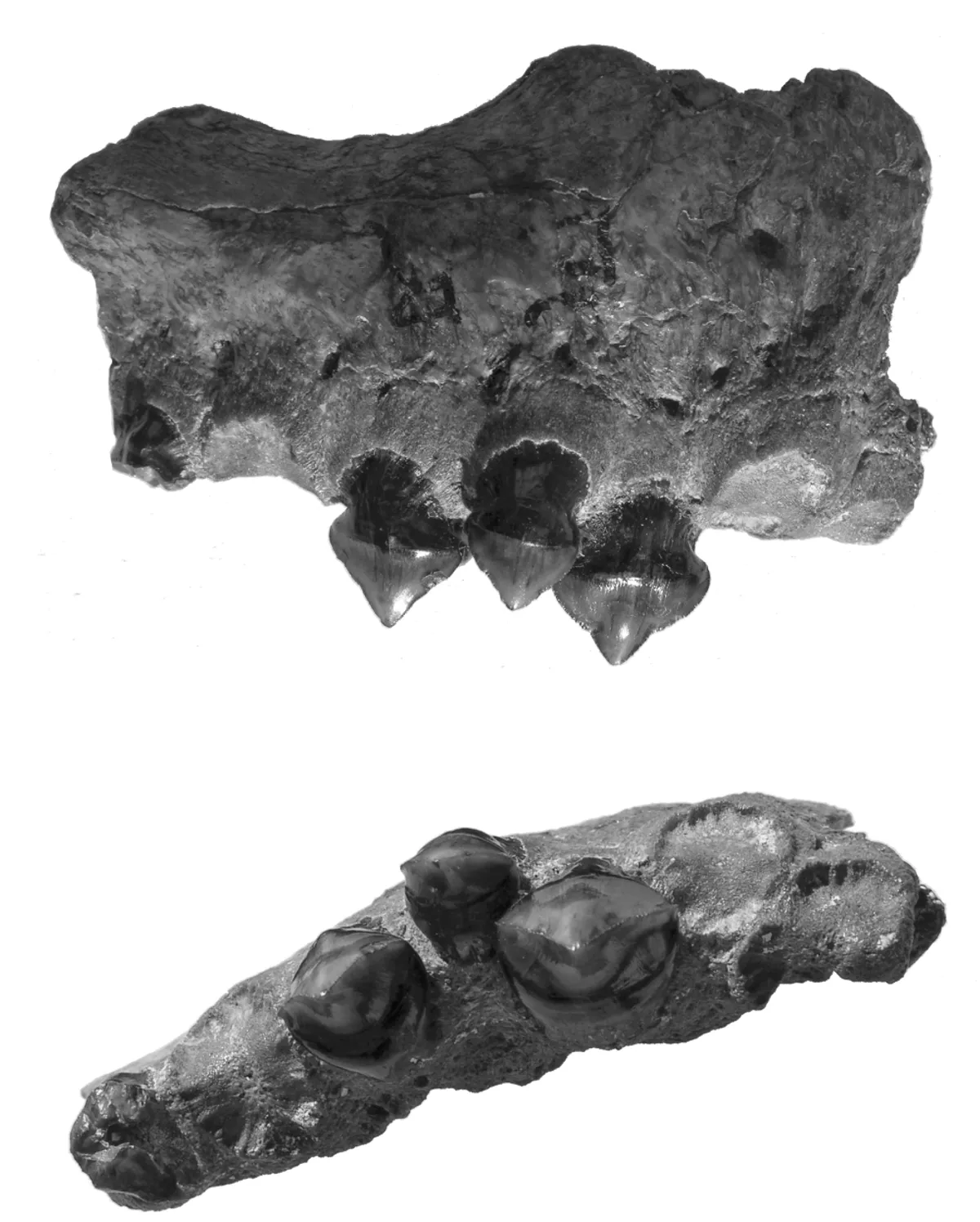
Credit: © Mark Sabaj-Pérez /via EurekAlert
The story of Megapiranha paranensis begins in an almost anecdotal fashion. The key fossil, a fragment of an upper jaw bearing three large teeth (there were seven originally), was discovered in Argentina, in the Paraná Formation, in the early 1900s. Yet for decades this bone fragment sparked little interest, tucked away among paleontological curiosities without substantive study.
It would take until the 1980s for paleontologist Alberto Cione to take a serious interest. It was not until 2009 that the species was officially described by Cione and colleagues Wasila Dahdul and John Lundberg, finally revealing to the scientific world the existence of this giant piranha that lived in South America between 8 and 10 million years ago. A century of waiting for a fossil that would upend our understanding of predatory fish.
Zigzag teeth, the missing link between the piranha and its vegetarian cousin
What makes this fossil particularly fascinating is not only its size but the unusually distinctive arrangement of its teeth. In today’s piranhas, teeth are lined up in a single, straight row. In their herbivorous cousins, like the pacu, they form two distinct rows. Megapiranha paranensis, by contrast, shows a zigzag arrangement, an intermediate configuration that literally makes it the missing link between these two lineages.
This discovery also revived debates about the animal’s real size. The first 2009 study suggested a fish exceeding a meter in length, with a weight comparable to that of a grown human. Subsequent work, however, revised these estimates downward, placing Megapiranha at roughly 0.7 meter for nearly 10 kilograms. A much more modest size, but that makes the expected bite force all the more astonishing.
How to calculate the bite of a fish that has been dead for ten million years
A natural question arises: how to measure the bite force of a creature that vanished millions of years ago when all that remains is a fragment of jaw? The method used for Megapiranha combines two complementary approaches. On one side, direct measurements were taken on two wild black piranhas (Serrasalmus rhombeus), a living species closely related to Megapiranha. On the other, these data were integrated into simulations that account for the anatomy and jaw mechanics inferred from the fossil.
This blend of contemporary biology with paleontological reconstruction yields a credible estimate for a phenomenon that cannot be measured directly. The result obtained through this method is clear: a bite force ranging between 1,240 and 4,749 newtons, more than enough to crush solid bones.
Stronger than the Megalodon: the calculation that challenges certainties
To put this figure in perspective, researchers compared it with the bite of a great white shark. Depending on the assumption, it would correspond to the bite of a 400 kg individual in a conservative estimate, or even that of a 3,000 kg specimen when accounting for Megapiranha’s specific jaw mechanics.
Even more striking, these same calculations suggest that even the Megalodon, the giant extinct shark long considered the ultimate marine predator, would not have been able to rival such a bite force. The living descendant of this lineage, the modern black piranha, already holds the record for bite force among bony fish, at 320 newtons, nearly three times that of an American alligator of similar size. This performance is made possible by a remarkably efficient jaw mechanism and jaw muscles that account for more than 2% of the animal’s body weight.
From this small jaw fragment forgotten in an Argentine drawer, a scientific narrative was born that redefines our benchmark for animal power. Megapiranha paranensis reminds us that in biology, the size of a predator does not tell the whole story of its real danger. One is left to wonder what other surprises lie dormant, forgotten, in the dust-covered collections of our natural history museums.
