
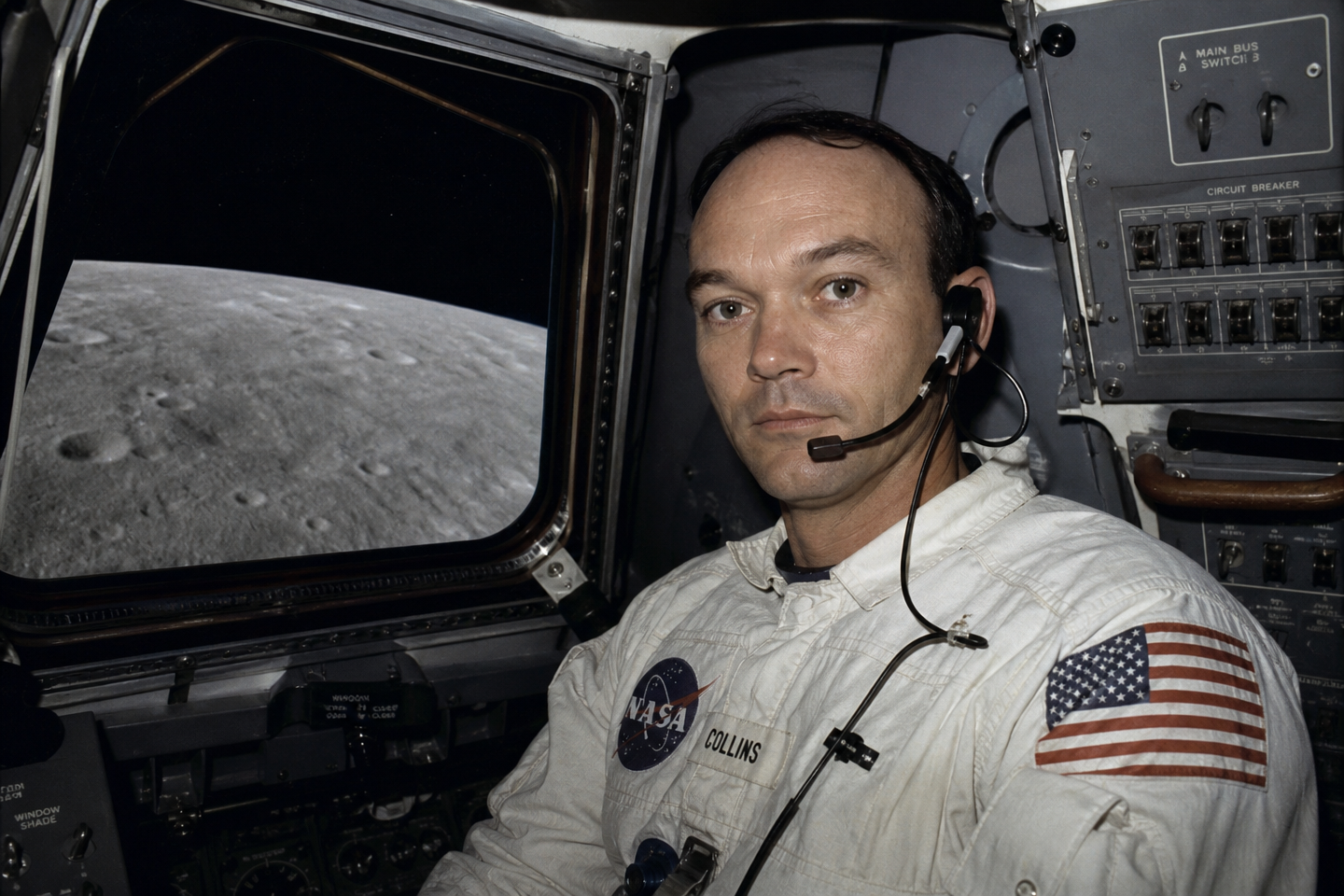
On July 20, 1969, while hundreds of millions of people fixed their gaze on a television screen to witness Neil Armstrong take his first steps on the Moon, a third man also lived through a moment as historic, though far removed from television glory. This man was Michael Collins, left solitary aboard the Command Module Columbia, circling the Moon in orbit. While Armstrong and Aldrin etched history on the surface of our satellite, Collins repeatedly vanished behind the Moon’s far side, cut off from any communication with Earth for 48 minutes with each revolution. A silent, intimate confinement, almost anecdotal in popular Apollo 11 narratives, yet one that deserves attention for what it reveals about a less known facet of this space odyssey.
The Man Erased from the World by the Moon
We know Armstrong and Aldrin’s faces by heart, immortalized in school textbooks and documentaries. Michael Collins, however, tends to linger in the shadow of a mission that he nevertheless made possible. Yet his role is pivotal: he pilots the command module, the capsule that must remain in lunar orbit while his two teammates descend to the surface aboard the lunar module Eagle. Without him, there would be no possibility of returning to Earth.
While his colleagues leave their mark in the lunar dust, Collins endlessly turns, again and again, around the Moon. He becomes, for a time, the most isolated man in human history. No human before him had been so far from any trace of other people, aside from his two fellow astronauts who themselves tread the Moon’s surface under the world’s gaze. Collins has only silence and the instruments of his spacecraft for company.
48 minutes where no one on Earth could hear him
The command module follows an orbital path that brings it behind the Moon’s dark side at regular intervals. At that precise moment, the lunar bulk blocks radio waves between the capsule and Earth. For about 48 minutes, Collins is unable to transmit or receive any message. Neither Houston, nor his surface colleagues, nor anyone on Earth can hear his voice or detect any signal from his capsule.
This total radio blackout repeats with each orbit, several times during the mission. Imagine the scene: a man alone, inside a metal capsule the size of a small car, hurtling at over 5,000 kilometers per hour around a dead star, with no contact whatsoever with the rest of humanity. Even the Soviet astronauts of the Cold War era had never faced such isolation. Collins becomes, literally, the most solitary human being in history, with only the gray craters sliding past his window to mark his horizon.
In the absolute silence, the strangest fear he ever felt
What is often remembered about this experience is the almost metaphysical solitude it could provoke. Collins would later say that he felt less fear of dying alone in space than the more insidious fear of having to depart without his crewmates if something went wrong during their ascent back from the lunar surface. That anxiety—purely psychological—seems to have weighed more heavily on the astronaut than the physical isolation itself.
Picture the scenario: every time he slips behind the Moon, Collins knows he will receive no news if an incident occurs on the surface. There is no way to know if Armstrong and Aldrin are safe, no possibility to intervene if trouble arises. This total impotence, coupled with radio silence, creates a psychological tension that is unique, quite different from the classical fear of the void. It is an active solitude, heavy with responsibility, more than a mere absence of noise.
What Collins experienced up there changes our view of Apollo 11
Returning to Michael Collins’ experience allows us to nuance the story that centers on the two men who walked on the Moon. Apollo 11 isn’t solely the tale of a bootprint left in the lunar dust; it is also the story of a third man in orbit, a silent guarantor of the mission’s success. Without his careful work and his capacity to endure this extreme solitude, the return to Earth would simply not have been possible.
This dimension, often eclipsed by the iconic image of the American flag planted on the Moon, deserves to be brought back into focus. It reminds us that space exploration rests as much on visible individual feats as on quieter missions, just as essential. Michael Collins never set foot on the Moon, but his role in this adventure remains, in his own way, just as extraordinary as that of his two celebrated travel companions.
More than fifty years after this achievement, the story of Michael Collins continues to fascinate by what it reveals about the human condition in the face of the vastness of space. As new lunar programs are being prepared today, this unique experience of absolute solitude invites us to ponder: what will the astronauts of tomorrow feel, confronted with missions even longer, toward Mars or beyond?
