
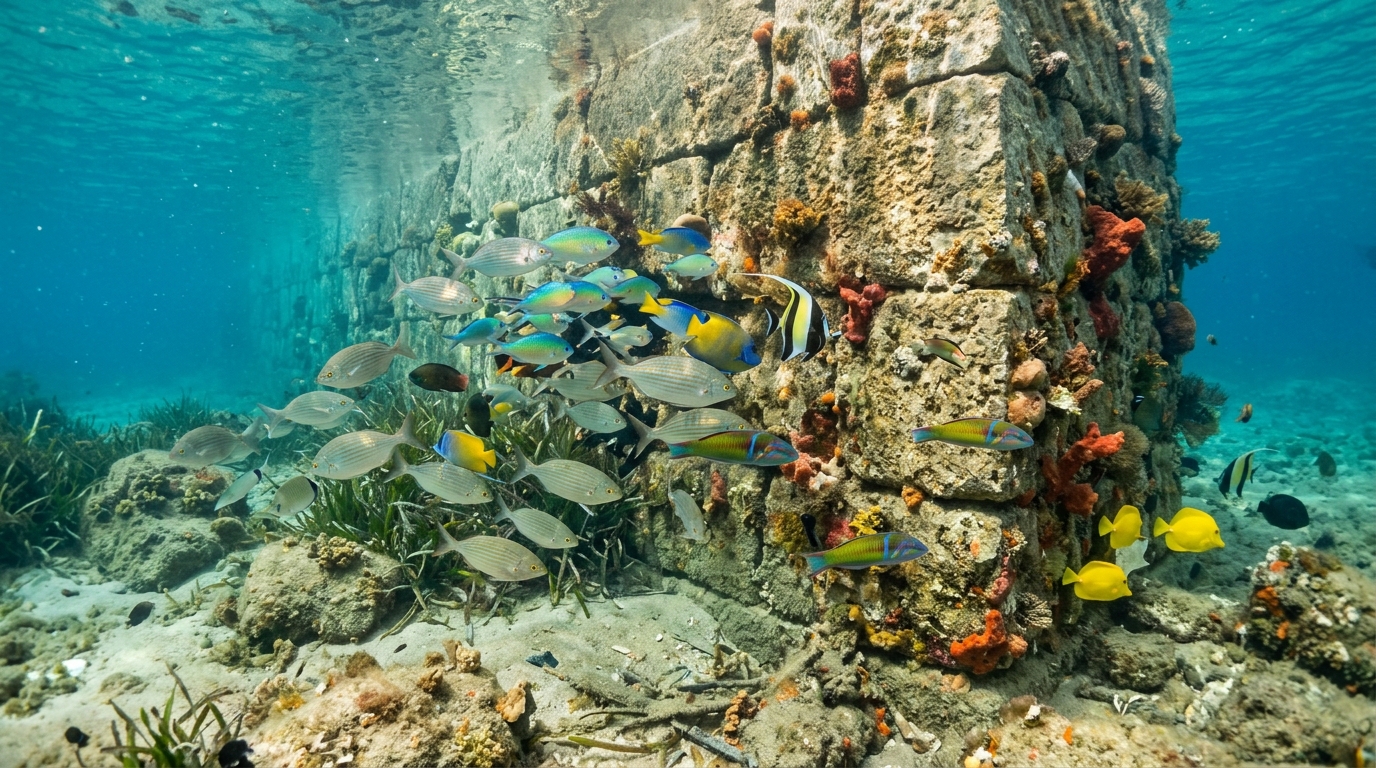
We often imagine the Mediterranean as a static ecosystem since antiquity, with its dolphins, its red tunas, and its immutable Posidonia oceanica meadows. Yet this is a stereotype that deserves serious nuance. For by digging a simple trench between two seas, humanity sparked one of the largest migrations of species ever observed in the marine world. Since the opening of the Suez Canal, the Mediterranean is no longer a sanctuary frozen in time: it has become a vast open-air laboratory, where the redistribution of biodiversity is taking place in real time.
Key takeaways
- Since the opening of the Suez Canal in 1869, nearly 500 species from the Red Sea have colonized the Mediterranean, a phenomenon known as Lessepsian migration.
- This migration is unidirectional because Red Sea species, more resilient, find in the Mediterranean fewer predators and less competition.
- Species such as the rabbitfish or the nomad jellyfish are depleting seabed vegetation and competing with local fauna, a phenomenon accelerated by climate change.
- When a lock rewrote the map of marine biodiversity
- The Lessepsian migration, an unprecedented phenomenon in marine history
- Rabbitfishes and venomous jellyfish: these invaders reshaping the Mediterranean seabed
- Why some local species disappear quietly
- What climate warming is already accelerating in the Suez Canal
When a lock rewrote the map of marine biodiversity
The opening of the Suez Canal in 1869 did not merely bring Europe closer to Asia by offering ships a spectacular shortcut to the Indian Ocean. It also pierced, perhaps not fully measured at the time, an ancient biological boundary that spans millions of years. Until then, the Red Sea and the Mediterranean were separated by the Isthmus of Suez, a land barrier that prevented natural exchange between these two marine worlds that were nevertheless geographically close. By digging this artificial channel, engineers opened a door that nature had kept closed for eons of geological time.
The outcome surpasses anything that could have been imagined at the time: nearly 500 species native to the Red Sea have since colonized the Mediterranean, taking up permanent residence in its waters and upending ecological balances that had been in place for millennia. Fish, mollusks, crustaceans, jellyfish: the roster of newcomers continues to grow, year after year.
The Lessepsian migration, an unprecedented phenomenon in marine history
Scientists have even given this phenomenon a name: the Lessepsian migration, in homage to Ferdinand de Lesseps, the man behind the canal project. This label denotes the movement of marine species from the Red Sea toward the eastern Mediterranean, a shift that has continued without interruption for more than one and a half centuries.
What makes this phenomenon so remarkable is its unidirectional nature. Contrary to what one might expect, exchanges do not occur in both directions in a balanced way. The Red Sea, warmer and saltier, hosts species particularly well-equipped to withstand harsh conditions. Once introduced into the Mediterranean, these species often encounter a milder environment, with fewer natural predators and less competition than at their origin. This imbalance largely explains why the migratory flow proved so extensive and enduring, without a comparable reverse flux of similar magnitude.
Rabbitfishes and venomous jellyfish: these invaders reshaping the Mediterranean seabed
Among the new inhabitants of the Mediterranean, some have left a particularly strong impression, not only on biologists. The rabbitfish, for example, has become one of the most visible symbols of this quiet invasion. This herbivorous fish devours the algae that coat rocky seabed, transforming areas once lush into barren underwater deserts. Divers who frequented certain Greek or Turkish coastlines a few decades ago hardly recognize today’s landscapes that are increasingly barren.
Another notable arrival is the nomad jellyfish, capable of forming vast swarms that sting and disrupt regular tourist activities and fishing in the eastern Mediterranean. Its sting, particularly painful, has become a public-health concern for local authorities during the summer season. In addition to these two examples, dozens of mollusks, crabs, and shrimps have settled into habitats they did not know, gradually reshaping the appearance of the Mediterranean seabed.
Why some local species disappear quietly
This massive arrival of exotic species does not come without consequences for native fauna. Some historically Mediterranean species are experiencing worrying declines, often without the general public immediately noticing. Competition for food and space plays a decisive role: when a rabbitfish colonizes an area and strips away the algae that previously covered it, local species that depended on that vegetation for feeding or reproduction lose their natural habitat.
This quiet decline also affects some crustaceans and demersal fish, unable to compete with predators or rivals arriving from the Red Sea, often more resilient to temperature and salinity shifts. The phenomenon remains difficult to quantify precisely as it unfolds over decades, but eastern Mediterranean fishermen have long noticed a clear change in the composition of their catches.
What climate warming is already accelerating in the Suez Canal
If the Suez Canal opened the door to this migration in 1869, climate warming today acts as a powerful accelerator of the process. The Mediterranean, historically cooler than the Red Sea, is warming gradually, making its waters increasingly hospitable to species originating from tropical or subtropical environments. What used to be a natural thermal barrier is thinning year after year, easing the permanent establishment of new arrivals.
Moreover, the successive enlargements of the canal, undertaken to accommodate ever-denser maritime traffic, have mechanically increased the volume of water exchanged between the two seas. This factor, combined with rising temperatures, leads scientists to believe that the Lessepsian migration is far from over. The researchers monitoring the evolution of the Mediterranean fauna even expect new species to settle in the coming years, continuing a dynamic set in motion more than a century and a half ago.
Ultimately, what nineteenth-century engineers viewed as a purely technical and commercial achievement proved to be much more: a large-scale ecological experiment, whose effects are still playing out before our eyes. The Mediterranean we know today is no longer exactly the one our grandparents visited, and it will likely continue to transform in step with climate change and human activity. The question remains whether this storied sea will find a new balance between its ancient inhabitants and its newcomers.
