
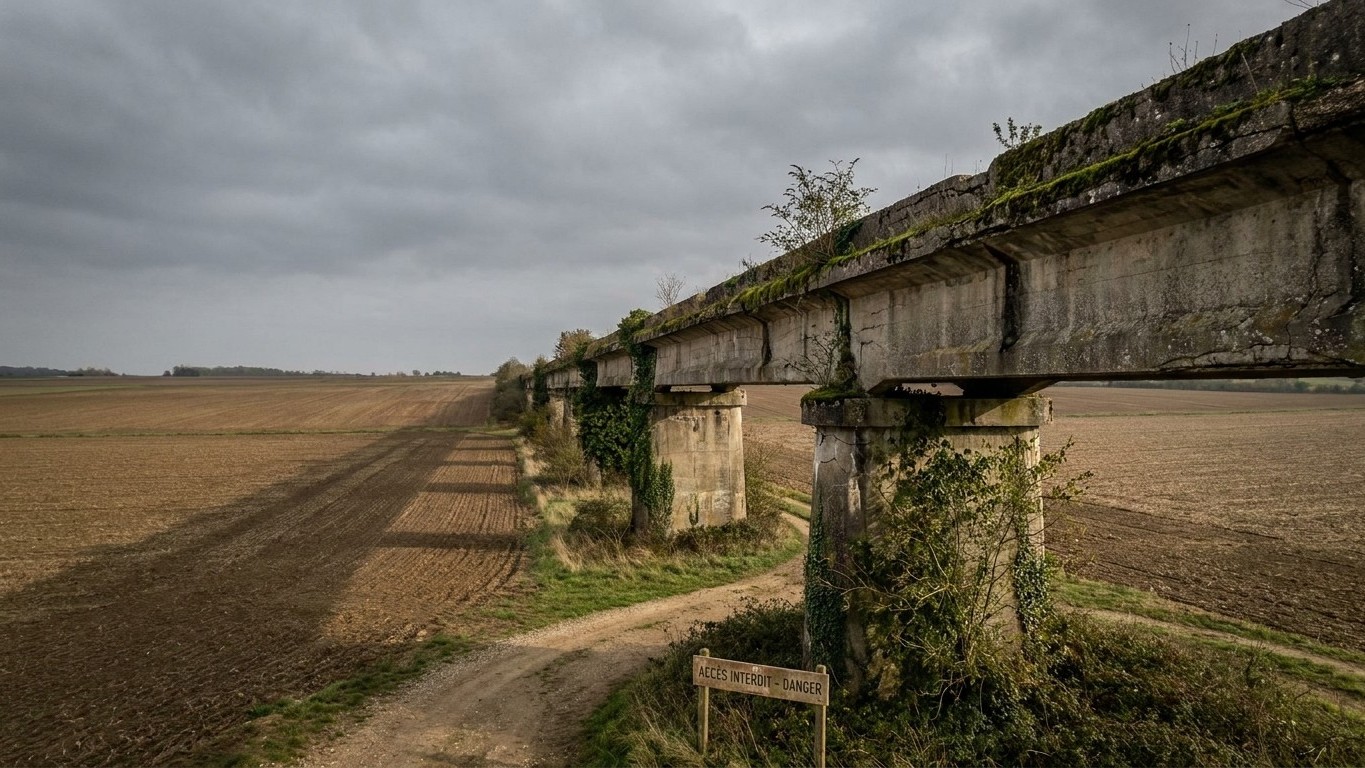
An 18-kilometer concrete ribbon still cuts through the Beauce fields, between Saran and Ruan, in the Loiret. No one maintains it, no one tears it down either. It has stood there since 1969, mounted on pillars, like a vestige of a future that never came to be. And yet, on that forgotten viaduct, a French machine once streaked faster than any commercial TGV would dare today.
The I80-HV established the world speed record for guided ground transportation at 430.4 km/h on March 5, 1974. Five years before the first commercial TGV service between Paris and Lyon, a wheel-free train, without catenary and without steel rails, pulverized all speed records. Its name: the Aérotrain. Its inventor: an engineer named Jean Bertin, a Polytechnicien who had moved from aeronautics, who dreamed of replacing the train as we knew it with a vehicle gliding on air cushions.
To note
- A wheel-less train shattered speed records before the TGV ever went into service
- The Aérotrain project was brutally halted four months after its major achievement
- The real reasons for the abandonment were not technical, but political and economic
A concrete rail for a train that didn’t run
Technically, the Aérotrain never touched its rails. The Aérotrain track is the last relic of an industrial transport project that blended train and airplane, a train moving on air cushions and propelled by a propeller or a turbojet. The principle bordered on carnival magic: a few millimeters of compressed air lifting the vehicle above a track shaped like an inverted T, eliminating all mechanical friction. The result? An astonishing stability, even at very high speed, and a jet-engine-like roar that must have turned the heads of Beauce farmers.
The track itself has a concrete and numeric history. Built by the Société des Grands Travaux de Marseille, it comprises 900 pylons spaced roughly 20 m apart, bearing monolithic concrete segments of 120 m in length, situated between 5 and 10 meters in height. Completed in September 1969, the test track cost 24,586,790 francs—a colossal sum for the era—financed by the State, which believed wholeheartedly in the project. The straight alignment was not a stylistic flourish: the straight track enabled speeds of 400 km/h. In other words, Jean Bertin already imagined very far into the future, even before the first test.
Five years of records before the axe fell
From January 1969 onward, the early results were impressive. On January 22, 1969, the Aérotrain 02 reached the speed record of 422 km/h on the Gometz-le-Châtel test track. But the story truly pivoted on the Loiret viaduct. After a pause for modifications, the Aérotrain, now named I80 HV, resumed testing in September 1973, and on November 14 of the same year it hit 400 km/h. The machine was no longer a laboratory toy: it continued testing, carrying more than 1,400 passengers in about 100 hours of operation.
March 5, 1974 would remain the watershed date. That day, propelled by an aircraft jet engine, the machine tore through the Beauce air and entered the history of transportation. The record still stands today for a ground-guided air-cushion vehicle; the TGV, by contrast, has its records on conventional rail, but in a completely different technological category. Four months later, everything stopped. The project was officially abandoned on July 17, 1974. The announcement fell like a guillotine, with no public consultation, no technical report made public. Strikingly, on June 21, 1974, a contract for building an aero-train line between the city of Cergy and the La Défense district was signed, but the State reversed its decision on July 17, 1974. Twenty-six days between the handshake and the burial. Twenty-six days—the approximate time it now takes to renew a vehicle registration at the prefecture—pale in comparison to the scale of the decision.
Neither the technology nor the speed killed the Aérotrain
So why this abrupt reversal? The answer lies in a deft blend of politics and economics, and frankly, it can be irritating to any innovation enthusiast. Jean Bertin received formal assurances from the French authorities in early 1974, but President Pompidou died on April 2, and on July 17, the State withdrew from the project. The new president, Valéry Giscard d’Estaing, leaned clearly toward the opposing camp. The 1973 oil crisis finished off the Aérotrain by rendering it fuel-hungry, while the TGV promised electric operation on an already existing network.
There is also a player too often forgotten: the SNCF itself. The public company, with its own lobbyists and engineers, had no interest in seeing a system emerge that would escape its control, built on new infrastructure and incompatible with its 30,000 kilometers of existing rails. Building an Aérotrain network would have meant starting from scratch; modernizing the existing rails cost infinitely less. The TGV won, not solely because it was superior, but because it fit within the existing framework. A victory of budgetary logic over technological audacity, one might regret it, but this is exactly the kind of arbitration that still shapes our infrastructure today.
Jean Bertin never recovered from this failure. He never fully recovered from the great disappointment. He died on December 21, 1975, at 58, just a few weeks after the official announcement of a Paris–Lyon TGV line, as if history were sticking a jab at the man who had opened the path. The final prototypes were later burned in looting fires in the early 1990s, as if to seal the door against any revival of the project.
A twentieth-century heritage that refuses to disappear
The viaduct, for its part, endured everything. Neither neglect, nor demolition plans, nor decades of abandonment could bring it down. In 2015, the 18-kilometer structure was labeled as a “Twentieth-Century Heritage” by the Ministry of Culture—a belated, almost symbolic recognition for this concrete skeleton overgrown with vegetation. But the question of its future remained unresolved: in 2017, the State, still the owner, commissioned experts to consider demolition. Since then, silence. The viaduct continues to cross Beauce, ignored by motorists speeding along the nearby A19, unaware that at this very spot a Frenchman invented great speed before anyone else, and that France chose to forget its fate rather than decide its future.
Sources: trainconsultant.com | dailygeekshow.com
