
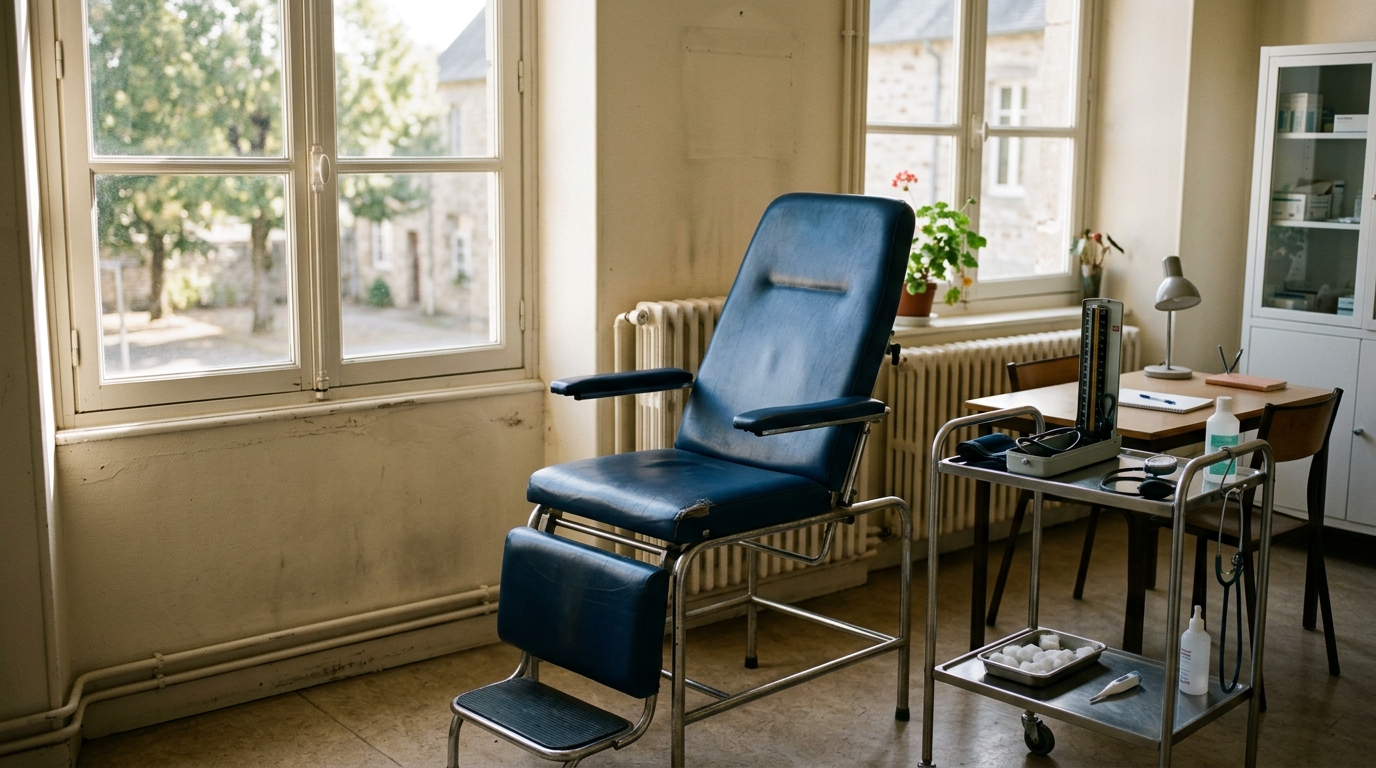
People still imagine, when they drop their child off at the middle school at the start of the school year, that a school doctor quietly watches over their health, ready to spot a vision problem, a growth issue, or a momentary malaise. This, in fact, is a durable stereotype. This vivid image, inherited from our own memories of students passing before the famous “medical check-up,” no longer matches the ground reality. As this new school year begins and millions of middle-school students return to classrooms, the question of who truly monitors their health deserves a straightforward answer. Because behind the busy corridors and overstuffed backpacks, an entire system has quietly collapsed, without most families realizing it.
- France now has only one school doctor for about 12,000 pupils, with sharp disparities across regions.
- Because of unattractive salaries and aging staff, it is now school nurses and teachers, not trained for this purpose, who detect warning signs among students.
- The Senate report proposes a substantial salary increase, the creation of multidisciplinary teams, and stronger links with city medicine to try to stem this shortage.
- A doctor for 12,000 pupils: the figure that chills the Senate
- How school medicine has drained its strength in twenty years
- Without a medical check-up, who identifies children in danger?
- What the Senate report proposes to save what remains of the system
A Doctor for 12,000 Pupils: The Figure That Chills the Senate
The reality rests on a single statistic, but it is enough to send a chill down the spine. According to a recent Senate report, France now counts only one school doctor for about 12,000 pupils. To grasp the scale of the problem, imagine a single practitioner tasked with monitoring the equivalent of several middle and high schools combined, a whole town’s worth of adolescents in growth, with all the vulnerabilities that implies. Once thought of as a universal safety net, school medicine has become a scarce commodity, almost symbolic in certain departments.
This ratio, dizzying as it is, masks substantial territorial disparities. In some rural areas or in academies already under strain, the situation is even more critical, with vacancies lasting for years and children who will grow up through their entire schooling without ever meeting a school doctor. The mandatory medical check-up, supposed to occur at key developmental ages, has thus become a ghost appointment for a non-negligible portion of French middle-school students.
How School Medicine Has Been Hollowed Out Over Twenty Years
This deterioration did not begin yesterday. For more than two decades, the profession of school doctor has suffered from a glaring lack of appeal. The salaries offered remain clearly lower than those in the private or hospital sectors, even though the responsibilities entrusted are substantial: monitoring growth, screening for sensory disorders, detecting violence or neglect, supporting children with disabilities. Faced with this demanding workload and little financial recognition, many young doctors naturally turn away from this path toward more lucrative specialties.
In addition, there is a phenomenon of an aging workforce: a large portion of the school doctors currently in post are approaching retirement, without sufficient recruitment to compensate for these departures. The result is mechanical and inexorable: each passing year weakens an already depleted system. Middle schools, in particular, find themselves on the front line of this shortage, because resources are often concentrated on the earliest ages of schooling, leaving adolescents with minimal medical follow-up at the very moment their bodies and minds undergo major changes.
Without a Medical Check-Up, Who Spots Children in Danger?
The gradual disappearance of this medical link raises a central, almost vertiginous question: who today is supposed to detect warning signs in a struggling child? In practice, it is now the school nurses, often themselves overwhelmed, who carry out most of the close monitoring. They play a valuable role, but they do not always have the time or the medical expertise to make certain diagnoses or promptly guide families toward appropriate care.
Teachers, for their part, also find themselves in the role of frontline observers, often without realizing it or lacking the proper training. A homeroom teacher may notice that a student looks tired, distracted, or isolated, but they lack the time or tools to link this to an underlying health issue. This diffusion of responsibility creates a system where everyone is watching, but no one can truly act with the necessary medical authority. Uncorrected vision problems, growth delays, early signs of eating disorders, or signs of psychological distress risk slipping under the radar much longer than before, with sometimes lasting consequences on schooling and the development of the young people involved.
What the Senate Report Proposes to Save What Remains of the System
In response to this alarming situation, the Senate report does not merely describe the state of affairs; it also advances several crisis-management proposals. Among the measures discussed is a substantial salary revaluation for school doctors, aimed at making the profession more attractive and competitive with other career options open to medical graduates. The idea is simple, but its implementation obviously runs up against the budget constraints of the Education Ministry.
Other proposals aim to rethink the very organization of school medical follow-up, leaning more on multidisciplinary teams combining doctors, school nurses, and school psychologists, able to pool their observations to better identify vulnerable students. There is also talk of strengthening ties between schools and city medicine, so that general practitioners can play a more active relay role with families. If implemented, these recommendations would not immediately solve the acute shortage of practitioners, but they could at least limit the damage while awaiting a hypothetical rebound in staffing levels.
Behind this figure of one doctor for twelve thousand pupils lies a reality broader than the staffing question alone. It is an entire model of prevention and support for young people that wobbles at a moment when health challenges, whether physical or psychological, have never been as numerous among adolescents. It remains to be seen whether the proposed measures will truly find the means to achieve their ambitions, or whether they will remain, as too often, beautiful intentions written on paper.
