
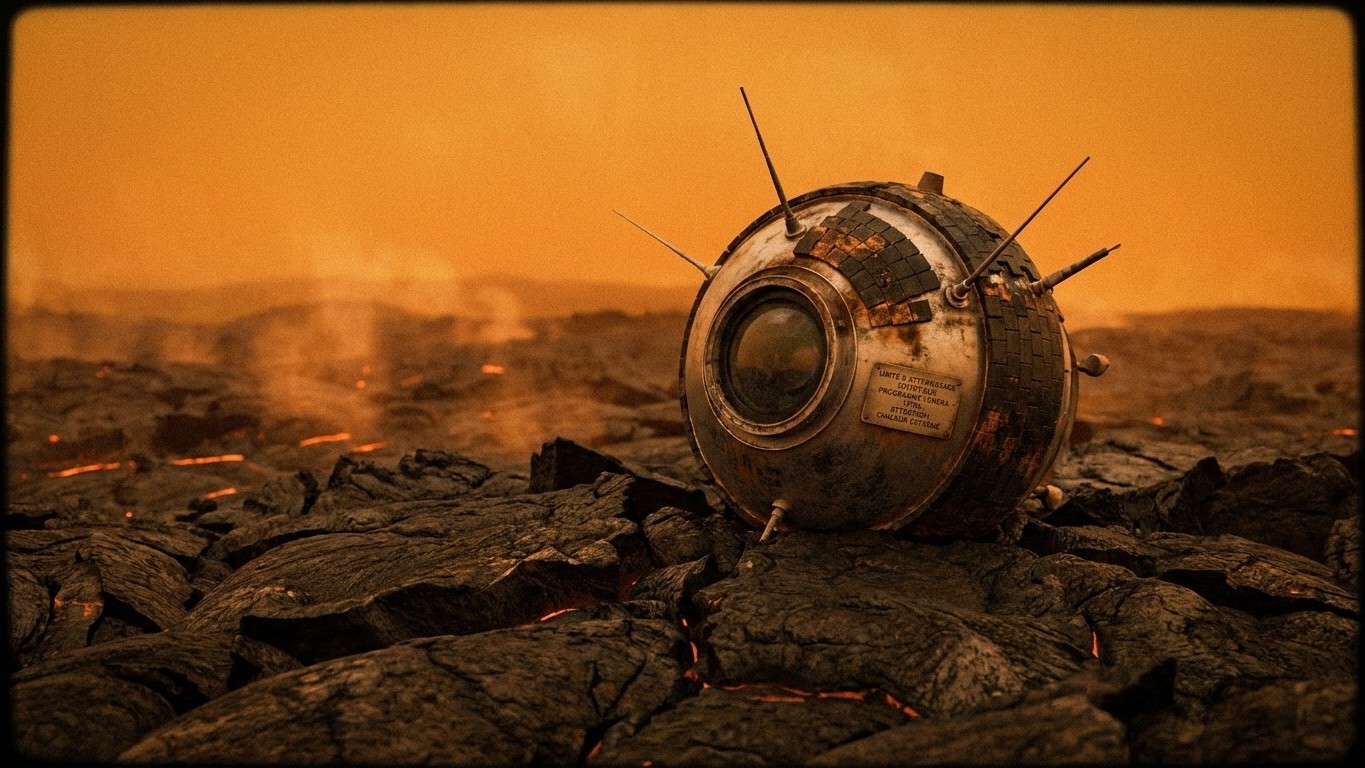
On March 1, 1982, at 3:57 UTC, a Soviet probe the size of a beer keg touched down in a volcanic region called Phoebe Regio. By placing their Venera 13 lander on Venus in 1982, the Soviets literally snatched 127 minutes of signal from a furnace at 465 degrees Celsius. No one since has done better.
The engineers of the era had only planned for a half hour of survival for their craft. After a descent through the atmosphere of about an hour, Venera 13 was designed to live on the surface for 32 minutes. The probe lasted nearly four times that technical expectation. An achievement all the more striking because the outside conditions were straight out of science fiction: a surface temperature around 465 degrees Celsius, hot enough to melt lead, zinc, and tin, and an atmospheric pressure about 92 times that at Earth’s sea level, equivalent to being under roughly a kilometer of seawater.
Key takeaways
- A Soviet machine endured four times longer than expected under extreme conditions
- It captured the first color photos of another planet and recorded sounds from elsewhere
- Forty years later, no space agency has yet attempted to beat this record
A Decade of Failures Before the First Signal
Venus never made things easy for Soviet engineers. Before Venera 13, years of unsuccessful trials were required merely to brush the surface without destroying the craft. Venera 3 crashed into the planet’s surface on March 1, 1966, making it officially the first spacecraft to crash on another planet. The subsequent attempts fared somewhat better, though none managed a soft landing: Venera 4, 5, and 6, in 1967 and 1969, managed to survive in the Venusian atmosphere for 90 and 50 minutes respectively, measuring very high levels of carbon dioxide in the atmosphere, before giving way to the pressure.
The turning point came on December 15, 1970. When it landed on the Venusian surface, Venera 7 became the first spacecraft to achieve a soft landing on another planet and the first to transmit data from the surface back to Earth. The probe operated for only 23 minutes, but it yielded a crucial datum: it recorded an extreme temperature of 465 °C on the surface of Venus. Twelve years before Venera 13, the figure was already present in the raw data of a capsule that had toppled on its side upon landing, its antenna misaligned, transmitting a weakened but sufficient signal to enter history.
127 Minutes That Changed the Scientific Landscape
What Venera 13 managed to accomplish in its brief extension beyond mere survival went well beyond mere endurance. The probe first delivered color photographs, the first ever taken from the surface of another planet, revealing a landscape of rocky slabs beneath an orange sky. But the instrument did not stop at photographing: a mechanical arm drilled into the surface, collected a sample, and moved it into a sealed chamber kept at about 30 degrees Celsius and a pressure close to Earth’s atmosphere, allowing an X-ray fluorescence spectrometer to study the sample before the outer heat finally destroyed everything.
The mission’s most unexpected detail remains acoustic. Venera 13 is widely credited with sending sound data from the surface of another planet, including information used to estimate wind speed. It is easy to imagine Venus as a silent world, given its harsh, mineral-like appearance. Yet that is not true: beneath the sulfuric acid clouds, in this dense carbon dioxide atmosphere, winds do blow, and a Soviet machine heard them more than four decades ago.
Four days later, its twin lander Venera 14 touched down about 950 kilometers away. The two craft yielded slightly different chemical results: the Venera 13 site was associated with alkaline rocks near basalt, while Venera 14 found chemistry closer to oceanic tholeiitic basalts. This contrast, seemingly minor, allowed planetary scientists to understand that Venus’s crust was not uniform, a valuable clue about the planet’s volcanic history.
Why No One Has Tried the Feat Since
The total cumulative time of all Soviet missions that touched the Venusian surface amounts to a near-derisive sentence: the combined survival time of all landers that reached the surface remains under nine hours, roughly the length of a workday. Since then, radio silence. No space agency has sent a craft to land on that surface since the 1980s. Nine years after Venera 13’s landing, the Soviet Union ceased to exist; the Lavotchkine bureau survived the transition and the Russian space program inherited the Venera files, but no subsequent mission to Venus’s surface ever flew. The last attempt, Vega 1 and 2 in 1985, deployed balloons and landers as part of a flyby of Halley’s Comet.
The current American projects, such as the DAVINCI mission, largely sidestep the problem rather than solve it. The American DAVINCI mission, slated for the early 2030s, is to send a descent probe through Venus’s atmosphere, but its science focuses on the descent itself, not on a surface landing. No one, to date, is seriously preparing a craft capable of surpassing the Venera 13 record by an order of magnitude. The heat that awaits us at the start of this September will seem modest compared to the 465 degrees that, in a little over two hours, brought down one of the most robust machines ever sent into the solar system.
Sources: scienceblog.com | nimareja.fr
