
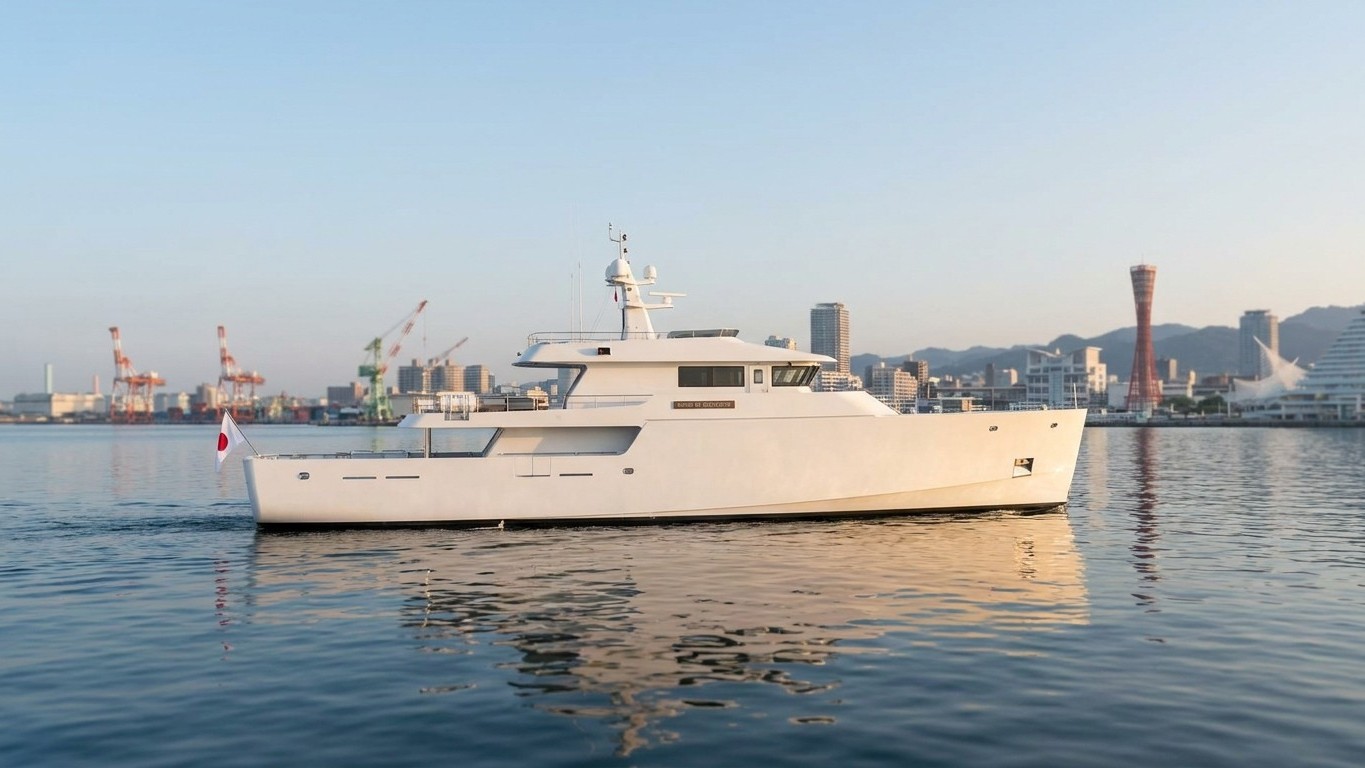
On June 19, 1992, in Kobe Bay, a peculiar 30-meter vessel glided across the water with no engine noise, no visible propeller, and not a trace of foam, propelled by a method unlike conventional turbine-driven craft. Its name: Yamato 1. Its peculiarity: it advances thanks to a physical principle that is usually taught in physics lecture halls, not on shipyards.
Built by Mitsubishi Heavy Industries for the Ship & Ocean Foundation (which has since become the Ocean Policy Research Foundation), this ship was constructed in the early 1990s in Wadasaki-cho, in the Hyogo-ku district of Kobe. A project launched as early as 1985, with a straightforward ambition on paper: to do away with all moving mechanical parts that have equipped ships for about a century and a half.
Key Points
- A ship without a propeller propelled by a magnetic field: how did physics fall short in practice?
- Promises of 100 knots pared down to 8 knots: where did Yamato 1’s dream go astray?
- Why didn’t this revolutionary technology ever have a successor despite its demonstrable success?
The Laplace Force Rather Than a Propeller
No blade rotated beneath the Yamato 1’s hull. The ship carried two magnetohydynamic (MHD) propulsion units with no moving parts, which were first successfully operated in Kobe harbor in June 1992. The operation rests on a single phrase from a physicist: an MHD device applies a magnetic field to a fluid that conducts electricity, in this case seawater used in Yamato 1’s propulsion units.
Concretely, an electric current runs through the saline water perpendicular to the magnetic field created by superconducting magnets. The intersection of these two forces generates what is known as the Lorentz force, which accelerates the water backward and, in turn, propels the vessel forward. No piston, no drive shaft, no propeller: just electricity, magnetism, and seawater doing the work.
To generate these magnetic fields with sufficient strength required superconducting magnets, cooled to extreme temperatures. The Yamato-1 used superconducting coils cooled by liquid helium to about -269 degrees Celsius to produce magnetic fields of roughly 4 teslas. A technical detail that matters: keeping liquid helium aboard a moving ship is no small logistical feat. The cryogenic cooling system for the electromagnets was entrusted to Kobe Steel, while Toshiba designed the second propulsion unit alongside Mitsubishi.
An Efficiency That Dashed Hopes
On paper, the calculations looked dreamlike. Some contemporary articles spoke of superconducting electromagnetic propulsion capable in theory of reaching speeds close to 100 knots, or roughly 200 km/h. The reality of sea trials was far more modest.
During its first outing in Kobe Bay, a minor fault—a quench, i.e., a sudden loss of superconductivity in the starboard magnet—limited the vessel to a cruising speed of 6 knots instead of the 8 knots hoped for that day. Once the adjustments were fine-tuned, Yamato 1 managed to reach its cruising speed, but it still topped out at 8 knots, about 15 km/h, well short of the engineers’ initial target of 12 knots and light-years away from the most optimistic projections.
The real issue was not so much speed as energy efficiency. Its efficiency hovered around 15%, which is extremely low compared with conventional systems, because seawater is a poor electrical conductor and superconducting magnets require constant cooling. To move 185 tons of steel and aluminum barely faster than a jogger, it demanded an outsized amount of electricity. The ship carried two main generators of 2,000 kW each, solely to power two propulsion units that, together, delivered only a limited thrust.
The calculation was unequivocal: a conventional diesel engine would have consumed far less fuel for an identical, if not superior, result. Higher speeds were also practically impossible to achieve without a major breakthrough toward more powerful, lighter magnets—a technological leap that never materialized.
A Scientific Dead End, Not a Pointless Failure
The program never produced a direct successor. Despite Mitsubishi’s development of several MHD-propelled ship prototypes in the 1990s, no Yamato 2 with greater power was built. Yamato 1 thus remained unique: the only full-scale passenger ship ever to be propelled by this technology. In fact, only the real-size Yamato-1 prototype ever carried people, in 1992.
After its tests, the vessel joined the Kobe Maritime Museum, where it remained on public display for two decades, a silent witness to a technological dead end. It was dismantled in 2016, hampered by space constraints and the lack of prospects for a revival of the project. One of its two MHD propulsion units escaped the scrap heap: it is now visible at the Ship Science Museum in Tokyo, for curious visitors who want to inspect up close this mechanism without a propeller or turbine.
The Yamato 1’s paradox is that it perfectly fulfilled its scientific mission by demonstrating the practical failure of its own principle. Research on MHD propulsion did not disappear entirely: American laboratories, notably Argonne National Laboratory and Penn State University, continued to explore alternative architectures with magnets of varying strengths. But thirty years after Kobe’s tests, no commercial ship floats by the force of Laplace. The physics worked; the engineering ran into a more mundane wall: energy efficiency and the weight of magnets.
Sources: cir.nii.ac.jp | techeblog.com
