
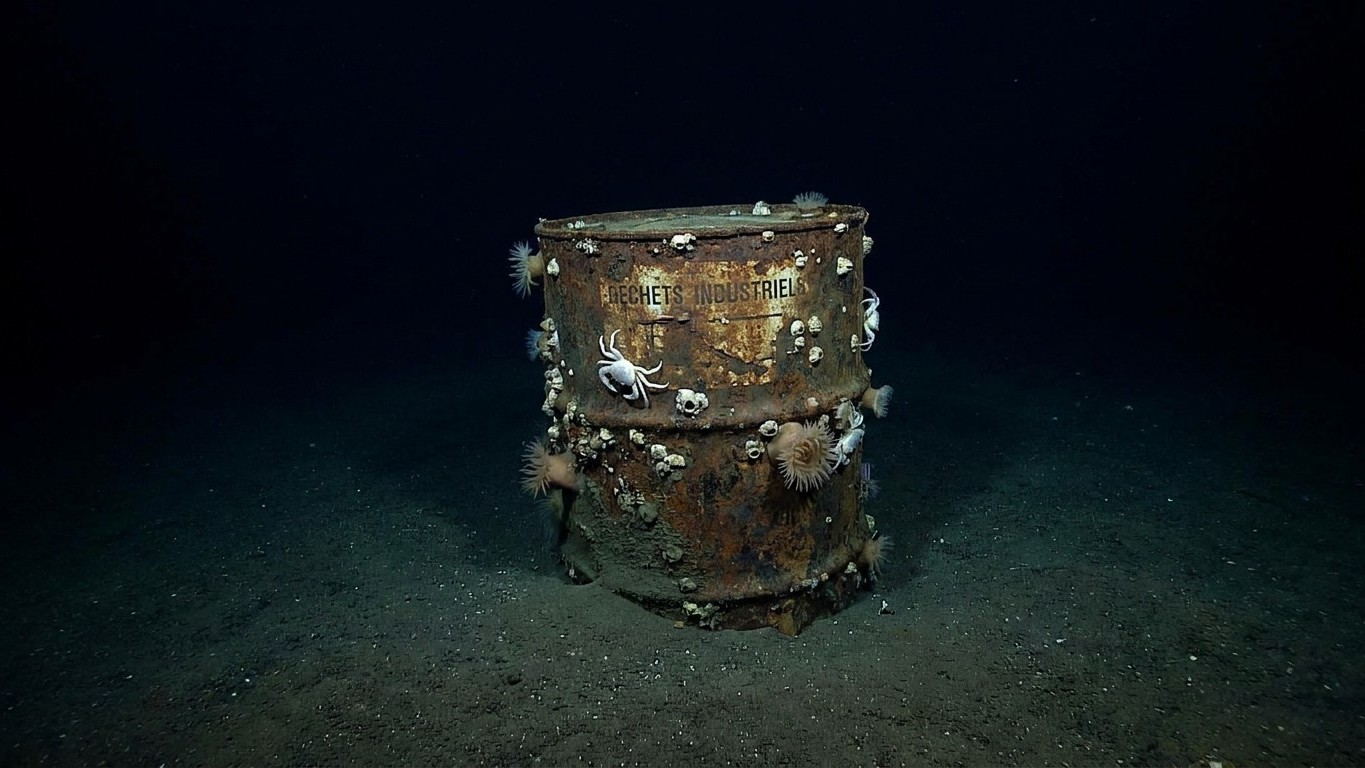
Two hundred thousand metal drums sunk to the ocean floor, treated like litter thrown into a ravine with the hope of never hearing about it again. Between 1946 and 1990, before this practice was banned by the London Convention, no fewer than 200,000 waste drums coated with cement, bitumen, or resin were dumped into the area by several European countries. Last summer, the French submarine Nautile went down to film them, at a depth of 4,700 meters. The sight is not pleasant: containers chewed, torn, their contents leaking directly into the sediments.
This closed-air nuclear dump lies in the Northeast Atlantic, a little more than 1,000 kilometers southwest of Brest. A distance that can make the mind reel when compared to a daily journey: it’s like starting in Paris and driving to Naples, without ever leaving the water.
Key takeaways
- Two hundred thousand sealed nuclear waste drums abandoned at the abyssal heart
- A postwar policy built on a myth: the infinite, purifying ocean
- The containers have passed their expiry date; the unknown governs the real consequences
A nuclear waste dump born from postwar carefree attitudes
To understand how we arrived here, one must go back to the immediate aftermath of World War II. Between 1946 and 1990, fourteen countries dumped their nuclear waste, neatly sealed in metal drums weighted with concrete or bitumen. The United States were the first in 1946 off the coast of California, followed by France, Belgium, the United Kingdom, Switzerland, and a few others. France was not a minor actor in this history: it disposed of more than 46,000 drums during operations conducted in 1967 and 1969.
The logic of the time can be summed up in a single sentence, almost naive in hindsight: the ocean, vast and inaccessible, dilutes everything, absorbs everything, forgets everything. For a long time, the ocean was seen as an infinite space capable of absorbing what humanity did not yet know how to manage. In the postwar years, this idea led to a decision that now seems insane: sinking radioactive waste to the bottom of the Atlantic. The problem is that these drums were never designed to last indefinitely. The confinement matrices, made of concrete and bitumen, had been designed to isolate the waste for only twenty years. Each container has now surpassed this expiry date.
And then, radio silence. Then, nothing more. The packages were forgotten in their marine cemetery for three decades, without the promised regular site assessments ever being carried out. Thirty years without a single look at what became of this mass of radioactive waste. An almost vertigo-inducing abandonment, when one knows that the same period saw humanity sending probes to Mars and mapping the human genome.
What the Nautile really saw at 4,700 meters depth
The turning point has a name: NODSSUM, for Nuclear Ocean Dump Site Survey Monitoring. The CNRS launched this program in 2025, aided by Ifremer and the Nuclear Safety and Radioprotection Authority. A first campaign, conducted in the summer of 2025 with the ship Atalante and the autonomous robot UlyX, made it possible to locate nearly 3,350 drums submerged more than 4,000 meters deep in the northeast Atlantic.
There remained the need to observe up close. That is where Nautile comes in, the bright yellow manned submersible from Ifremer, a veteran of the deepest places who has already explored the wreck of the Titanic. On board the Pourquoi Pas ? between May 27 and June 28, 2026, it carried out 20 dives in 20 days to explore these previously identified areas. Each dive to 4,700 meters required two hours to descend and five hours to explore.
What the researchers found exceeded even their fears. With the Nautile, they visually inspected several dozen of these drums, documented their advanced state of degradation, and observed particularly corroded containers. The contents of some of them spread onto the surrounding seafloor. A scene that the two mission leaders, Javier Escartín and Patrick Chardon, will not soon forget. One still recalls Greenpeace’s archival footage, while the other says he was struck by “the contrast between reactor-era nuclear as a future, clean energy and the fact that its waste was dumped to the ocean floor.”
Strikingly, life has reclaimed these toxic relics. The drums are colonized by various organisms, including anemones, sponges, and crabs. An ecosystem has settled directly on, and sometimes inside, these radioactive relics, with the price their inhabitants may pay for living in forced cohabitation still not fully understood.
Sampling, measuring, understanding: the unseen part of the work
Filming the drums was only the first step. On five study sites chosen for proximity and contact with the drums, Nautile carried out detailed sampling of sediments, water, organisms, and microbial communities. These samples were sent to laboratories in France, but also Norway, Germany, and Spain, as part of an international scientific collaboration.
The objective is precise: identify and quantify various artificial radionuclides and study their dispersion from the drums into the deep-sea environment. A long-term project that, according to the researchers, should yield one of the most comprehensive radioecological studies of the deep sea to date, finally enabling us to understand how these elements move through abyssal biological chains.
For now, no major alert has been triggered regarding ambient radioactivity. During the first mapping campaign, measurements did not detect radioactivity above the natural background. But this absence of a global signal says little about what happens at the direct contact of ruptured drums, where radioactive material locally seeps into the sediments. It is precisely this fine-scale view—the square meter around a corroded drum—that the ongoing analyses must illuminate.
A detail worth noting: this Atlantic dump is not an isolated case on the planet. At more than 80 sites scattered across the Pacific and Atlantic, it is estimated that hundreds of thousands of drums were dumped during the same period of nuclear naivety. Similar campaigns are beginning to organize in the Arctic, on other dumps inherited from the Cold War. A way, eight decades later, to close the books on an era that believed the ocean could digest everything without ever giving anything back.
Sources: lenergeek.com | journaldugeek.com
