
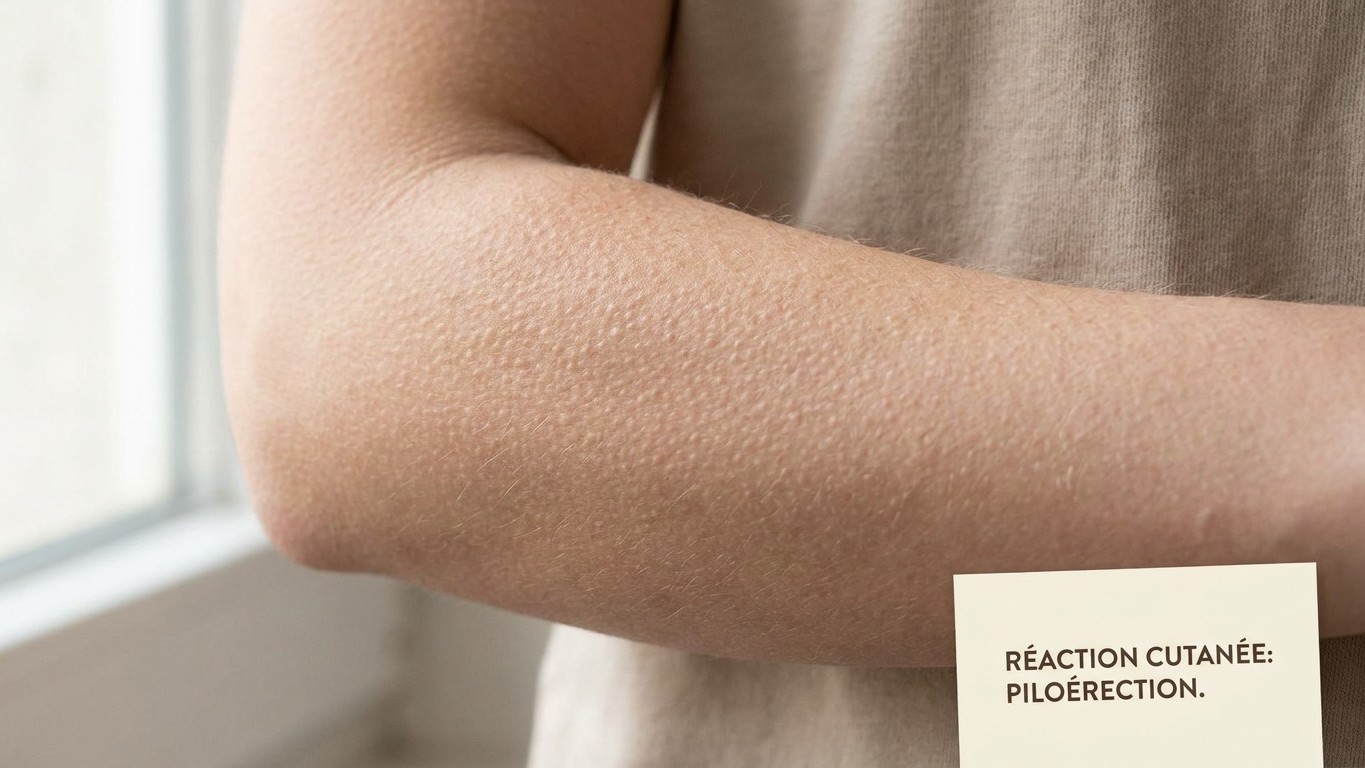
Under every strand of hair on your body, a tiny ribbon of smooth muscle waits, ready to contract at the slightest breath of cool air brushing your neck. This muscle bears a name that sounds almost lyrical: the arrector pili muscle. It measures only a fraction of a millimeter, yet it is directly responsible for what everyone calls goosebumps. And since our ancestors shed their fur, this little muscle has been idling.
Key takeaways
- A microscopic muscle contracts beneath your hairs with every shiver — but why?
- Our ancestors used it to cope with cold and to intimidate predators
- Evolution has kept it around even though it seems to serve no purpose
An inherited mechanism kept intact from our hairy ancestors
The erector pili muscle is one of the smooth muscles at the base of each hair in most mammals, including humans, and it participates in thermoregulation during shivering. Concretely, it connects the hair root to a more superficial layer of the skin at a precise angle. When it contracts, two things happen simultaneously: it lifts the epidermis where the hair emerges, and it depresses the epidermis where the muscle attaches, forming the small bumps we know as goosebumps.
This trigger is not voluntary. The contraction of these muscles is controlled by the autonomic nervous system, which oversees involuntary physiological processes, and it usually occurs in response to external stress factors such as cold or a perceived threat. Neither your will nor your consciousness has a say. The signal comes directly from the sympathetic nervous system, the one that handles fight-or-flight reactions.
In furry animals, a real survival strategy
To understand why this muscle exists, you have to look back to a time when the human species resembled more of an animal than a chilly office worker. The reflex mechanism triggers the contraction of the arrector pili muscles linking the hairs to the skin, which raises the hairs to the surface of the body and creates a thin insulating layer of air, which slows the outward transmission of heat thanks to the insulating properties of air. The thicker the layer, the more effective the insulation. In a mammal with dense fur, bristling the fur is like slipping into a down jacket in an instant.
Fear activates the same mechanism, but for a different reason. In the face of fear and strong emotions, raising the hairs could give a more intimidating appearance to predators and conspecifics. It’s exactly what a cat does when it puffs its fur in front of a dog, or a porcupine when it bristles its quills. The animal suddenly appears more imposing without moving an inch. In some species, this muscle is even fearsomely powerful: in cats, the arrector pili muscles are strong enough to cause hair breakage, a phenomenon commonly observed on veterinary examination tables.
Why this reflex survived the loss of our fur
Here lies the paradox. Our ancestors shed most of their body hair tens of thousands of years ago, but the muscle itself remained at the ready. In humans, the reduction of hair during evolution made this mechanism less effective, because little air is trapped by hair. The result: we end up with tiny bumps on our forearms rather than a proper insulating layer.
Why didn’t evolution simply remove this now-useless muscle? Because keeping it around costs virtually nothing. According to Scott Travers, an evolutionary biologist interviewed by Forbes, this system costs the body virtually nothing to maintain, and natural selection usually does not bother actively dismantling mechanisms that do not pose a problem. Charles Darwin himself had already noted the anomaly: he described human piloerection as evidence of a common mammalian ancestry as early as 1872. This is why we still shiver with a thrill at a horror movie or during a particularly intense moment at a concert, even though it provides no insulating or intimidating effect.
But the story does not end there. A Harvard team led by Ya-Chieh Hsu published in 2020 in the journal Cell work that softens the label of “useless.” In mice, when the arrector pili muscle contracts, it also activates hair follicle stem cells, suggesting that the sympathetic nervous system encourages hair regrowth through this muskular activation. There would therefore be a subtle link between stress, cold, and hair renewal, long ignored because researchers focused solely on the visible effect: the bump on the skin.
Another detail worth mentioning here, as it is rarely noted: this muscle does not simply raise the hair. Because of its position relative to the sebaceous gland attached to the hair follicle, its contraction also facilitates the expulsion of the gland’s contents. Each shiver would thus contribute, on a very small scale, to the natural lubrication of your skin. This puts the idea of a completely obsolete organ into perspective: goosebumps no longer warm most people, but they continue, behind the scenes, to do a little housekeeping beneath your skin.
Sources: intra-science.anaisequey.com | forbes.com | vetopsy.fr
