
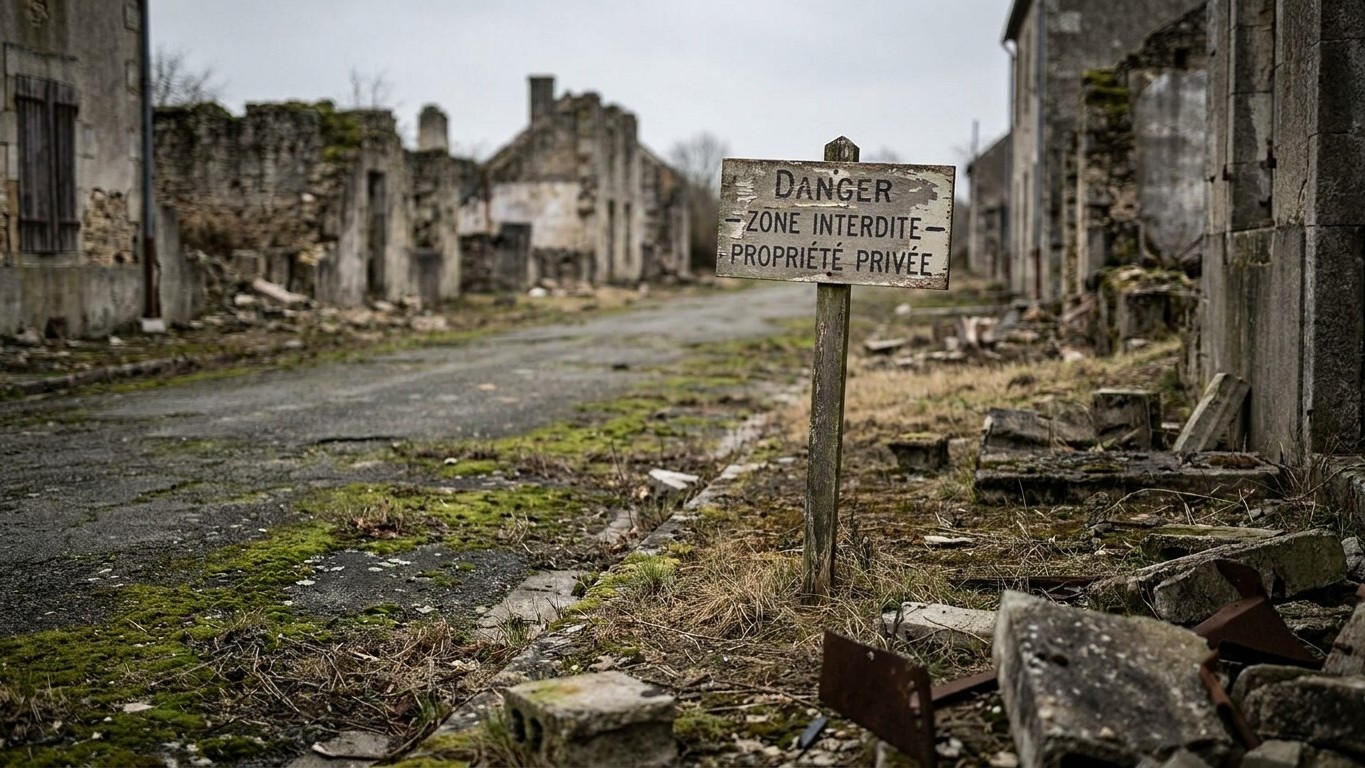
A trash-can fire lit to clean up before Memorial Day. That is the origin, almost banal, of the disaster that erased Centralia from the map. On May 27, 1962, in this small mining town in Pennsylvania, volunteer firefighters set fire to the municipal landfill. They did not yet know they were lighting a fuse that would burn for more than sixty years, beneath the deserted streets of their former municipality.
Key Takeaways
- A voluntary fire set to clean a landfill seeps into abandoned coal mines beneath the town
- For two decades, residents accustom themselves to the heat emanating from the ground before a tragedy reveals the deadly danger
- From 1,500 residents in 1962 to just 4 in 2025: a town literally erased by administration
A Cleanup Fire That Spirals into an Underground Catastrophe
The idea seemed reasonable on paper. Centralia’s town council planned the cleanup of the local landfill, located in an old open-pit mine, so the town would look presentable for Memorial Day celebrations. The Centralia council organized the cleanup of the open-pit mine landfill, but the reports do not describe the intended procedure, probably because state law prohibited burning at landfills, and five members of the volunteer fire brigade were recruited to carry out the cleanup. Burning trash was illegal, but everyone behaved as if nothing were wrong.
The fire was lit to clean the landfill on May 27, 1962, and water was used to extinguish the flames visible that evening. The problem: two days later, on May 29, flames reappeared. A week later, June 4, a fresh outbreak occurred. Each time, Centralia’s firefighters attempted to douse the blaze with hoses connected to Locust Avenue, never understanding where the actual heat originated. The answer lay beneath their feet: the flames had infiltrated through an unsealed opening in the pit wall, directly into the network of abandoned mining tunnels that crisscross the town below. The anthracite, this hard, carbon-rich coal typical of the region, caught fire in turn. Since then, no one has managed to put it out.
Extinguishing Projects That Fail One After Another
Excavation, water injections, trenching firebreaks — authorities tried everything. Numerous attempts were made to excavate and extinguish the fire, but all failed. One project even attempted to seal the tunnel network with an incombustible mixture, but the company overseeing the work chose to fill the tunnels only halfway, leaving space for the flames to move. The project ultimately exceeded its budget by nearly $20,000, and meanwhile the fire had already advanced about 700 feet, more than 200 meters.
For almost twenty years, the residents coped. Some no longer needed to shovel snow in front of their houses; others grew winter tomatoes thanks to the warmth of the ground. The situation took a dramatic turn in 1981. A twelve-year-old boy, Todd Domboski, collapsed into a hole several meters deep that suddenly opened in his grandmother’s yard, releasing such dense smoke that he could not see anything around him. He clung to roots to avoid slipping deeper, as his cousin pulled him back to the surface. The incident shifted the public’s perception of the danger: it was no longer a nuisance, but a mortal threat lurking beneath the homes.
From 1,500 Residents to a Handful of Holdouts
There were about 1,500 residents when the fire is believed to have begun. In 1983, the United States Congress allocated more than $42 million to fund a voluntary relocation program. The decision fractured the community: a majority accepted buyouts and left to rebuild elsewhere, while a minority refused, convinced that the state exaggerated the danger to reclaim mineral rights beneath the ground. Throughout the 1980s, the county redevelopment authority demolished emptied houses, neighborhood by neighborhood, leaving behind a grid of paved streets that led to nowhere.
By 1992, the population had fallen to around fifty people. The Governor of Pennsylvania then authorized formal guardianship of the entire area by eminent domain. Ten years later, in 2002, the town’s ZIP code was officially removed by the United States Postal Service: administratively, Centralia no longer really existed. A handful of residents persisted, until 2013 when an agreement with the state allowed the remaining residents to stay in their homes for the rest of their lives in exchange for a one-time payment of $349,500. They were seven or eight at the time. In 2025, the U.S. Census counted only four people living there.
A City Razed, a Buried Road, a Fire That Continues
The famous “Graffiti Highway,” that stretch of Route 61 covered with paintings and an accidental tourist draw, was buried under tons of earth in 2020 to deter visitors. Experts estimate the fire could keep burning for 250 years or more, given that the region’s coal reserves could fuel it for centuries. The area affected by the blaze now spans roughly 400 acres, about 160 hectares, the equivalent of more than 220 football fields.
Centralia remains a near-unique case in the United States: a town not abandoned by accident, but literally erased by administrative decision, house by house, down to the last ZIP code. The ground continues to smolder beneath the few foundations still visible. And beneath these silent remnants, the anthracite still burns, patiently, as it has since volunteer firefighters struck a match on a Sunday in May 1962.
Sources: pabook.libraries.psu.edu | en.wikipedia.org
