
What if a good portion of what makes up our universe was entirely invisible, undetectable, and yet very much there, right before our eyes? That is precisely the question that haunted an American astronomer throughout her career, until she put the finger on one of the greatest enigmas of modern physics. Her name: Vera Rubin. Her realm: distant galaxies, observed night after night through telescopes she sometimes had to fight to be allowed to use. Her legacy: the proof that the bulk of the universe remains unseen. And yet, despite the scale of her discovery, the Nobel Prize never recognized her among its laureates. A look back at a scientific story as fascinating as it is unjust.
Rotation curves that shouldn’t exist
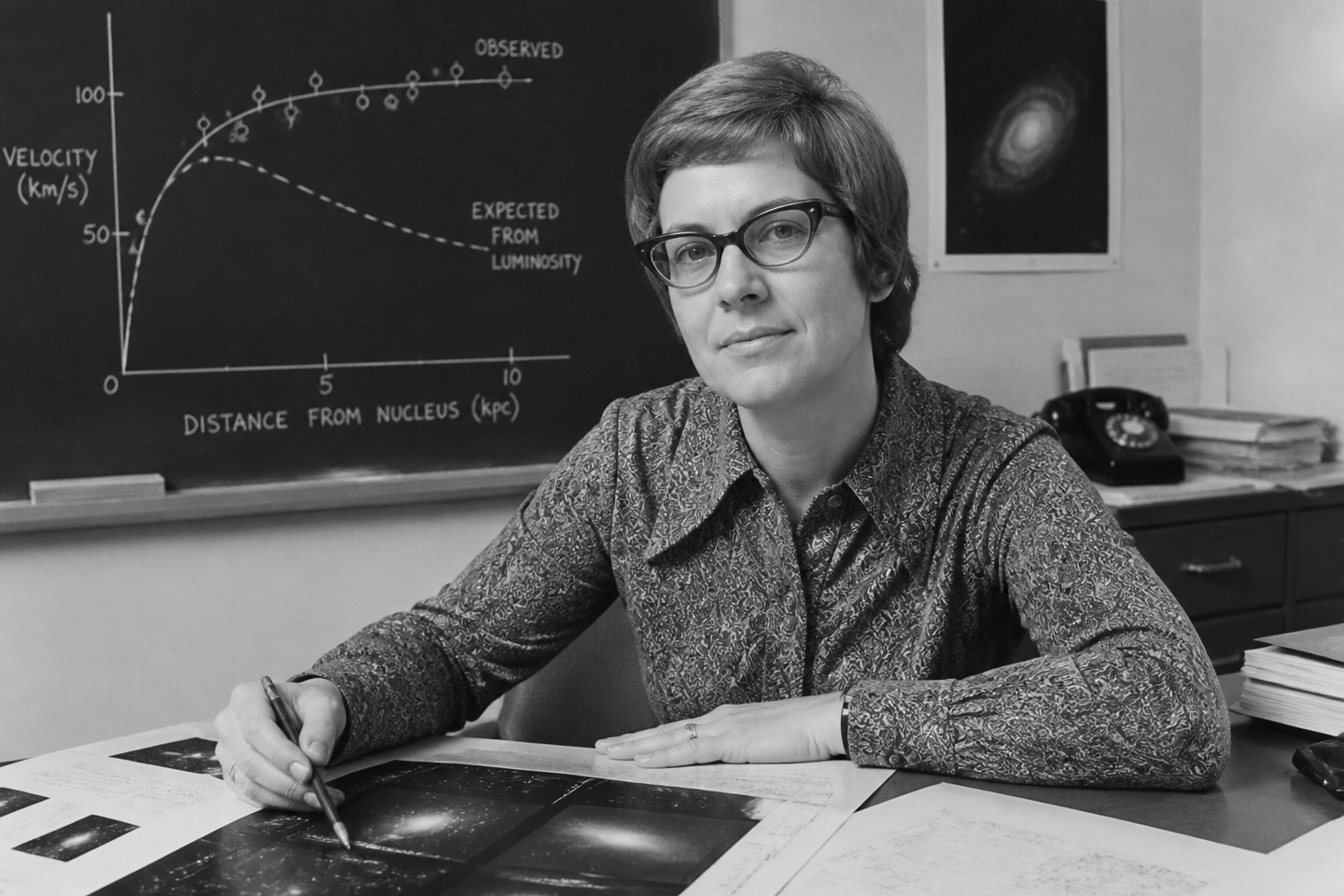
In the 1960s and 1970s, Vera Rubin set out on a task that appeared straightforward at first glance: measuring how fast stars rotate inside spiral galaxies. According to the laws of classic gravity, the farther a star is from the galactic center, the slower it should revolve, much like the planets of our solar system slow down as they move away from the Sun. It’s a logic that has stood for centuries under a steady gaze of observation.
But Rubin’s observations tell a wholly different story. The stars at the outskirts of galaxies rotate at nearly the same speed as those near the center. This phenomenon, flat rotation curve, makes no sense if you rely only on the visible matter—the stars, the gas, the dust that we can observe directly. Something else must exert additional gravitational pull, something that telescopes do not capture.
When the invisible weighs more than the visible
Delving into this anomaly, Vera Rubin arrived at a dizzying conclusion: galaxies indeed contain far more matter than what we can see. Matter that does not emit or absorb light, entirely undetectable by ordinary optical instruments, yet whose mass nonetheless governs the motion of everything around it. This mysterious substance is what we now call dark matter.
Her work, conducted across dozens of galaxies, suggests that around 85 % of the universe’s mass would thus escape any direct observation. A staggering proportion, implying that ordinary matter—the stuff of stars, planets, and ourselves—may ultimately constitute only a small fraction of what truly exists. Put differently, the universe we think we know might be merely the tip of an enormous cosmic iceberg.
A career built against closed doors
This brilliant scientific journey did not unfold without obstacles. At a time when astronomy remained a field largely closed to women, Vera Rubin faced refusals that would today seem unimaginable. Access to certain observatories reserved for men was denied; her applications to prestigious institutions were rejected; she was sometimes relegated to secondary roles despite the rigor of her work.
Rather than letting herself be discouraged, she persisted, logging countless nights of observation and refining her measurements with a precision that would eventually convince the scientific community. Her stubbornness and the robustness of her data gradually turned initial skepticism into lasting recognition, until dark matter became a cornerstone of contemporary astrophysics.
The most talked-about Nobel omission in history
Here lies the irony of this story: despite the magnitude of her discovery, which fundamentally redefined our understanding of the universe, Vera Rubin never received the Nobel Prize in Physics. She passed away before the Royal Swedish Academy of Sciences deemed worthy to reward work that opened the path to decades of research on dark matter.
This absence is regularly highlighted as one of the great injustices in the history of the prestigious prize. Some point to persistent biases against women scientists, others recall that the Nobel Committee long favored discoveries verifiable in laboratory experiments over astronomical observations, however groundbreaking they might be. In any case, the name Vera Rubin endures in the minds of many researchers as a symbol of recognition deserved but never granted.
What Vera Rubin’s story reveals about science itself
Beyond the Nobel question, Rubin’s journey illuminates a broader reality: science progresses in part thanks to figures who remain in the shadows for a long time. Her work also reminds us that the greatest scientific revolutions sometimes grow from a simple anomaly, a detail that does not fit a well-established theory, and that the patience of careful observation can outvalue even the most elegant equations.
Today, a major astronomical observatory bears her name, a belated but symbolically strong tribute aimed at continuing the exploration of that invisible universe she first revealed with such clarity.
As we reflect on this astronomer who spent her life with her eyes fixed on the sky, we realise how scientific recognition can arrive too late, or not at all. One question continues to stir astrophysicists around the world: what will we discover the day when this still-mysterious dark matter finally reveals its true nature?
