
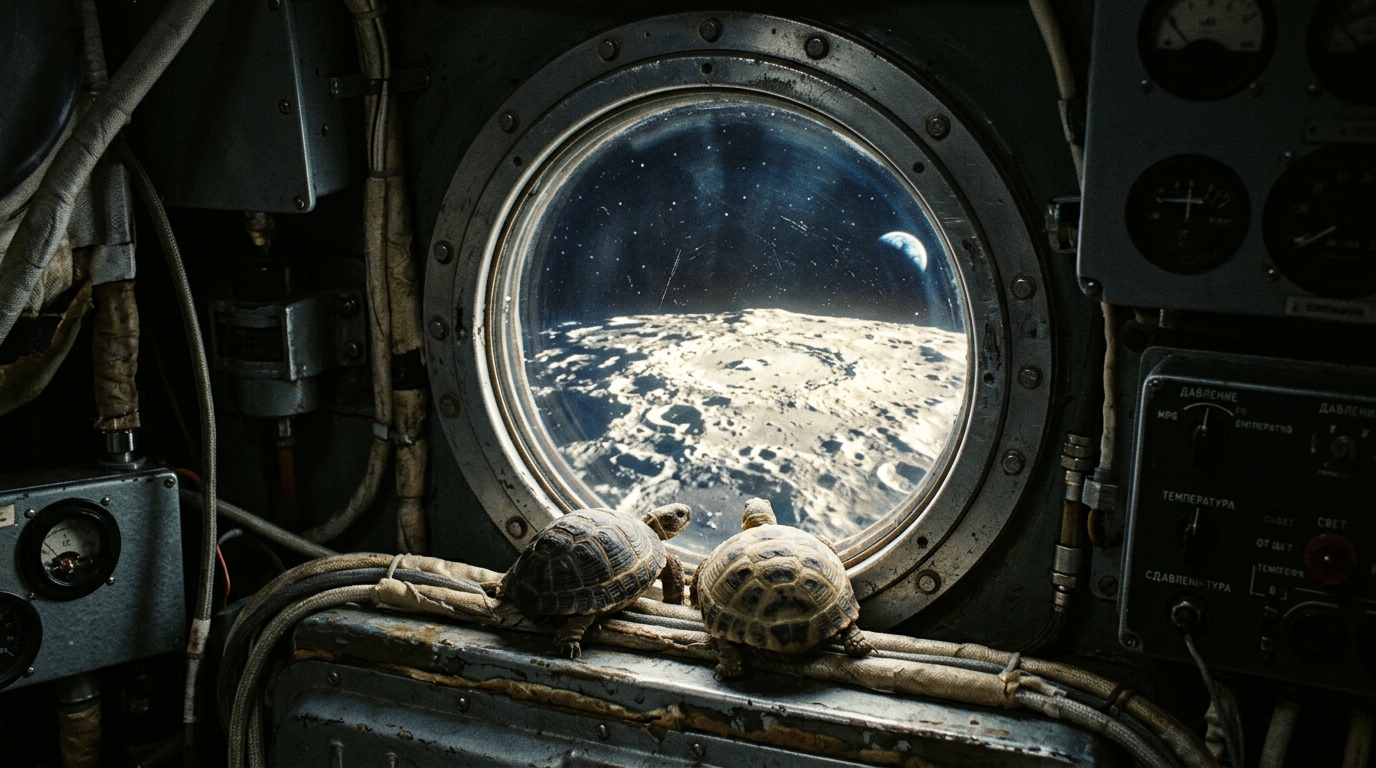
Imagine for a moment having to choose between sending a human being or an animal to withstand unknown radiation, inside a capsule that had never proven itself. This is precisely the dilemma Soviet engineers faced in the late 1960s, amid the fevered rush toward the Moon. While the world’s spotlight focused on American programs and their heroic astronauts, a modest, discreet convoy rose from the steppes of Kazakhstan, carrying two rather unexpected passengers aboard. Not pilots, not scientists, not even mammals: two Central Asian tortoises were about to write, unknowingly, a little-known page in space history.
Two tortoises rather than humans: the choice that surprised the entire world
At that time, no one really knew how a living organism would react to a circumlunar flight. Cosmic radiation, prolonged weightlessness, temperature fluctuations — so many unknowns that sending a human seemed exceedingly risky. The Soviet engineers therefore opted for a solution as simple as it was clever: to use steppe tortoises, reptiles renowned for their robustness and their ability to survive in extreme conditions. This decision, far from trivial, fit into a precise logic: to test, under real conditions, the resistance of a living organism before risking a cosmonaut.
These two tortoises were not alone aboard. The descent module, initially designed to accommodate cosmonauts, also carried fly eggs, bacteria and some plants, as well as various scientific instruments meant to measure the voyage’s effects on living matter. A miniature Noah’s Ark, propelled toward the lunar unknown.
Zond 5, the Soviet capsule quietly outpaced the Americans
On September 14, 1968, a Proton-K rocket lifted off from the Baikonur Cosmodrome, carrying the Zond 5 probe. Its mission: to outline a circumlunar trajectory, i.e., to loop around the Moon without landing, then return to Earth. A remarkable technical feat for the era, which quietly placed the USSR ahead in the lunar race, even as the public focus remained on American advances.
A few days later, on September 18, the probe passed by our natural satellite at a distance of merely 1,950 kilometers, a feat of precision for the time. It also captured Earth photographs from a distance of 90,000 kilometers, delivering images of unprecedented quality. What makes this mission unique is that it became the first to include animals in a circumlunar flight, and above all the first to return to Earth without incident.
Seven days in the vacuum of space: what the tortoises endured around the Moon
The return did not go exactly as planned. On September 21, after a seven-day journey, the capsule splashed down in the Indian Ocean, far from the Kazakhstan target initially aimed for. Guidance problems compromised the precision of reentry, forcing the recovery teams to improvise the plan on the fly.
Despite this chaotic trajectory, the good news awaited the Soviet teams: the entire biological payload remained intact. The two tortoises, although they had lost about 10% of their body weight during the voyage, were in good health upon retrieval. They had not even lost their appetite, an encouraging sign that hinted at a calmer future for future manned missions. This detail, almost anecdotal, carried crucial importance: it proved that a living organism could survive such a journey without major aftereffects.
An overlooked achievement that nonetheless changed the course of lunar conquest
Strangely, this major success remained confidential for several weeks. It was not until November, a month before the historic Apollo 8 flight, that the official newspaper La Pravda finally revealed the presence of living organisms aboard Zond 5. This belated announcement did not escape American strategists, who saw in it tangible proof that the Soviets were making rapid strides toward a crewed lunar flight.
This mission also played a decisive role in speeding up NASA’s schedule. Three months later, Apollo 8 ventured into lunar orbit, marking the first crewed flight around our satellite. The tortoise adventure did not end there: other animals followed the same path, such as the four tortoises on Zond 7 in August 1969, then the five mice that orbited the Moon 75 times during Apollo 17 in December 1972.
Today, the story of these two tortoises remains largely unknown to the general public, eclipsed by the iconic images of American astronauts setting foot on the lunar surface. Yet, without this discreet detour through the Indian Ocean and these two resilient reptiles, space exploration might have taken a very different course. A humbling reminder that major scientific advances do not always bear a human face, and that sometimes the smallest actors pave the way for the grandest ambitions.
