
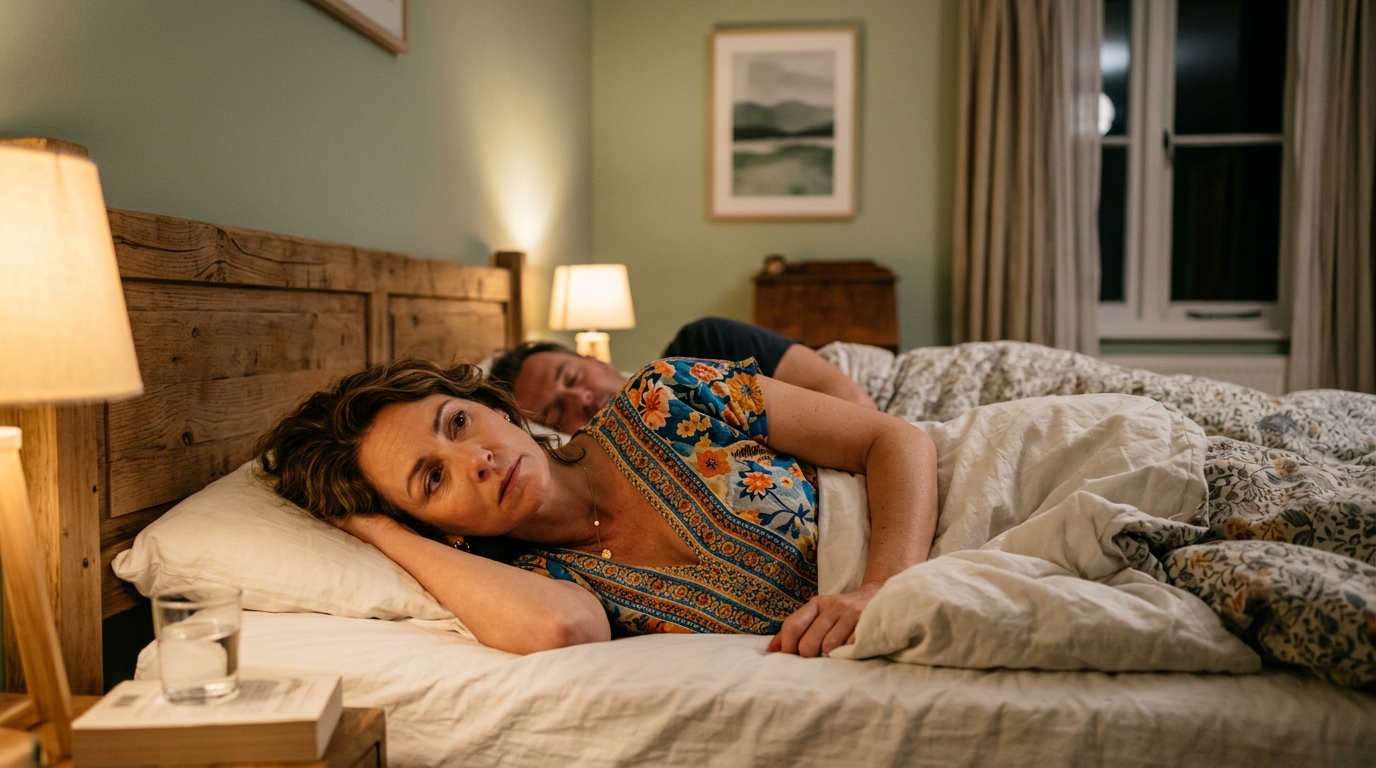
Snoring and sleep apnea are not the same thing, even though the general public often confuses the two. The former is loud but usually harmless, while the latter can have serious consequences for cardiovascular health. And the boundary between these two realities is drawn in the quiet, not in the noise. Tonight, once again, lying beside your partner, you may have counted, perhaps subconsciously, the seconds between two snores, a little uneasy about that pause that seemed to stretch on. This small nocturnal game, far from being harmless, is precisely the very first question that any sleep specialist asks a snoring patient. So, from how many seconds of silence should the alarm really be sounded?
That Silence Speaks Volumes About Your Partner’s Night
A classic snoring pattern generally follows a regular rhythm: a loud inhale, exhale, another inhale, and so on throughout the night. It’s unpleasant for the bed partner, but it is usually merely a mechanical phenomenon linked to the vibration of the soft tissues in the throat. By contrast, when this rhythm is abruptly interrupted, when the snoring stops suddenly and no sound emerges at all, something more worrying may be at play. This silence often corresponds to a breathing pause, that is, a moment when air no longer circulates normally through the airways. The sleeper usually does not notice it. It is therefore most often the partner, in the darkness of the bedroom, who takes on this involuntary role of privileged observer. A role which, even if not always recognized, can prove valuable for spotting a sleep disorder that would otherwise go unnoticed.
Ten seconds, the figure that changes everything for diagnosis
In the minds of sleep professionals, one figure recurs constantly: ten seconds. That is indeed the duration beyond which a breathing pause during sleep is considered clinically significant. This phenomenon has a precise name, often unfamiliar to the general public: sleep apnea. In concrete terms, if the silence between two snorings exceeds this threshold, it means that air is no longer circulating properly, and the brain, deprived of oxygen for a few moments, will trigger a micro-arousal to restart breathing. This mechanism can repeat dozens, or even hundreds, of times per night, without the sleeper retaining any memory upon waking. It is precisely this repetition that worries doctors: the more frequent and longer the pauses, the more fragmented the sleep becomes, and the greater the strain on the body. In the long run, these repeated interruptions are associated with chronic fatigue, higher blood pressure, and an increased cardiovascular risk. That is why the question posed by the physician is almost never “Do you snore loudly?” but rather “Has your partner noticed pauses in your breathing during the night?” The volume of sound ultimately matters little; it is the duration of the silence that constitutes the real warning sign.
What to do once doubt has settled in the bedroom
Once this doubt has taken hold, it’s hard to pretend nothing is wrong. The first step is simply to observe, without sensationalizing. It can help to note, over a few nights, the frequency of these prolonged silences, or even discreetly record a few minutes of sleep with a smartphone to objectify the situation. Other signs may complete the picture: unusual daytime sleepiness, headaches upon waking, the sense of never truly feeling rested despite a full night, or awakenings with a start and a sensation of suffocation. If several of these elements come together, it is advisable to consult a general practitioner, who can direct you to a sleep specialist if needed. An examination called polysomnography, typically performed at home or in a specialized center, can then precisely measure the number and duration of breathing pauses over an entire night. It is only with these objective data that a diagnosis of sleep apnea can be established, and a tailored management plan proposed, ranging from simple lifestyle changes to nocturnal breathing devices. In any case, this is not a subject to treat lightly, nor to overdramitize without medical advice.
According to the French Health Insurance, sleep apnea would affect several million people in France, often without those affected realizing it themselves. This is precisely the challenge of that nightly tally performed, sometimes involuntarily, by the partner: turning a daily nuisance into a real health indicator. So, the next time the silence lingers a little too long beside you, perhaps it will be an opportunity to talk about it, simply, over coffee the next morning.
