
Key takeaways
- How could a crate of 101 cane toads trigger one of the century’s worst biological invasions?
- Why do Australian predators die after encountering these imported amphibians?
- Has natural selection made these toads even more dangerous than when they arrived?
A Failed Introduction on Day One
Everything begins in June 1935 when entomologist Reginald Mungomery arrives at Gordonvale port in northern Queensland, carrying a crate containing 102 cane toads captured in Hawaii. One animal dies during the journey. 101 remain, a number that has become famous in Australian natural-history lore. The Bureau of Sugar Experiment Stations, the public agency charged with defending sugar-cane crops, hopes these terrestrial predators will tackle the greyback cane beetle, an insect that gnaws roots and has plagued harvests for decades.
The problem? No one had checked whether the plan would actually work. Cane toads are indeed opportunistic feeders, but this particular beetle spends most of its time high on the plant stems, out of reach of a ground-hugging, lumbering amphibian. Result: the toads never solved the agricultural problem they were brought to address. Ironically, the very Dermolepida albohirtum continues to plague certain plantations today, as if Gordonvale’s 101 pioneers had never existed.
Some scientists of the era foresaw the disaster. Entomologist Walter Froggatt spoke out publicly, fearing the animal would become a major nuisance. A 1936 report in The Australian Naturalist even compared the risk to that of rabbits or prickly pear, two plagues already well known to Australians. These warnings proved futile: by August of that same year, about 2,400 cane toads had already been released into sugar cane fields near Cairns.
A Biological Machine Built to Invade
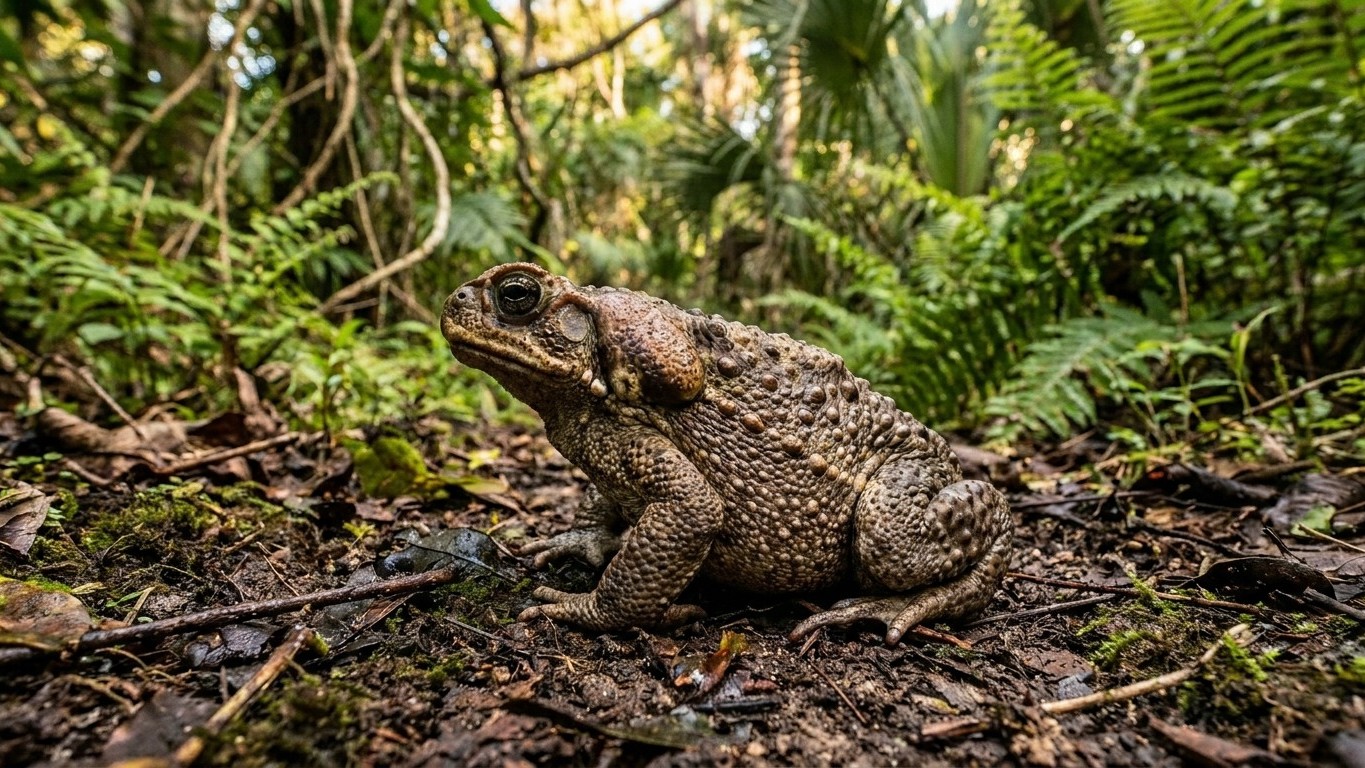
What makes the cane toad formidable is not only its appetite. It can reproduce at a rate that defies belief: a female can lay up to 30,000 eggs in a single clutch, several times a year. No native Australian species approaches this reproductive tempo. Add to that a toxin, bufotoxin, secreted by parotoid glands on its shoulders, capable of inducing cardiac arrest in anyone foolish enough to bite it, and you have an almost indestructible creature in an environment where few people know to beware.
The toad found a continent to its liking: a mild climate, abundant food, and above all, no predator capable of keeping it in check. From a few dozen individuals, the population exploded to surpass five million by the 1980s and continued to grow without slowing. Today, estimates hover around 200 million individuals across the country, a figure that makes one’s head spin when reminded that only 101 were needed at the outset.
The Silent Carnage Wrought by Australian Predators
That is where the story becomes tragically clear for native fauna. The northern quoll, a carnivorous marsupial, and the goanna (a type of monitor lizard) experienced spectacular population declines after the cane toads arrived. The toad invasion drove down several species, including the endangered northern quoll, the floodplain monitor, and the freshwater crocodile. These animals, long used to preying on harmless amphibians and reptiles, bite cane toads without caution and die within minutes.
The numbers are staggering. In some areas, more than 90% of northern quolls, freshwater crocodiles, blue-tongue skinks, and certain monitor species die soon after cane toads arrive, and many northern quoll populations have been wiped out. According to the National Cane Toad Taskforce, northern quoll populations had already vanished from the Northern Territory by 2005. Snakes are not spared either. A Darwin snake-handler, cited by the public broadcaster ABC, reports a dramatic collapse in encounters with the king brown, a venomous snake once common: “before the toads arrived, we’d see 10 or 20 king browns a year during calls at Darwin; since then, we’ve dropped to one or two, if we’re lucky.”
An Invasion Front That Never Stopped Accelerating
Perhaps the most worrying aspect is not the scale of the invasion but its accelerating pace. The front is advancing faster and faster, from about 10 kilometers per year in the early decades to roughly 40–60 kilometers per year today. This acceleration is no climate accident: researchers at the University of Sydney, notably around biologist Rick Shine, have shown that toads at the invasion front develop longer legs generation after generation, a form of natural selection that literally makes them faster than their ancestors. Introduced in northeastern Queensland in 1935, the toads have spread at an ever-accelerating rate, moving from 1–15 kilometers per year in the decades after release to 55–60 kilometers per year today.
The cane toad has, over the years, colonized about 1.2 million square kilometers, an area larger than the combined sizes of France and Spain. The front continues its westward march, from Queensland to the Northern Territory, toward the border with Western Australia. The toads have already colonized Queensland’s coast up to the Kimberley region in the west and are expected to reach Broome on the western coast in the coming years. What began in a wooden crate in Gordonvale will, if nothing changes, eventually touch the entire tropical continent of Australia.
Yet all is not lost for native wildlife. Researchers at Macquarie University have developed a method called conditioned taste aversion, which involves feeding native predators small juvenile cane toads paired with a substance that induces nausea, without a lethal dose. This major innovation trains predators to avoid eating cane toads by linking the taste to nausea, with encouraging results in quolls, monitors, and blue-tongue skinks. Some species even adapt naturally: certain native predators have learned to eat cane toads with no risk of poisoning, such as the Australian water rat, which has developed a technique to bite into the animal and consume only the heart and liver, avoiding the toxic skin. Proof that even in the face of a 90-year-old mistake, nature sometimes slowly finds its own countermeasure.
Sources: ncbi.nlm.nih.gov | journals.plos.org
