
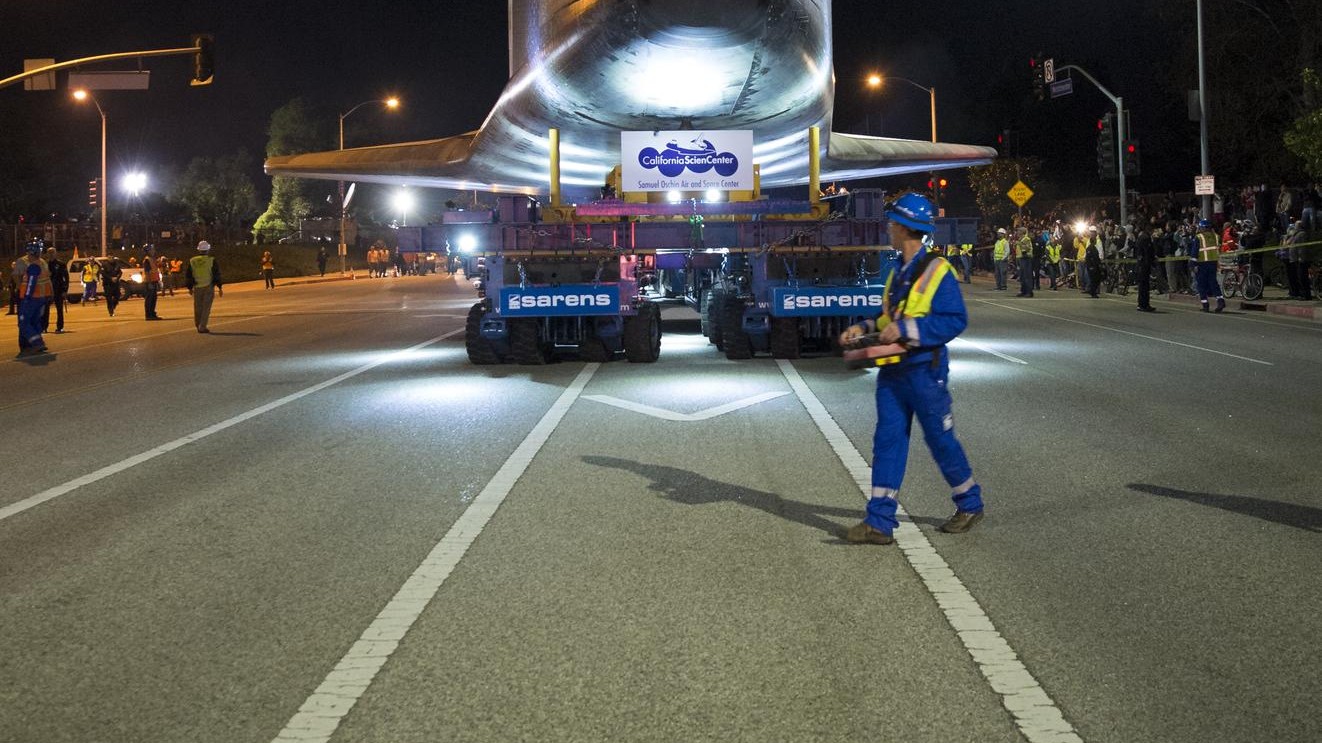
On October 12, 2012, an extraordinary convoy took to the streets of Los Angeles: the space shuttle Endeavour, perched on a platform with 160 wheels, began a journey of 19 kilometers at a pace only slightly faster than a brisk walk. Some 400 trees had to be uprooted, provoking the ire of nearby residents, and power had to be cut along parts of the 19-kilometer route to allow passage of the 85-ton shuttle, which moved on average at 3.2 km/h. A vessel capable of reaching 27,000 km/h in orbit reduced to the tempo of a pedestrian crossing its own adopted city.
Takeaways
- A space shuttle capable of reaching 27,000 km/h slowed to pedestrian pace in an urban setting
- How many trees must be sacrificed for 68 hours of one logistical operation?
- Tens of thousands of spectators, only a few inches of clearance, and a decision to replant three times as many trees
A convoy too large for the city that hosts it
The problem came down to a single, simple figure: 78 feet, almost 24 meters across, wider than the width of most two-lane streets in Los Angeles. At 78 feet wide, Endeavour could not pass beneath highway overpasses, forcing its 12-mile route to be cleared of trees along medians and sidewalks. Lifting the shuttle into space and ferrying it by air to the museum was a fantasy: disassembling the vehicle was ruled out, and at 170,000 pounds, transport by helicopter was deemed impossible. The remaining option was the road, with its traffic lights, street lamps and urban canopy to negotiate centimeter by centimeter.
The engineers faced an obstacle impossible to circumvent: Interstate 405, the only major expressway along the itinerary. The shuttle could not pass under an underpass, so it had to cross the 405 from above, the sole major expressway on its route. This nocturnal crossing, performed on a bridge built for the occasion, remains one of the most spectacular sequences of the entire operation. The route itself had been chosen after a genuine study of urban engineering: the technical team evaluated numerous potential ways before settling on a 12-mile (19-kilometer) path through Inglewood and Leimert Park.
Hundreds of trees sacrificed for a 25-meter wingspan
That is where the project sparked local controversy. The final 12-mile journey of Endeavour through the streets of south Los Angeles prompted protests from some residents, because 400 trees had to be cut to clear the shuttle’s intended passage between Los Angeles International Airport and the California Science Center. The geographic breakdown of the cutting was precisely tallied: according to a Los Angeles Times estimate, 128 trees would be removed in the city of Inglewood, and about 265 in South Los Angeles. Pines, ficus, and other varieties planted decades earlier fell in a matter of days to make room for an object that would not pass that way again.
Facing the anger of residents who pointed to the loss of shade, birds and squirrels in neighborhoods already sparse in greenery, the California Science Center had to revisit its plan. Its president, Jeffrey Rudolph, announced a program of replanting that was revised upward, with nearly 1,000 new trees to improve the urban landscape of Inglewood, Westchester and South Los Angeles; the initial offer of two trees planted for every one cut was raised to more than three for one. Other sources even mention a commitment of four trees replanted for each tree sacrificed. A detail almost overlooked at the time: most of the trees that posed a problem were ultimately not cut, either because they were old or protected for other reasons—for example, trees planted in honor of Martin Luther King, underscoring that even a project of such magnitude has its limits.
Two days, 68 hours, a few centimeters of margin
On the ground, the operation took much longer than expected. From October 12 to 14, 2012, the retired orbiter crawled from Los Angeles International Airport, through Inglewood and into Los Angeles proper, to the California Science Center, a journey that lasted about 68 hours, Endeavour never exceeding 2 mph and stopping frequently as teams managed power lines, traffic equipment, buildings and trees. When averaged, the feat assumes a different dimension: twelve miles over 68 hours equates to roughly 0.176 mph, about the pace of a block traversed in an hour. In some places, maneuvering space was measured in inches: at several points, the wing’s 78-foot span left only a few inches of clearance with surrounding obstacles.
The spectacle drew crowds despite the heat. Tens of thousands of onlookers lined the route, with improvised signs and sidewalk picnics, for an event that the head of the transport company responsible for the operation summed up with a sober remark: “This is unlike anything we have moved before.” The full route passed notably through Westchester, where the shuttle had to wait several hours to allow the power lines to be raised, before crossing Manchester Boulevard and then the 405 in the dead of night.
What the shuttle has become since
After its triumphant arrival at the California Science Center, Endeavour remained displayed horizontally for more than a decade, like a grounded aircraft. A radical change occurred recently: in 2024, the shuttle was hoisted into a vertical configuration, mated to an external tank and real propulsion boosters, to adopt the posture it had on the launch pad before each liftoff. The forthcoming Samuel Oschin Air and Space Center will be the only place in the world where one can view a complete, authentic space shuttle system, displayed in launch posture at a height equivalent to twenty stories. The opening of this new 200,000-square-foot building is slated for November 13, 2026, almost exactly fourteen years after the shuttle’s street crossing in South Los Angeles. The trees cut in 2012 have since regrown elsewhere, but the urban scar of that October week remains, to this day, a case study cited by heavy-lift logistics engineers around the world.
Sources: californiasciencecenter.org | prnewswire.com
