
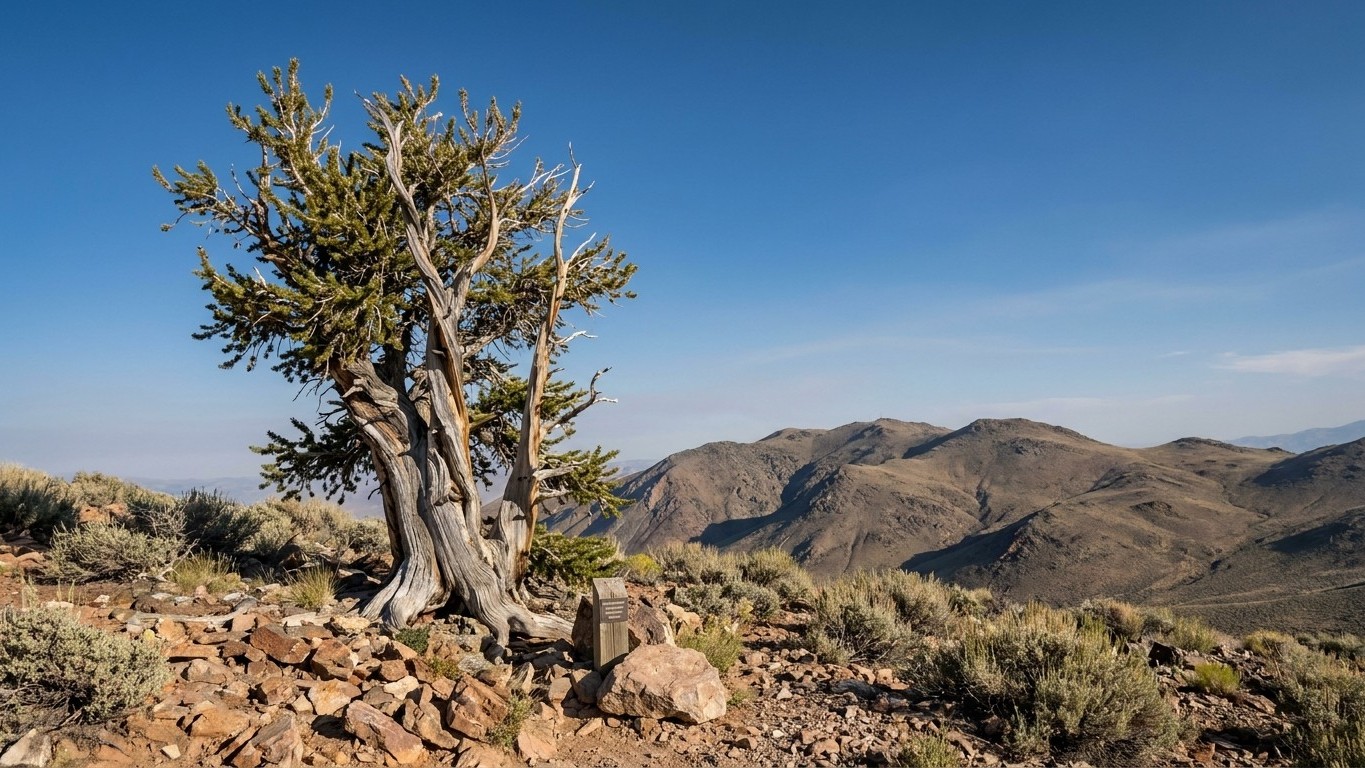
A PhD student, unknowingly, felled the oldest non-clonal tree ever documented on Earth. It wasn’t lightning or drought that brought down this millennia-old Nevada pine, but a simple coring drill that became stuck in the trunk during the summer of 1964. The story, as absurd as it is fascinating, remains one of modern science’s greatest regrets.
Takeaways
- A tree that should have survived for millennia was destroyed in minutes by a researcher
- The corer got stuck in the wood: the fatal decision that would alter history
- Conflicting accounts still persist today about the true reasons for the felling
A Researcher, a Broken Corer, and 5,000 Years of Lost History
Don Currey was a graduate student at the University of North Carolina working on his master’s thesis about glacial movements in the Great Basin when he came across a tree that looked extraordinarily ancient. His objective was not exotic: dating glacial moraines, those traces left by vanished glaciers, by using the growth rings of trees as a natural calendar. In 1964, this graduate student named Donald Rusk Currey sought permission to fell a tree growing on the slope of a Nevada mountain.
The tree in question had a name given by hikers a few years earlier: Prometheus. Around 1958 or 1961, a group of naturalists had christened some of the sector’s largest or most curious specimens, including this one. Officially, in Currey’s records, it bore the designation WPN-114, the 114th tree sampled in White Pine County. A serial number for what would later become, in hindsight, a living archaeological artifact.
Here is where the affair takes a nearly comic turn. To obtain the growth data sought, one uses a corer to extract a wooden cylinder the thickness of a pencil, called a core. Currey had secured permission from the U.S. Forest Service to sample these trees from a stand of pines beneath Wheeler Peak, Prometheus included. But his tool jammed in the wood, too dense, too resistant. The doctoral student’s corer became stuck in the ancient timber; he then cut the tree to retrieve the tool, and it was while counting the rings that he realized his historic mistake.
A Ring Count That Shook Scientific Certainties
The figure initially seemed enormous, then dizzying. The ring count Currey performed on the cross-section was 4,844; a few years later, it was raised to 4,862 by Donald Graybill, from the Tree-Ring Laboratory at the University of Arizona. This pine had germinated well before the construction of the great Egyptian pyramids. The rings corresponded to layers of xylem that had begun forming even before the pyramids were built.
The wood of Great Basin pines (Pinus longaeva) is no trivial matter. These conifers are among the hardiest there are: slow-growing, with dense wood that makes them resistant to the elements, to insects, and to fungi; the species Pinus longaeva can live for thousands of years. It was precisely this extreme density that trapped Currey’s corer, and, by extension, doomed the tree. Not a storm, not a fire, not a parasite: just a simple coring tool ill-suited to the wood’s hardness.
What stands out in hindsight is the mismatch between the scale of the discovery and the ordinariness of the act that triggered it. Currey was preparing a thesis on the “Little Ice Age,” a topic that should have required only about 600 years of rings to study. Six centuries would have sufficed for his research. The tree contained more than eight times that amount. Chance had placed on his path, without warning, the living witness oldest ever documented at that time.
A Controversy That Has Never Really Been Settled
Versions differ on the exact reasons for the felling, and no one, today, can say for certain. There are “several versions” of the circumstances according to the Great Basin National Park: in one, Currey had to fell the tree to retrieve his drill stuck during sampling; in another, a full cross-section was deemed necessary for a thorough analysis of the rings. The park itself acknowledges its uncertainty: “we may never know the true story of what happened,” writes the institution.
Other accounts mention unsatisfactory core samples, or simply the ignorance of the tree’s real age at the time of the decision. The versions range from broken coring tools, to a lack of knowledge about the tree’s true age, to unsatisfactory core samples, to the need for more precise data requiring full felling. What is certain is that the Forest Service gave its green light, and no one at the time grasped the scope of the act.
The ripple, however, was very real once the news broke. The felling of the tree reinforced the bristlecone pine-protection movement in general and the Wheeler Peak groves in particular; a movement already in place to designate the area as a national park, status achieved twenty-two years after the incident. Currey himself testified before the U.S. Congress to support the park’s creation. The error, paradoxically, saved Prometheus’s neighbors.
Today, fragments of the stump still circulate, almost like relics. Sections of the tree are at the Great Basin National Park Visitor Center, the Ely Convention Center, the Tree-Ring Laboratory at the University of Arizona, and the U.S. Forest Service’s Forest Genetics Institute in Placerville. What remains striking is that this pine was probably not an isolated case: other specimens in the same forest, never corered due to lack of time or budget, could well exceed five millennia without anyone ever knowing, or ever knowing it.
Sources: monumentaltrees.com | nevadaappeal.com
