
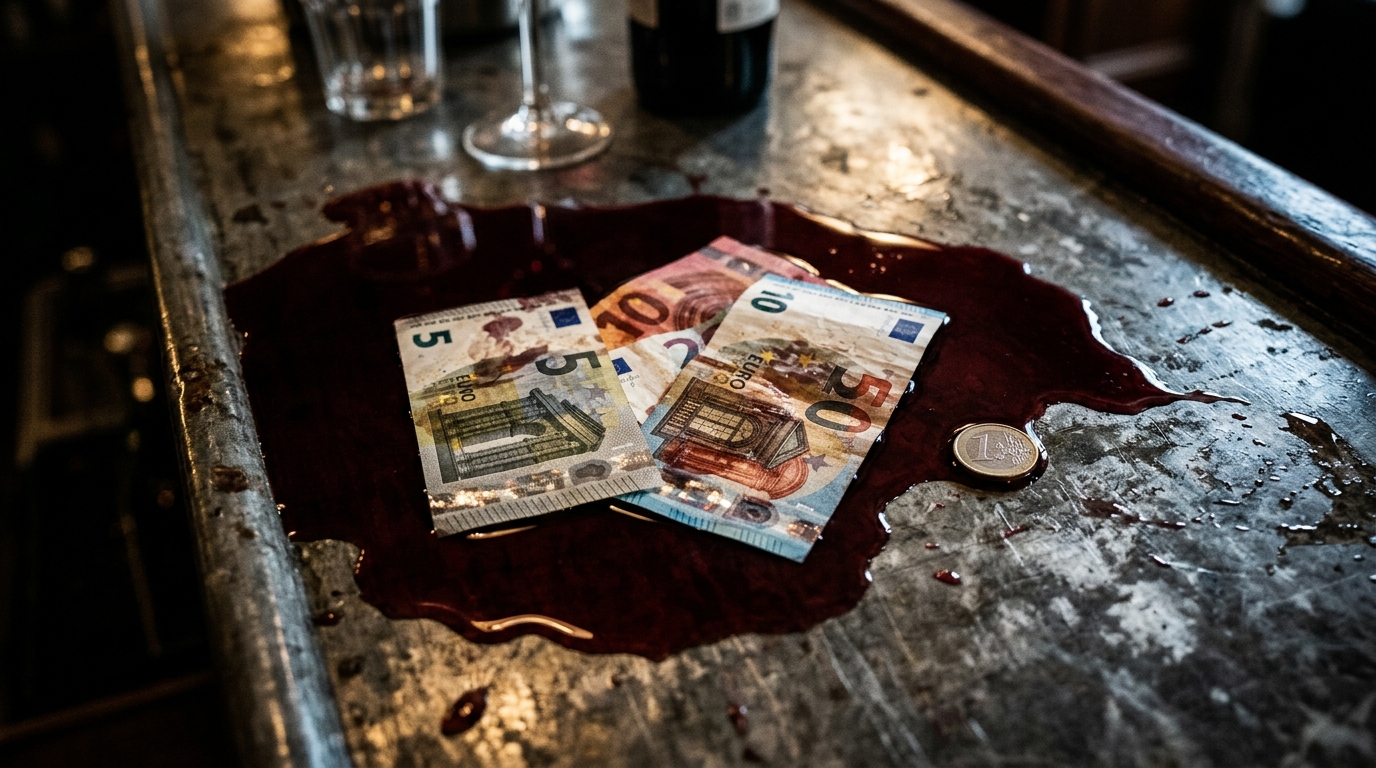
A glass of rosé on a sunlit terrace, a beer shared among friends at the end of a workday, a glass of champagne to celebrate a happy event: alcohol accompanies many of the convivial moments in France. It’s hard to imagine, behind these so ordinary gestures, that every swallow quietly participates in one of the most vertiginous expense items in our country. Because when you add up medical care, sick leave, road accidents, domestic violence, and lives cut short, the bill climbs to dizzying heights. And the most troubling part of this story is that the money the state collects through alcohol taxes represents only a tiny fraction of this collective tab.
An unseen financial abyss
Recent work by the French Observatory on Drugs and Drug Addiction (OFDT) has allowed for an updated estimation of alcohol’s social cost in France: 102 billion euros for the year 2019, a figure already colossal but slightly lower than earlier estimates. Indeed, a decade earlier, the same social cost was assessed at 120 billion euros, a figure long used as a benchmark in public debates and parliamentary discussions. This relative decline is mainly explained by methodological adjustments, particularly in how lost life expectancy is calculated, and not by a real improvement in health conditions. By way of comparison, tobacco remains the top item with 156 billion euros of social cost, while illegal drugs, often more highlighted, weigh in at only 7.7 billion euros. Alcohol thus occupies a far heavier place in public finances and in the daily life of the French than is generally imagined.
This social cost is not limited to a simple summing of hospital bills. It encompasses loss of economic production, the degradation of the quality of life for those affected, and above all, the value of lives shortened by excessive alcohol consumption. Every year, 41,080 deaths are attributed to this substance in France, a chilling figure that places alcohol among the main causes of preventable mortality in the country. By statistical convention, each life lost is valued at €115,000, which largely explains the magnitude of the final figure.
Care, accidents, violence: where does the money actually go
Behind this overall amount lies a concrete reality, made up of occupied hospital beds, overwhelmed emergency services, and families torn apart. The direct cost of care related to alcohol reaches 7.8 billion euros per year alone, a sum that reflects the treatment of cirrhosis, cancers, cardiovascular disorders, and withdrawal syndromes. Some parliamentary estimates also mention 4.2 billion euros for direct care alone, evidence that calculation methods vary, but the order of magnitude remains very high.
At the European level, the World Health Organization notes that the economic cost of deaths from alcohol-related cancers alone approaches 5 billion euros across the European Union. Alcohol is indeed considered the second leading cause of cancer in France, just behind tobacco, making it a major public health issue, rarely treated with the same media intensity as other addictions. Added to this are road accidents under the influence, domestic violence aggravated by drinking, and repeated sick leaves, all of which weigh heavily on the finances of the Social Security system and on social cohesion as a whole.
Alcohol taxes, a drop in the bucket against the real cost
In the face of this flood of figures, one might think alcohol taxation would at least partially offset these expenses. Yet the reality is quite different. Revenues from taxing alcoholic beverages amount to around 4 billion euros per year, a sum that seems trivial once put into perspective. Just to cover the cost of care, estimated at 7.8 billion euros, nearly 3.8 billion euros would already be missing. In other words, the state spends more on treating alcohol-related illnesses than it collects in taxes on bottles sold in supermarkets or at the café counter.
If you relate these 4 billion in tax receipts to the total social cost of 102 billion euros, the ratio becomes even more telling: for every euro recovered by the state through alcohol taxation, the community spends around twenty-five euros elsewhere. Tax revenues would thus cover only about 42% of the cost of care, leaving a substantial deficit that taxpayers indirectly fill. This weak tax yield is also explained by a taxation perceived as not very deterrent: the relative price index for alcoholic beverages stayed virtually stable between 1990 and 2011, a sign that taxes never truly aimed to curb consumption. The Scottish example, however, shows that another path is possible: since the introduction of a minimum price on alcohol in 2018, the country has seen a 13.4% decrease in alcohol-attributed deaths and a 4.1% decrease in related hospitalizations.
What these figures reveal about our collective priorities
These amounts are not mere abstract statistics meant to impress. They directly challenge how French society balances cultural pleasure, individual freedom, and collective responsibility. France remains among the European countries with the highest per capita alcohol consumption, a status inherited from a long wine-loving and festive tradition, but one that comes at a real price rarely displayed on labels. As budget debates approach, the question of alcohol’s fiscal yield keeps resurfacing, without strong measures having been adopted so far.
That gap between social cost and taxation raises a fundamental question: how far is a society willing to subsidize, without saying so, the consequences of a consumption it continues to celebrate? The Scottish example shows that a more ambitious price policy can yield measurable health effects in just a few years, without necessarily overturning cultural habits.
Between the real weight of alcohol on public finances and the timidness of current fiscal policies, a gap remains. Perhaps the real question is no longer how much alcohol costs France, but how much longer will the community keep paying the bill for those who profit from it.
