
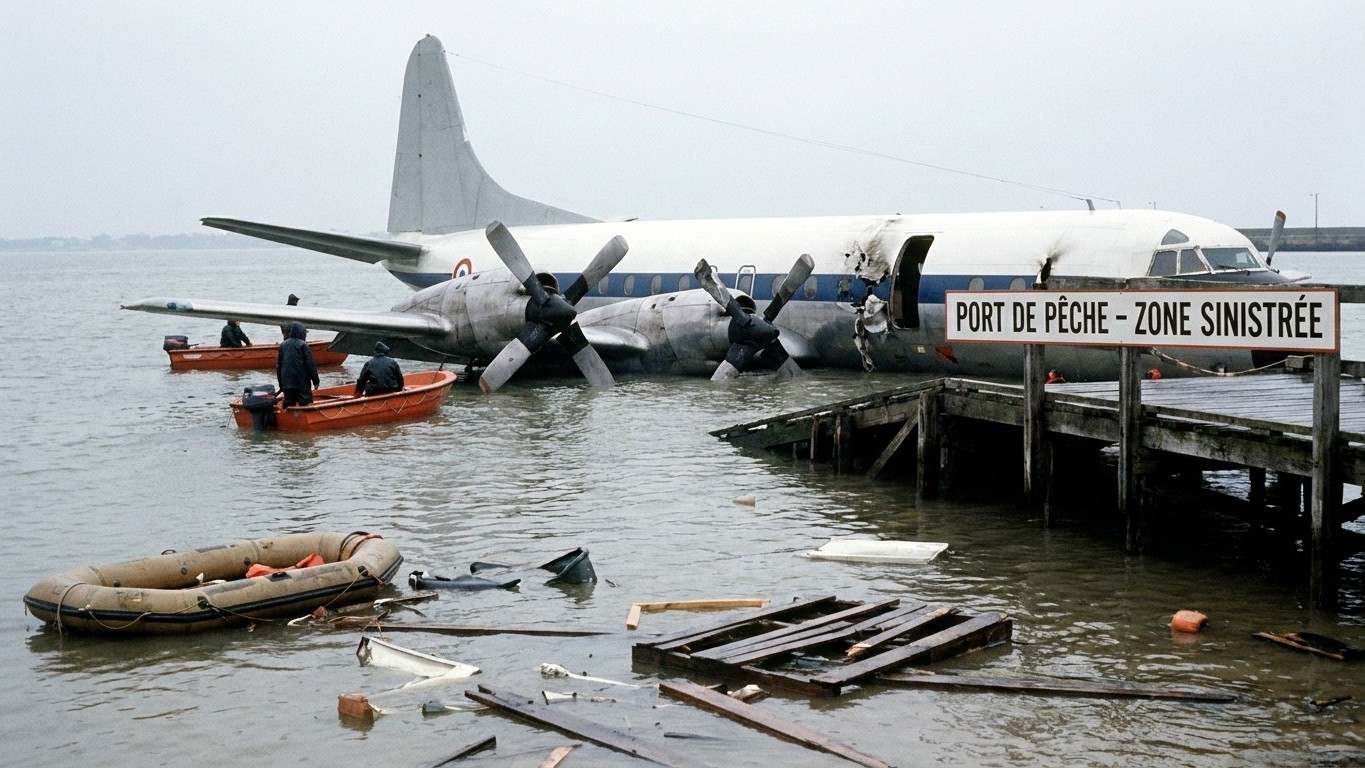
Six seconds. It was the time that elapsed on October 4, 1960, from a routine takeoff to the worst bird-strike catastrophe in American aviation history. The plane did not explode due to a classic engine failure, and it wasn’t a fuel shortage. What choked three of its four turboprop engines were birds. Specifically, a flock of European starlings sucked into the intakes as Lockheed L-188 Electra was lifting off from Boston’s Logan Airport.
Key takeaways
- Six seconds separate a normal takeoff from the worst American bird catastrophe: ingestion of birds into the engines
- Hundreds of starlings crossed the aircraft’s path and de-stabilized three of the four engines asymmetrically
- The invasion traces back to a wealthy socialite who deliberately released starlings in New York a century earlier
Flight 375, or How a Cloud of Feathers Brought Down a Plane
That evening, the aircraft departed from Runway 9 bound for Philadelphia, carrying 67 passengers and 5 crew members. The plane lifted off at 5:35 p.m., was cleared to take off at 5:39 p.m., and the takeoff proceeded normally until, six seconds later, the aircraft collided with a flock of starlings. At an altitude of barely 120 feet, roughly 37 meters and about the height of a twelve-story building, the Electra struck a large flock of birds, ingesting them into engines 1, 2, and 4.
The consequences were immediate and cascading. Engine 1’s propeller automatically went into a feathered state and the engine was shut down by the crew, while engines 2 and 4 suffered drastic thrust losses before recovering—recoveries did not occur synchronously. This mismatch was enough to destabilize the aircraft. The loss of thrust, the asymmetric force, and the rapid reduction in speed resulted in a loss of control that led to the crash. The aircraft spiraled and plunged almost vertically into the cold waters of Winthrop Bay, just off the runway. The toll was terrible: 62 of the 72 people on board died, ten survived, nine of whom were badly injured.
Investigators quickly understood the source of the problem. Wildlife experts found the remains of about 75 starlings scattered along the runway and its surroundings, and later it was estimated that three of the four engines ingested a large number of birds. Some testimonies even described a far larger flight: a flock that could number as many as 20,000 starlings crossing the plane’s path, with hundreds of birds drawn into the engines. A chilling detail completes the picture: the Civil Aeronautics Board discovered that birds had struck the windshield, severely reducing visibility, about sixty birds lay on the runway, and remains recovered from Pitot tubes made the airspeed indicators unreliable.
An invasion born from a literary whim, seventy years earlier
To understand why hundreds of starlings were flying en masse over Boston in 1960, one must go back to a frigid March morning in 1890, in Central Park. A wealthy New York socialite named Eugene Schieffelin released around a hundred common starlings there as part of a decidedly quirky project to introduce in the United States all the birds mentioned in Shakespeare’s works. The myth says Schieffelin, obsessed with the Bard, wished to offer America every avian species cited in the English playwright’s plays.
The historical reality is somewhat more nuanced. Researchers have shown that this version, popularized long after the fact, rests on no direct testimony from Schieffelin himself: no quoted words from Schieffelin, no firsthand or secondhand evidence to corroborate the story. What is documented, however, is his affiliation with the American Acclimatization Society, a New York club that exchanged plants and animals across continents in the belief of enriching the local environment. Regardless of the exact motivation, the outcome is real: in 1890 Schieffelin released 60 starlings imported from England into Central Park, and repeated the act with 40 more birds the following year.
Yet the species did not disappear. In a few years, only 32 of the original 100 birds remained alive. But starlings possess a formidable capacity for adaptation; they are not picky eaters and they can nest almost anywhere, from tree holes to building cornices. This ruggedness allowed them to colonize the entire continent within a few decades. The result, a century later, is dizzying: starlings proliferate in North America to an estimated population of 200 million individuals. A hundred released birds, by whim, have generated a population nearly twice the size of France. Even today, the species causes nearly a billion dollars in agricultural damage each year in the United States, not to mention the risks it poses to aviation.
An accident that rewrote engine certification standards
The crash of Flight 375 did not leave regulatory authorities unmoved. U.S. agencies had to rethink entirely how engine resistance to bird impacts is tested. Two distinct scenarios emerged from this reflection. The first imagines the ingestion of a large bird—a goose or an eagle—by a single engine without compromising the flight’s safety. The second, directly inspired by the Boston tragedy, starts from a more insidious hypothesis: all engines on a multi-engine aircraft ingest birds simultaneously, and the combined loss of thrust must not exceed that of a single engine on a quad-engine airplane, a risk associated with smaller to medium-sized birds like starlings, gulls, or pigeons.
To refine their conclusions, investigators even recreated the accident in a laboratory. The Civil Aeronautics Board brought in identical propeller-driven engines and literally fed them anesthetized starlings to study the effects. A method that now seems almost artisanal, but it laid the groundwork for the bird-ingestion tests still used to certify modern jet engines, the same ones that, in 2009, allowed the crew of US Airways Flight 1549 to survive a ditching on the Hudson after a collision with geese.
One question remains that few travelers ask when boarding a plane: how many aviation accidents bear, somewhere in their lineage, a decision made by humans decades earlier with no apparent relation to aviation? The Boston story answers plainly. A man who sought to honor Shakespeare in a New York park, without knowing it, helped shape the safety standards that govern the design of every engine flying above our heads today.
Sources: boston25news.com | celebrateboston.com
