
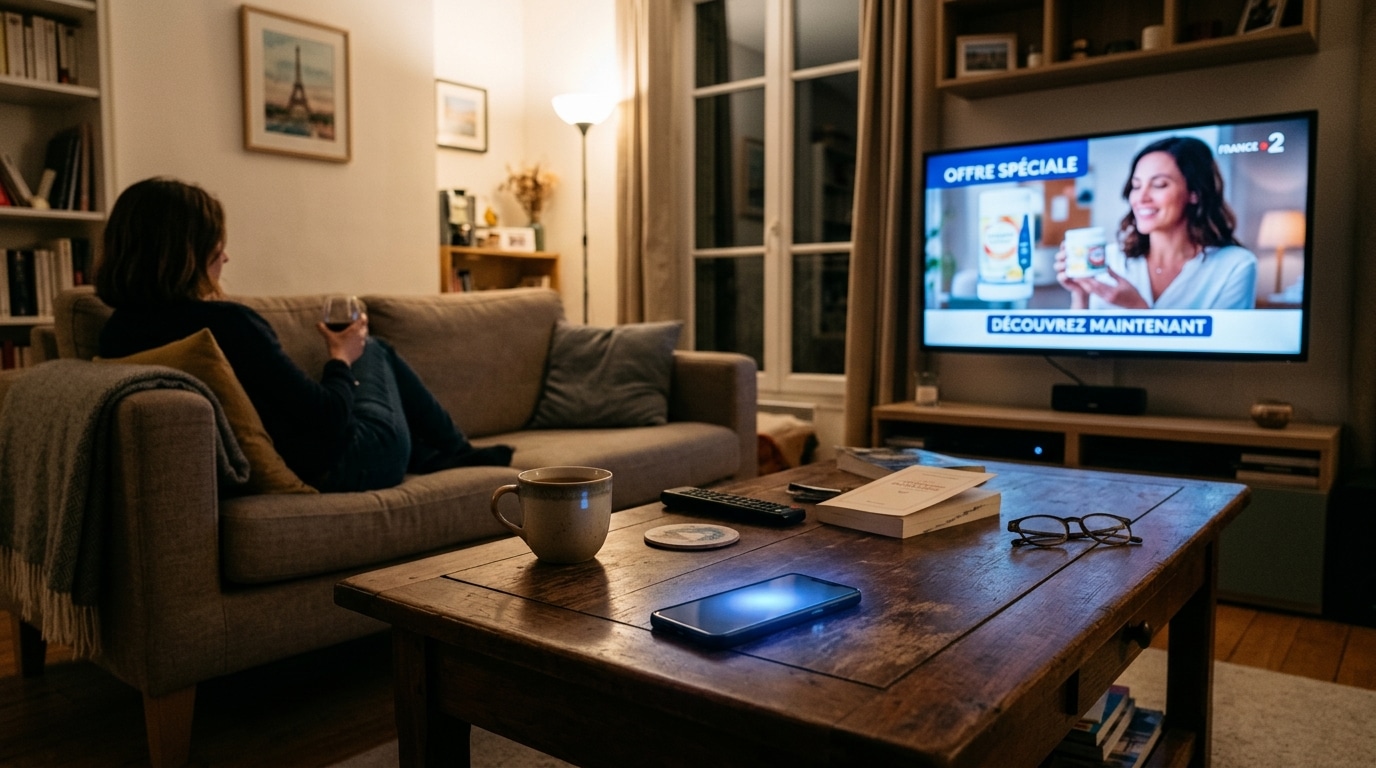
No, this isn’t paranoia: certain television advertisements actually emit a sound that your ears never pick up, yet the microphone on your smartphone catches with ease. This phantom signal, too high-pitched for human hearing, acts as an invisible bridge between your living room screen and the device tucked in your pocket. The idea may feel like something straight out of a science-fiction novel, and yet this technique exists, has a name, and operates on acoustical principles that are well understood. Welcome to the quiet universe of ultrasound tracking, a method designed to link your devices without your knowledge and to refine the advertising profile built around you. Here’s how it works, why it raises questions, and especially how you can take back control.
The sound your ears miss but your mic catches effortlessly
Our ear is a remarkable instrument, but it has its limits. It generally perceives frequencies from about 20 hertz up to 20 kilohertz, and that upper boundary tends to shrink with age. It’s precisely in this borderline zone, between 18 and 20 kHz, that the signals we care about slip in. At that exact spot in the sound spectrum, a sound can exist that no one in the room can hear—much like a dog whistle perched at the top of the audible range.
The microphone of a smartphone, however, does not share these constraints. Designed to be sensitive and versatile, it readily records these high frequencies that our brain tends to ignore. That’s the whole trick: broadcasting an audio message inaudible to humans but perfectly readable to machines. These messages go by a name, ultrasonic beacons, and they form the fundamental building block of the technique known as inter-device tracking by ultrasound.
How a simple invisible “beep” links your TV to your pocket
Imagine an advertisement playing on your television. On the surface, you hear a voice, music, a slogan. But within the soundtrack lies a unique acoustic signature, a kind of code emitted in the high frequencies. If an app installed on your phone contains a suitable receiver and listens at the right moment, it can pick up this signature. The result: the system understands that the device that heard the commercial and the screen that aired it are in the same household, and probably in the hands of the same person.
This mechanism isn’t limited to your living room couch. The same logic can operate in a store where the entrance emits a beacon, or on a web page that injects an ultrasound signal into its content. Each time, the objective remains the same: connect devices together to establish that your computer, television, and smartphone form a coherent set. Points of your profile are linked in this way, and your interests are inferred by observing, for example, which ads you actually watch at home.
Apps that listen constantly, without your knowledge
The central mechanism of this story is mobile applications. To detect a beacon, software must integrate a specialized kit—a component capable of decoding these frequencies. Names such as SilverPush, Lisnr, or Shopkick have marked this field: the first aimed at cross-device tracking, notably via television ads, while the others focused more on in-store localization. By the mid‑2010s, software that used smartphone mics to identify beacons embedded in television advertisements was already making headlines.
What stands out is the sheer number of apps that could be involved. Security research has shown that hundreds of Android apps requested microphone access to integrate this type of beacon. It’s important to emphasize a reassuring point: this tracking does not activate by itself. For an app to listen, you must have granted it permission to use the microphone. In short, the breach is closed by a simple adjustment.
What this technique reveals and how to regain control
Beyond targeted advertising, this technology raises deeper questions about online anonymity. Security research has demonstrated that a well-placed ultrasound signal could theoretically de-anonymize a privacy-conscious user: if a page emits a sound and a nearby device hosts a receiving app, the link between the computer and the phone can be established. It serves as a reminder that a channel as seemingly innocuous as sound can become a powerful tool for identification.
The good news is that the remedy is within reach. The most effective step is to check which apps have access to your microphone and revoke unnecessary permissions.
- On Android: Settings, then Apps, then the microphone permissions.
- On iOS: Settings, then Privacy, then Microphone.
In short, this sound no one hears isn’t magical: it simply exploits a natural boundary of our hearing and the sharp sensitivity of our microphones. Ultrasonic beacon tracking, emitted by speakers and detected by the phone, remains discreet, but it can operate only with the permission you can withdraw. So, the next time an advertisement airs in your living room, you may start wondering what your pocket is truly listening to.
