
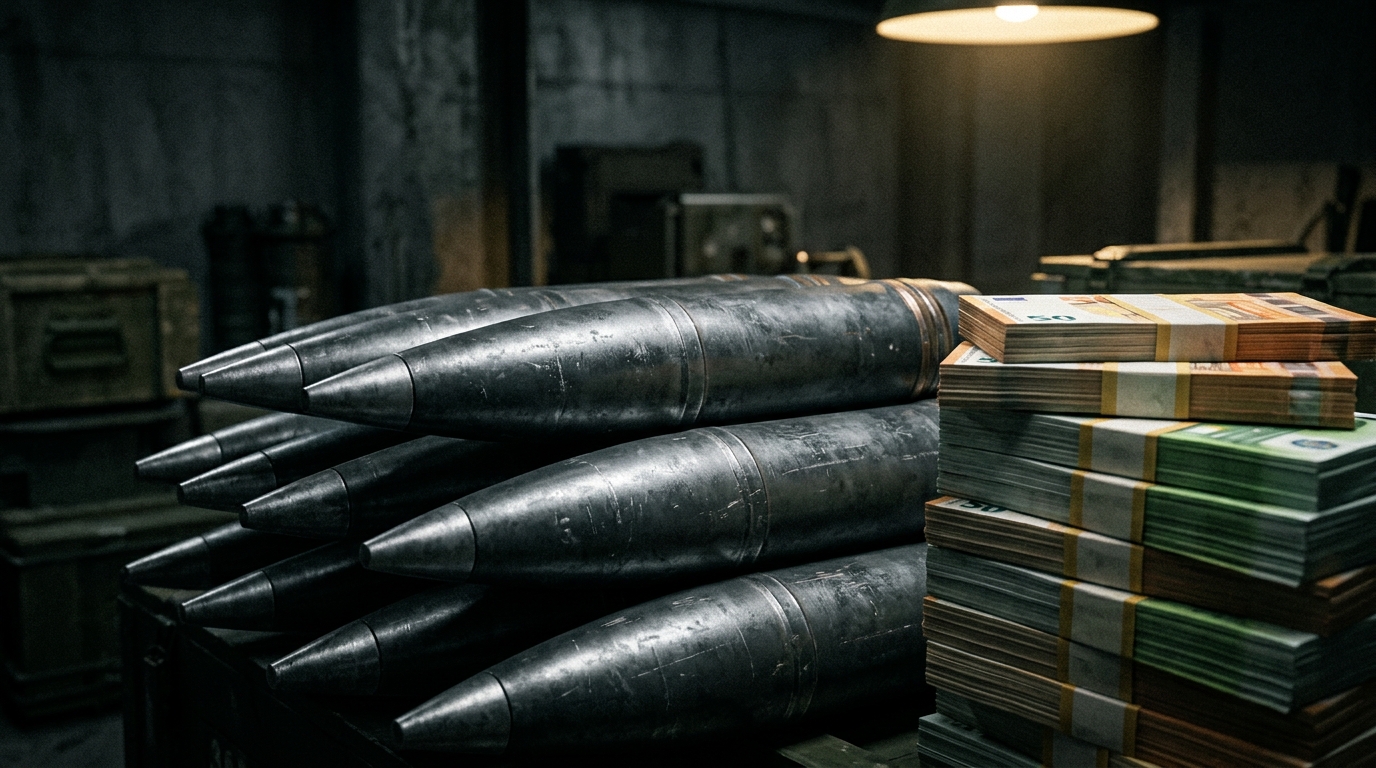
How can a country cut off from the world, unable to feed its own population adequately, display the fastest economic growth in eight years? The answer lies in a word Pyongyang dares not utter publicly: war. While tanks blaze in the Ukrainian plains, North Korea is reaping the dividends of a conflict it has never officially joined, yet feeds with shells, with soldiers, and with a complicit silence. A chilling paradox that the Bank of Korea’s figures bluntly illuminate today.
North Korea Has Found Its El Dorado in the Ruins of Ukraine
The data published by the Bank of Korea are unequivocal: the North Korean economy jumped 3.7% in 2024, its strongest pace in eight years. A figure that confirms a trend begun the previous year, with growth of 3.1% in 2023, after a 0.2% contraction in 2022. This spectacular rebound is no statistical accident: it coincides very precisely with the intensification of military ties between Pyongyang and Moscow. The sectors driving this growth leave no doubt about their nature. The heavy chemical industry, boosted by the production of metal components destined for export, rose by 10.7%, a record for the sector. Construction, for its part, surged by 12.3%, driven in particular by the development of transport infrastructure and the arrival of Russian tourists. The mining and manufacturing sectors are not far behind, with increases of 8.8% and 7% respectively. In other words, North Korea’s productive apparatus is running at full tilt for one single destination: the Russian front.
Munitions Against Oil: the Barter That Saved Pyongyang from Economic Drowning
Official North Korean trade, by contrast, tells a very different story, almost anecdotal by comparison. The total volume of recorded exchanges fell by 2.6% to stand at only $2.7 billion in 2024, a level still below the pre-pandemic era. On paper, official exports rise by 10.8% to reach $360 million, but they are mainly driven by items as surprising as wigs and watches, two goods that evade international sanctions. In 2025, these same exports would rise another 30%, with the addition of feathers, toys and sporting goods to the trade basket. A tableau almost comic if one ignored what lies behind it: according to estimates by the South Korean Institute for National Security Strategy, North Korea would have earned between $7.7 and $14 billion between August 2023 and December 2025, thanks to troop deployments and supplying arms to Russia. These sums, rarely paid in cash, take the form of sensitive military technologies, food and energy, all vital resources for a regime historically choked by sanctions. Relative to a gross domestic product estimated at $25 billion, these parallel revenues would account for up to 56% of the national economy, a figure that is dizzying and that explains, by itself, most of the growth reported.
Moscow, a Captive Client: Why Russia Had No Choice But to Pay a Heavy Price
This large-scale barter is nothing like a friendly gesture between two isolated regimes. It primarily answers a pressing military necessity for Moscow, whose ammunition stocks have been markedly depleted since the conflict began. Faced with a Russian defense industry unable to keep up with the consumption of a front stuck in attrition warfare, North Korea has established itself as an indispensable supplier, possessing arsenals inherited from the Cold War and an active production capacity. This balance of power explains why Pyongyang could negotiate terms far beyond occasional deliveries. The most tangible proof of this opportunistic alliance is currently taking shape at their shared border: a road bridge, barely nineteen kilometers long, is under construction according to observations by the Ukrainian organization Truth Hounds. Far from merely a civil infrastructure project, the structure is described as a true logistical artery designed to facilitate the transport of troops and military equipment between the two territories. A concrete symbol, if one can call it that, of the sturdiness of a route that neither sanctions nor international pressure have managed to shake.
An Alliance That Redraws the Balance of Power in Asia and Threatens the Global Nuclear Equilibrium
Behind these macroeconomic figures lies a human reality that growth cannot obscure. The gross national income per capita in North Korea was capped at $1,239 in 2024, a mere 3.4% of the level seen in neighboring South Korea, where the indicator exceeds $50,000. The Bank of Korea itself notes that a substantial portion of the population continues to suffer from malnutrition, a stark observation when contrasted with the billions generated by arms exports. This dissonance perfectly illustrates the nature of the North Korean regime, where wealth produced by bloodshed elsewhere never trickles down to civilians. But the stakes extend far beyond humanitarian concerns. In exchange for its military shipments, Pyongyang would also gain access to sensitive technologies, notably in space and nuclear domains—a transfer of know-how that seriously worries regional security analysts. This unprecedented proximity between the two capitals thus reshapes the geopolitics of Northeast Asia, further isolating South Korea and Japan, while granting a regime once marginalized a strategic legitimacy it had not known since the end of the Cold War.
Ultimately, this North Korean growth tells less of an economic success story than of a well-oiled machine in which the suffering of some nourishes the wealth of others. While heavy chemical plants operate at full capacity and bridges rise at the border with Russia, the North Korean population continues to await the fruits of a prosperity that is never meant for them. The question remains broader than the North Korean case: how many regimes around the world today turn distant conflicts into real economic opportunities, disregarding any humanitarian considerations?
Sources: Bank of Korea via Zonebourse/Reuters, 29 August 2025 — AFP/Noovo.info, July 2026 — TradingEconomics, BOK data
