
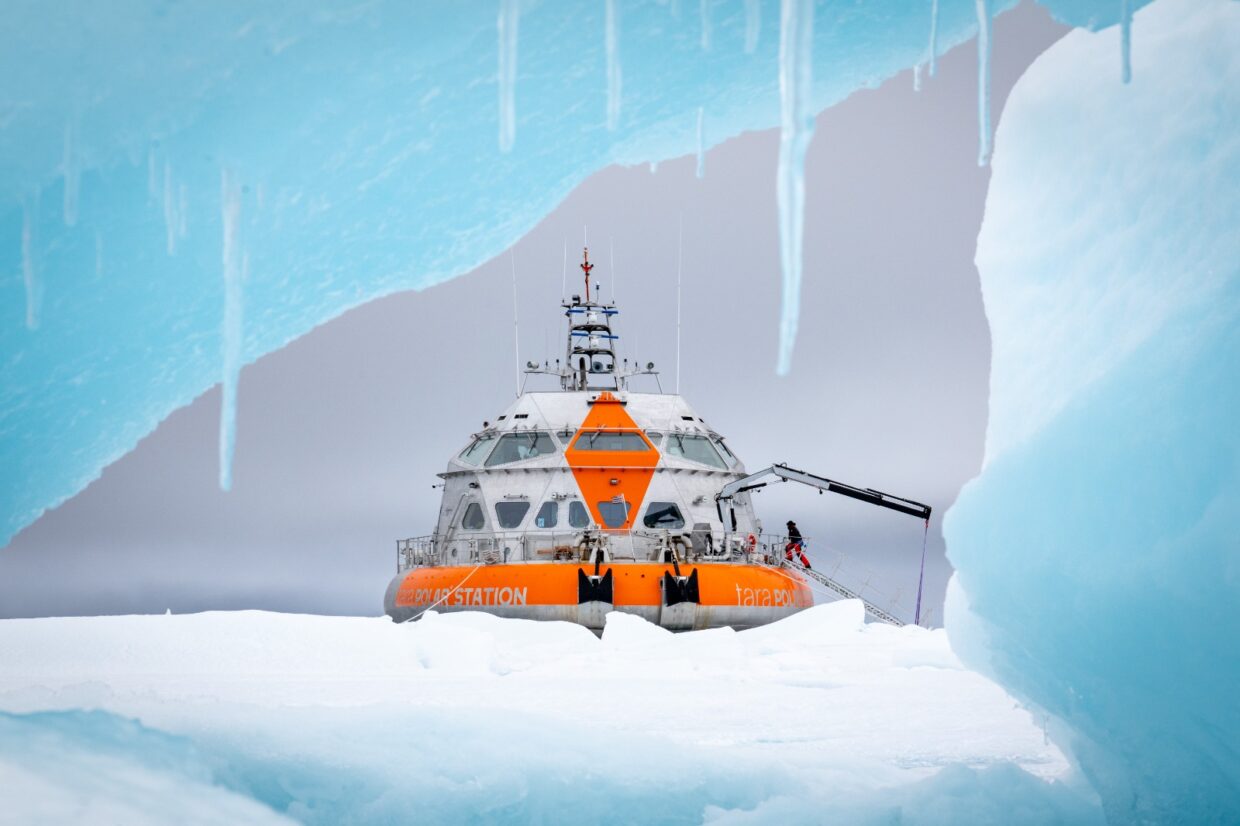
A true masterpiece of French naval engineering, the Tara Polar Station stands as a scientific laboratory designed to drift across the Arctic Ocean. It has just begun a program comprising about ten scientific missions over a span of two decades. What does the first expedition of this program entail?
The Start of Twenty Years of Research
Designed by naval architect Olivier Petit, the Tara Polar Station is managed by the Tara Ocean Foundation. It is in fact a vessel measuring 26 m in length and 16 m in width, with a dry mass of roughly 250 tonnes. The concept emerged in 2014, but its industrial development began in 2023, with an inauguration scheduled for April 24, 2025. Subsequently, several tests have taken place, including a first one-month drift in the Arctic to validate the systems, or a first wintering in real icy conditions in Finland.
On July 19, 2026, the Tara Polar Station set off from Lorient, as part of the Tara Polaris I expedition. As explained on the project’s official page, this mission marks the start of a two-decade observational program (through 2045) in the central Arctic Ocean. It is worth noting that this region is almost inaccessible in winter and also largely invisible to most satellites.
Currently, the vessel is heading toward Norway for a transfer voyage of about a month, in order to load the final heavy scientific equipment. Afterwards, it will position itself strategically off the coast of Russia to allow itself to be deliberately trapped by the pack ice, in September. For a year, the station will be blocked 90% of the time and during the remaining 10% will drift with the currents across the central Arctic Ocean to the Fram Strait, between Svalbard and Greenland.
What is the objective of this first expedition?
In practice, the Tara Polaris I expedition has four major objectives. The first will be to explore the polar unknown, i.e., to continuously study marine life during the long polar night—roughly six months—to understand how life can endure the cold and total darkness. The second objective will be to analyze the unique biological and genomic mechanisms that viruses, bacteria, and the ice‑pack microbiome develop to withstand these harsh conditions.
The expedition will also aim to assess pollution impacts. Indeed, while it will quantify the effects of accelerated ice melt, the central task will be to measure the ubiquity of new chemical pollutants and plastics reaching the North Pole via the various ocean currents. Researchers will also work on identifying new molecules and/or novel biological processes that can be exploited in the medical or biotechnological fields — cutting‑edge bioprospecting.
What equipment does the station carry?
The Tara Polar Station features a “Moon Pool,” a vertical shaft that traverses the hull to a depth of up to three meters. This setup enables the safe immersion of sensors and divers in the face of surface ice and the ice thickness. Also notable is the central geode, an insulated structure housing broad, thermally resistant glass, which crowns the vessel and provides a 360° view to monitor ice movements. It is also worth noting that the station benefits from hybrid propulsion, using a Hydrotreated Vegetable Oil (HVO) biofuel, solar panels, a wind turbine, and smart batteries.
Regarding the crewmate life autonomy—12 people in winter and 18 in summer—the station houses a desalination plant capable of producing 300 litres of potable water per hour. Finally, communications are ensured by the European high‑speed satellite network OneWeb, whose coverage became global in 2023.
