
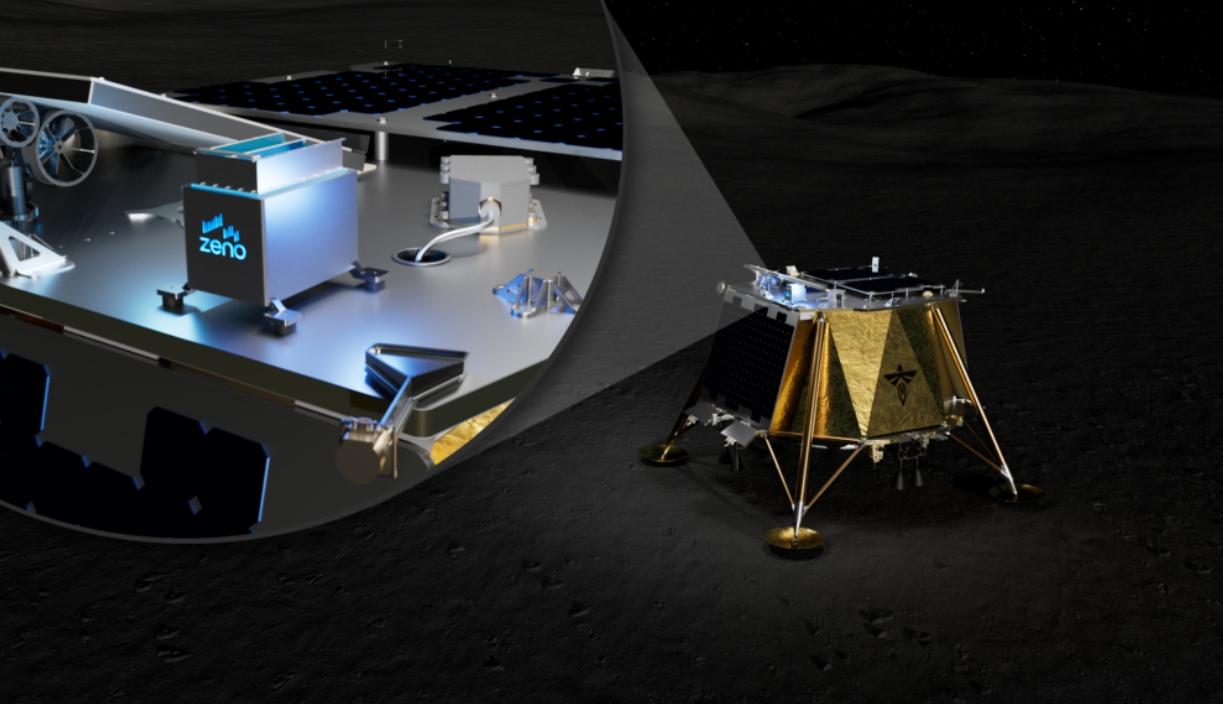
In a very near future, Firefly Aerospace will launch a nuclear heating system to the Moon. On the celestial body, nights are so long and so cold that the integrity of solar-powered batteries and electronic components is compromised. The small thermal unit discussed here embeds a particular radioactive isotope: americium-241, a component offering greater longevity and more affordable costs.
A system to ‘survive the night’
First, let us recall that NASA is currently developing Moon Base, its project for a permanent lunar base at the Moon’s south pole, which officially replaced, in March 2026, the initial idea of an orbital station (Lunar Gateway). The agency plans a permanent human installation as early as the 2030s but, unsurprisingly, still has to tackle numerous challenges. Among these, there is the night. Indeed, a night on the Moon lasts about 14 Earth days, with extreme temperatures plunging below -170 °C.
Unfortunately, this cold destroys the batteries and electronic components of machines whose power depends solely on solar panels. Building on this observation, Firefly Aerospace formalized a partnership with Zeno Power Systems, as revealed in a press release published on August 19, 2026. The objective is the design of a nuclear heating system named Survive-the-Night, which should be shipped to the Moon no earlier than 2028, aboard the Blue Ghost lander.
« A hardware capable of withstanding the extreme cold of the lunar night will be essential to enable continuous operations on the Moon.», said Tyler Bernstein, CEO and co-founder of Zeno Power Systems.
On D-Day, Blue Ghost will land on the visible face of the Moon and will operate its conventional payloads using solar energy, notably for NASA’s Commercial Lunar Payload Services (CLPS) program. When the 14-day night falls, the Survive-the-Night system will take over in order to keep the lander’s vital equipment warm, while transmitting telemetry data back to Earth.
Americium-241 plutôt que le plutonium-238
Le système intègrera un petit générateur de chaleur à radio-isotopes (RHU) de 5 watts. Ce dernier fonctionnera avec de l’Americium-241 (Am-241), un isotope radioactif issu du recyclage de combustibles nucléaires usagés. Comme l’explique Firefly Aerospace, sa désintégration naturelle génère de la chaleur en continu, sans dépendre du Soleil. Par ailleurs, il s’agit ici d’une véritable rupture stratégique, puisque le carburant historique de la NASA est le plutonium-238 (Pu-238).
Ces deux éléments fonctionnent selon le même principe, à savoir la production de chaleur par désintégration radioactive naturelle. Toutefois, ils répondent à des logiques industrielles et scientifiques bien différentes. Avec le Pu-238 – notamment utilisé pour les sondes Voyager et le rover Perseverance – la NASA recherchait la puissance. En revanche, l’Am-241 se distingue plutôt par sa stabilité et sa longévité, puisque sa demi-vie dépasse les 430 ans contre moins de 90 ans pour le Pu-238.
D’autres raisons vont dans le sens de l’Am-241, notamment son coût. Il faut dire que, comme le Pu-238 ne se trouve pas dans la nature, il doit être fabriqué à l’aide de réacteurs nucléaires militaires spécifiques. Or, la plupart de ces réacteurs ont été fermés après la Guerre froide, de sorte que la NASA dispose de stocks très limités. Autrement dit, l’Am-241 coûte cinq fois moins cher que le Pu-238.
