
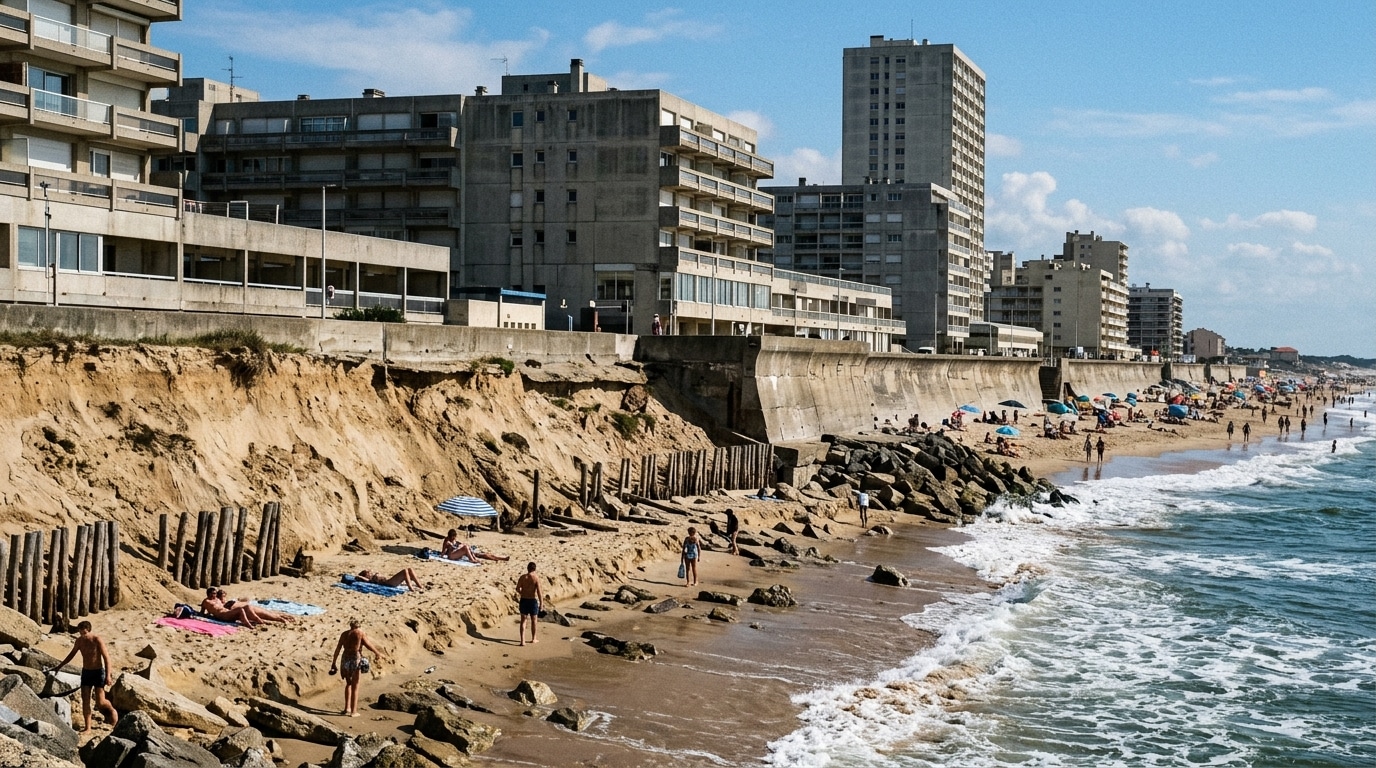
Sand may seem the most ordinary resource imaginable. Just go to the beach, plunge your hand into the soil to pick up kilograms, and one is quick to imagine that there is an inexhaustible reserve. Yet this impression of abundance is misleading. Right now, as the last summer visitors still enjoy the coast, a quiet reality is becoming evident to scientists: we are consuming this tiny grain at a furious pace, much faster than it can reform. And to build our cities, our roads and our buildings, we draw directly from the soil that protects our shores. Each year, around 200 million tonnes of sand are torn from our beaches and dunes. The result is striking: we are accelerating, with our own hands, the disappearance of the shores we cherish.
The most consumed resource after water, and yet invisible
We all have in mind the image of water as a vital and threatened resource. But few people know that sand comes just after, ranking second among the most-used substances on the planet. Each year, humanity swallows nearly 50 billion tonnes of sand and gravel. To picture this invisible mountain, imagine a wall 27 meters wide and 27 meters high encircling the Earth. That is what we extract year after year, almost without thinking about it.
This paradox is fascinating: sand is everywhere, yet its extraction remains completely absent from our daily concerns. It hides in the concrete of our apartments, in the glass of our windows, in the asphalt of our roads. The United Nations today sounds the alarm, because we take it faster than it can be replenished. In other words, sand has become a non-renewable resource, on par with oil. And that changes everything.
Why not all sand is equal for a concrete mixer
At this stage, an obvious objection seems clear: why not simply draw from the vast deserts of the world? The Sahara alone holds astronomical quantities of sand. The answer lies in a subtle aspect of physics. Desert sand, shaped by wind for millennia, is too fine, too rounded, and too smooth. Its grains, polished like marbles, do not cling to one another. Impossible, therefore, to produce a solid concrete from it.
Concrete, on the contrary, requires angular, rough sand, capable of interlocking to form a strong paste. This precious material is found mainly in rivers, seabeds and beaches. That is why pressure concentrates on these fragile environments. And since the majority of this sand is used to make cement, whose production accounts for about 8% of global greenhouse gas emissions, the ecological bill is doubled by a climate bill.
When the beach disappears, the whole coast collapses
A beach is not merely a strip of sand for towels and parasols. It is a natural rampart, a shield that absorbs the energy of waves and protects the hinterland from storms. Removing this sand means taking away the first line of defense of the coastline. The consequences are brutal: accelerated erosion, salinization of freshwater aquifers, the disappearance of entire habitats. In Indonesia, 24 islands have already been erased from the map, and hundreds more are threatened with submergence.
There is no need to travel to the other side of the world to observe the phenomenon. In France, at Noirmoutier, some beaches have lost more than one meter of width in fifteen years. To attempt to stem the retreat, 145,000 cubic meters of sand had to be dumped, for a bill of 1.5 million euros. A costly bandage on a wound that keeps reopening. Elsewhere, demand has fueled illegal supply chains, notably along the Moroccan coast, and fed regional tensions, such as around Singapore’s expansion onto the sea.
Rebuilding without devouring the coastline: emerging pathways
Faced with this reality, the first recommendation is clear: to outright ban sand extraction from beaches, given their essential role in coastal resilience, the environment, and the tourism economy. But banning alone is not enough if demand continues to burn. It is therefore necessary to rethink our way of building.
Several avenues are emerging today. Recycling demolition rubble would allow recovering part of the sand already used, rather than drawing new material. Alternative materials, such as industrial ash or certain recovered wastes, are beginning to replace a fraction of the sand in concrete. Finally, a more radical route consists simply in building less and better, prioritizing renovation over demolition. All these levers, used together, could relieve the pressure on our shores.
Sand, that grain we let slip between our fingers without thinking, is becoming one of the century’s quiet but major challenges. We have built our cities by drawing from the soil that protects our coasts, and the resource is depleting faster than it can reform. The next time you walk barefoot on a beach, remember that this sand is at once a treasure and a shield. Perhaps the real question is this: are we ready to change our way of building before our shores slip away from under our feet?
