
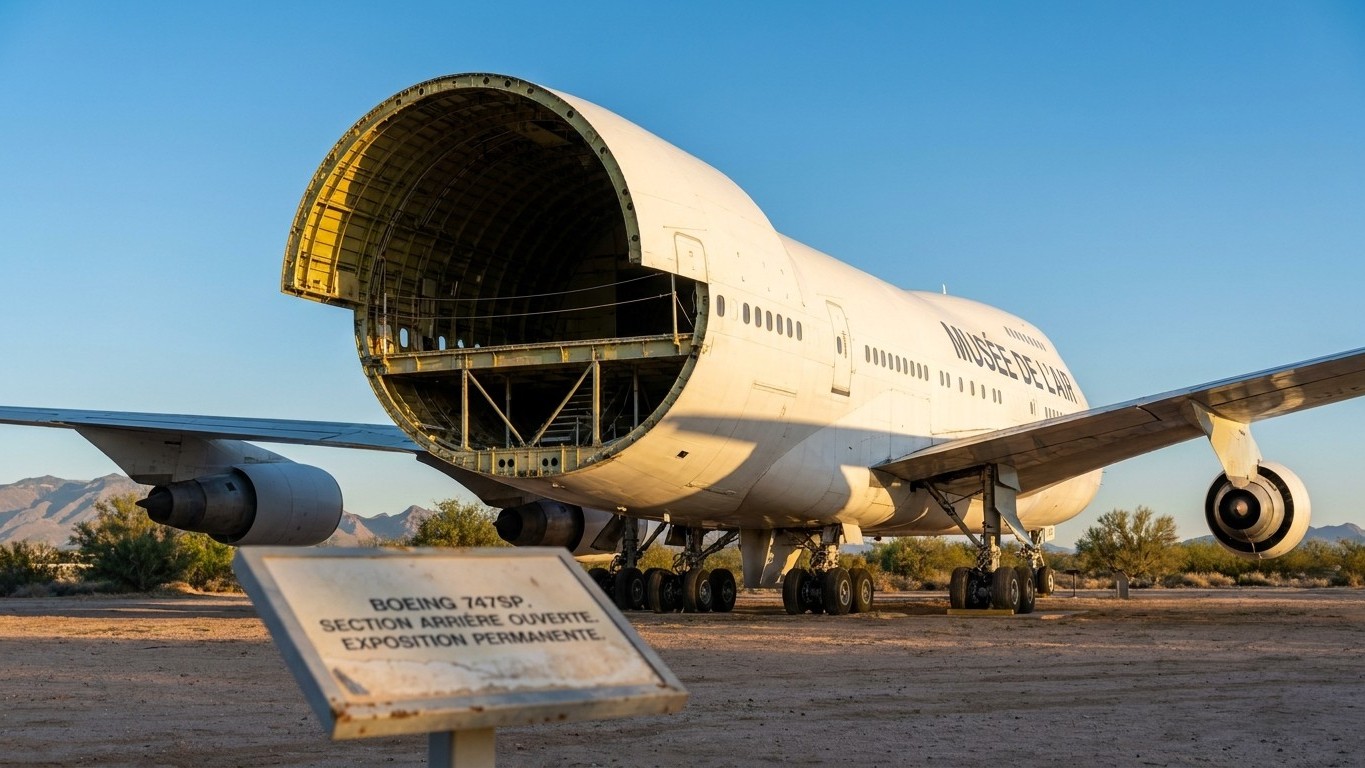
Since the end of 2022, a stationary Boeing 747 waits for visitors on the tarmac of the Pima Air & Space Museum in Tucson. There is nothing trivial about its silhouette: on the left rear flank of the fuselage, a 5.5‑meter‑high aperture gapes as if suspended in mid‑flight. This is not a fault or an accident. It is the mark of one of the boldest scientific experiments ever conducted aboard a commercial airliner: SOFIA, the Stratospheric Observatory for Infrared Astronomy.
The aircraft, a Boeing 747SP registered N747NA, is no ordinary recycled airliner. After almost two decades of commercial service with Pan Am and then United, it spent eight years carrying out scientific missions for NASA and the German space agency DLR. The program, launched in 1996, took fourteen years to take off in earnest: it first saw the light in 2010 and achieved full operational capability in 2014. The principle was a feat of pure engineering. A 2.7‑meter telescope, weighing more than 17 tons according to NASA’s figures, was installed inside the fuselage, behind a hatch that could open in flight without destabilizing the aircraft.
Key takeaways
- A commercial airliner transformed into a flying telescope to observe the universe invisible to ground-based instruments
- Why NASA sacrificed 900 exceptional scientific missions for budgetary reasons
- The 5.5‑meter scar that tells eight years of engineering feats and astronomical discoveries
Flying Above Water Vapor to See the Invisible
Why convert a passenger aircraft into a flying observatory instead of building a telescope on the ground? The answer hinges on a single word: water vapor. It soaks up a large portion of infrared radiation before it can reach the surface, effectively blinding most ground‑based telescopes to this kind of observation. SOFIA’s solution was to climb very high, cruising between about 12,000 and 13,000 meters, well above the usual commercial air routes. By soaring through the stratosphere, the aircraft managed to rise above 99.9% of the water vapor in Earth’s atmosphere—the very substance that typically obstructs infrared observations from the surface.
In practical terms, once at cruising altitude, the giant hatch opened to expose the telescope to the stars, the planets, and distant galaxies. The pilots running these flights recalled that you could not tell whether the door was open, in transition, or closed from the cockpit, and that opening it below 35,000 feet was simply out of the question. A dizzying detail: hours of flight with a cavity the size of a small building open to the void, with the crew unable to verify it in any way other than via instruments. Yet the scientific results were far from trivial. Observations of the Moon, planets, stars, star‑forming regions, and nearby galaxies notably led to the discovery of water on the sunlit surface of the Moon in 2020, a finding that sent shockwaves through the astronomical community, in addition to detecting galactic magnetic fields and a primordial ion, helium hydride.
$85 Million Per Year, the Bill That Changed Everything
Flying high comes at a steep price. SOFIA consumed about $85 million annually, making it the second‑largest operating budget in NASA’s astrophysics program, surpassed only by the Hubble Space Telescope. It is a sum that is hard to defend when compared with the scientific output of the program. Between 2014 and 2020, SOFIA flights yielded 178 scientific publications, compared with more than 2,700 for Hubble and Chandra over the same period. The gap was enough to raise eyebrows among anyone responsible for funding space science.
It was this imbalance that sealed the fate of the aircraft. The 2020 Decadal Survey on Astronomy and Astrophysics, the key reference for prioritizing American astronomical research, judged that SOFIA’s scientific productivity did not justify its operating costs. NASA and its German partner followed that judgment to the letter. Some mission investigators argued the situation had changed: SOFIA had increased its flight hours and doubled its annual publication rate between 2019 and 2022, a productivity surge they believed the report had not adequately captured. But the decision had already been made. SOFIA was scheduled to end operations no later than September 30, 2022, at the end of its final mission extension. In practice, the aircraft concluded its operations on September 29, marking eight years of scientific flights and more than 900 sorties above continents.
From the Palmdale Hangar to the Tucson Museum
What should be done with such a singular aircraft once its mission ends? NASA followed the standard process for disposing of excess government property, and the choice landed on a logical site: Arizona already hosts one of the world’s largest aircraft boneyards, at Davis-Monthan, just next to the Pima Air & Space Museum. The plane made its final flight, from NASA’s Armstrong Flight Research Center in Palmdale, California, to Tucson, on December 13, 2022.
Since then, SOFIA has rested on the tarmac of this museum, which comprises six hangars, 80 hectares of outdoor displays, and more than 425 aircraft from around the world, plus its own workshop to restore incoming airframes. The 5.5‑meter hatch remains visible, open or pried ajar as required by display needs, a deliberate scar rather than a hidden detail. That is precisely the point of keeping it exposed: it narrates, more effectively than any plaque, what this aircraft was and what it accomplished during eight years of service.
The paradox deserves highlighting: SOFIA was designed for a twenty‑year lifespan, and its cessation after just eight years of operational service remains a topic of debate within the astrophysical community. Some researchers continue publishing analyses drawn from the mission’s data archives, proof that questions about its true productivity may not be fully settled even three years after its final flight to Arizona.
Sources: vintageaviationnews.com | upi.com
