
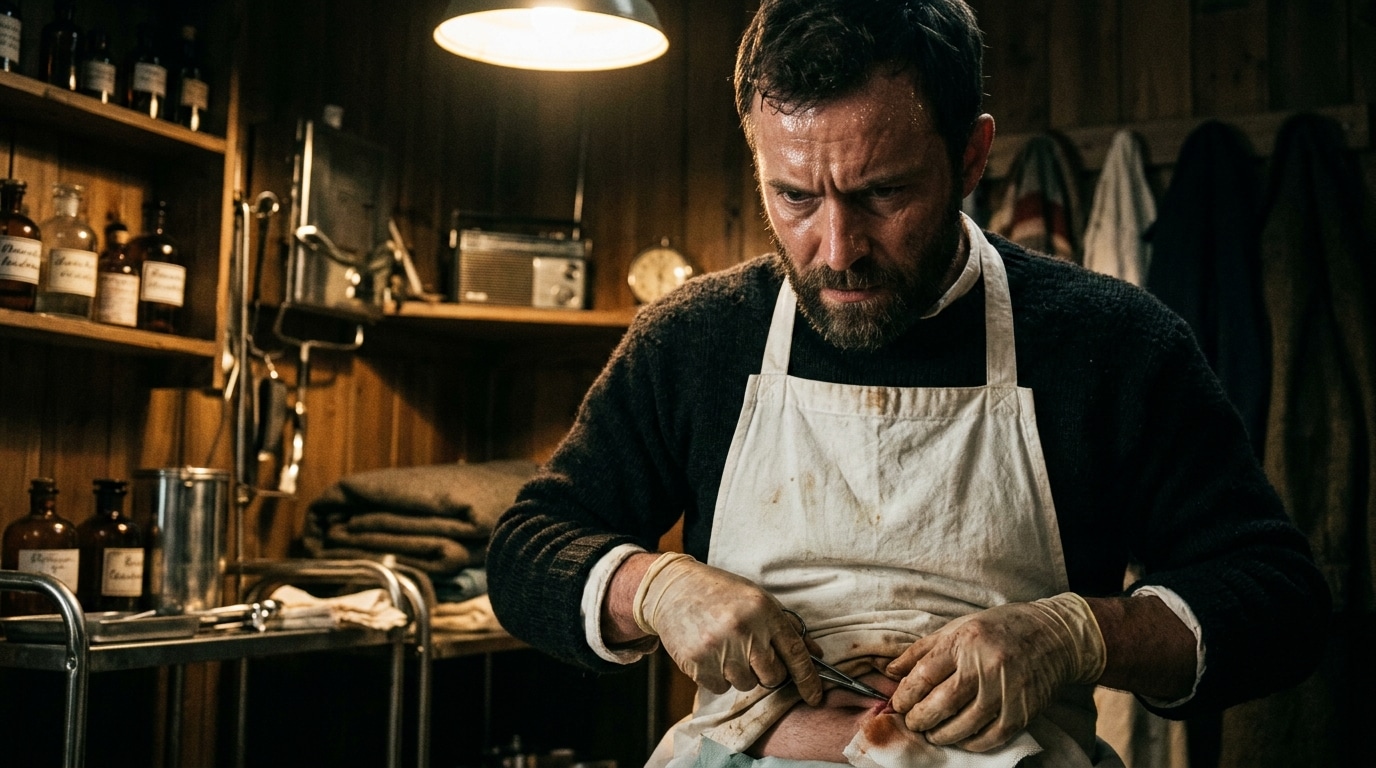
What would you do if your body betrayed you far from civilization, thousands of kilometers from the nearest hospital, with no possibility of help? This is the grim, real nightmare that a young Soviet surgeon lived through in the early 1960s, isolated on the planet’s most hostile continent. As Antarctica closed in on him like a trap of ice, this man understood that he could rely on only one person to save him: himself. What he then decided to undertake, in the deafening silence of the polar night, straddles despair and a courage almost unimaginable. A story that, even today, leaves people stunned.
A Polar Night, a Burning Stomach, and No Way Out
We are in the spring of 1961, but in Antarctica that word means nothing. At the Soviet base Novolazarevskaya, austral winter sets in and traps twelve men in a landscape of endless white. Around them, raging snowstorms render navigation impossible: no ship will come, no plane will take off before the season’s end. The base is cut off from the world, isolated like a space station perched on the ice.
It is within this frozen confinement that Leonid Rogozov, a surgeon of barely 27, begins to feel a dull ache in his lower abdomen. Fever, nausea, weakness: the symptoms do not deceive this experienced doctor. He is suffering from acute appendicitis. In any city, the matter would be settled in a few hours by a routine operation. Here, at the heart of the white desert, this ordinary illness becomes a death sentence deferred.
When the Only Doctor Becomes His Own Patient
Rogozov’s tragedy rests on one sentence: he was the expedition’s sole medical professional. No one around him knew how to wield a scalpel. No one could operate. And an untreated appendicitis leads to peritonitis, a widespread infection that, without intervention, almost always ends in death. The countdown had begun, and the surgeon knew it better than anyone.
In his journal, he offers a chillingly lucid reflection: “It seems I have appendicitis. I keep quiet, I even smile. Why frighten my friends? Who could be useful?” These few words encapsulate the burden he carried. Facing the impossibility of awaiting rescue and with his condition rapidly worsening, Rogozov understood that there was only one option, terrifying as it was. He would have to operate on himself.
The Unthinkable Gesture: Cutting Open One’s Own Body to Survive
That night, the surgeon’s room was transformed into a makeshift operating theatre. Two tables, a bed, and ultraviolet lighting designed to destroy as many pathogens as possible formed the entire stage. Rogozov gathered two improvised assistants: mechanical engineer Teplinski held a mirror to reflect the image of his own abdomen, while meteorologist Artemiev handed him the instruments. A ragtag team for a procedure that no one had ever dared to attempt.
Around two o’clock in the morning, after administering local anesthesia with novocaine, Rogozov began to open his own abdomen. The operation lasted nearly two hours. The surgeon worked largely with his eyes, guided by the reflection in the mirror, and sometimes by the mere sensation of his hands in his own flesh. After thirty to forty minutes, weakness and dizziness overwhelmed him: he was forced to grant himself short five-to-ten-second breaks every five minutes simply to avoid fainting. Despite nausea and exhaustion, he persisted until the final suture was placed.
What Rogozov Changed for All Explorers After Him
Most astonishing is what followed. Rogozov removed his own stitches, took antibiotics, and fifteen days after the operation, he was back to work. His feat quickly rippled through the Soviet Union, where he became a national hero. He was even compared to Gagarin, who had just accomplished the first human orbit. Two feats, one aimed at the stars, the other at the limits of the human body.
Beyond the legend, this episode had very real consequences. The Soviet government reformed safety policies for all personnel stationed at Antarctic bases, so that such a tragedy could never happen again. Other nations adopted even more radical measures: in Australia, for example, doctors slated to overwinter on the white continent now undergo a preventive appendectomy before departure. A precaution that might seem absurd elsewhere, but which makes perfect sense in one of the world’s most inaccessible places.
Leonid Rogozov passed away at the age of 66 from lung cancer, leaving behind a story that continues to fascinate. His act reminds us of how far human will and composure can push the boundaries when every other option is closed. At a moment when we dream of sending crews to Mars, in even more extreme isolation, one question remains: would we be ready, like him, to become our own last resort?
