
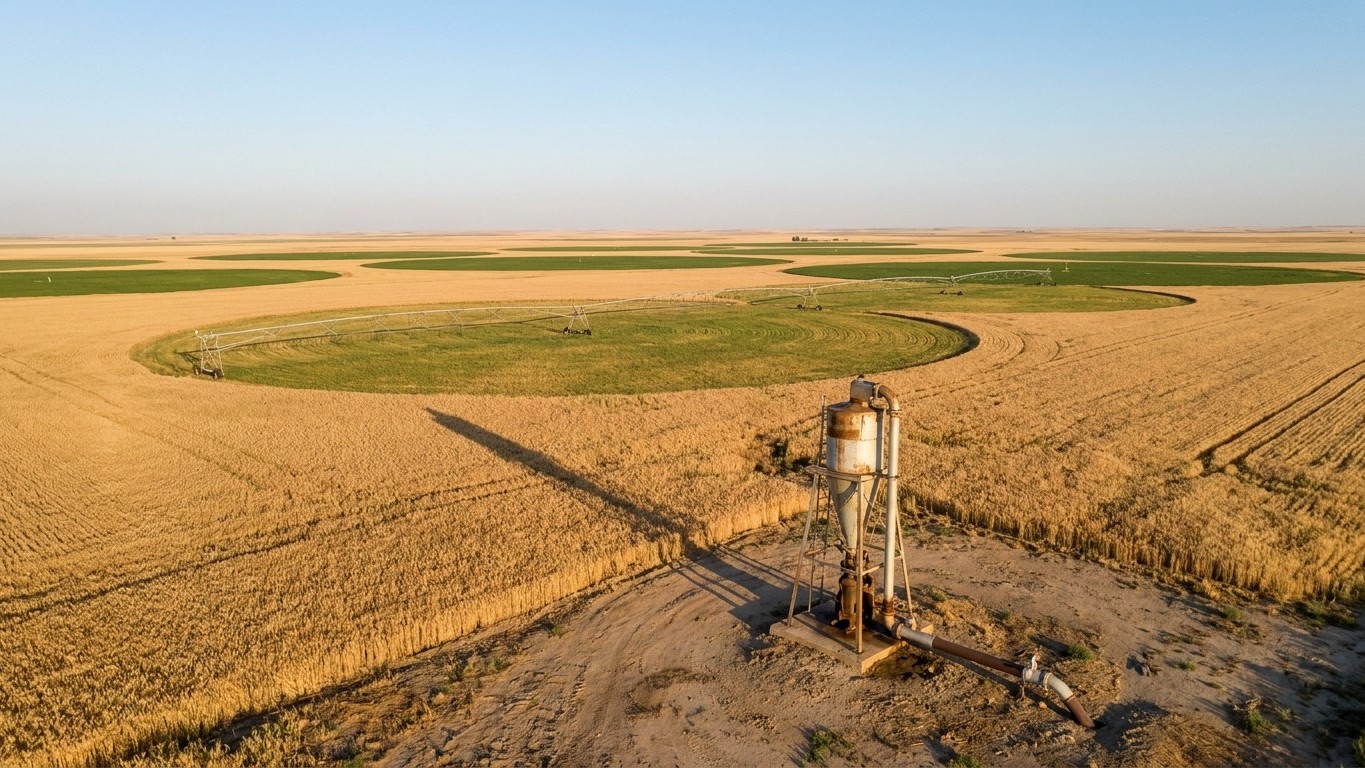
Under the wheat fields of Kansas, the cotton fields of Texas, and the prairies of Nebraska, a vast underground water reservoir has been losing ground for more than seventy years. The High Plains aquifer, better known as the Ogallala, spans eight U.S. states and supplies about 30% of the country’s irrigation water. Since the onset of large-scale pumping in the 1950s, its level has fallen by an average of five meters, but in some parts of the Texas Panhandle and western Kansas the decline exceeds 70 meters. Some wells have gone dry. Lands that were once irrigated are returning to dry farming, because there is no water to pump.
Key takeaways
- Since 1950, a giant water reserve has collapsed beneath eight American states
- Some wells have lost more than 80 meters in depth over seven decades
- Irrigated lands are reverting to dry land farming, with no return possible for millennia
An underground ocean retreating state by state
The aquifer itself isn’t a recent geological myth: it is a formation of sand and gravel laid down millions of years ago by the erosion of the Rocky Mountains. According to the US Geological Survey, the High Plains aquifer covers 111.8 million acres, or about 175,000 square miles, across eight states: Colorado, Kansas, Nebraska, New Mexico, Oklahoma, South Dakota, Texas, and Wyoming. It is a surface roughly the size of all of Spain, saturated with freshwater, and it stands as the country’s largest underground reservoir.
The benchmark report on the topic, Scientific Investigations Report 2023-5143 published by the USGS, provides a stark assessment for the period from before development, around 1950, to 2019. Water-level changes, measured from well to well, ranged from a rise of 86 feet to a fall of 265 feet; for 99% of wells, the range was a rise of 42 feet to a fall of 203 feet. In meters, this means some measurement points saw their water table drop by more than 80 meters since the mid-20th century. Averaged across the entire aquifer, the overall decline was 16.5 feet from pre-development to 2019, with a slight rebound of 0.1 foot between 2017 and 2019, equating to about five meters lost in just under seven decades, a figure that hides enormous regional disparities.
Because the average masks extreme cases. A well near Lubbock, Texas, saw its level fall by more than 76 meters between 1950 and 2013. In Texas County, Oklahoma, water levels have dropped by more than 70 feet since pre-development, compared with more than 50 feet in Cimarron County, a difference experts attribute directly to the density of irrigation wells. The deeper you go south, the more severe the drawdown becomes: an USGS hydrologist summarized this observation by noting that the general trend is that the depletion of the Ogallala aquifer worsens as one moves south.
Why the water nearly never recharges
The mechanism is brutally simple. In the arid southern stretches of the aquifer, the rain that does fall evaporates before it can reach the groundwater. As summarized in a report from Oklahoma State University, the Ogallala aquifer in this region has a very low recharge rate, meaning very little precipitation actually reaches the underground waters. The result: every drop pumped to irrigate corn or cotton is almost never replaced. We are dealing with a fossil stock, accumulated over millennia, that is consumed like a bank account with no deposits.
The storage figures confirm the scale of the drawdown. The recoverable water stored in the aquifer in 2019 was about 2.91 billion acre-feet, a decline of roughly 286.4 million acre-feet since pre-development. This lost volume, if poured into a lake, would submerge the Massachusetts coastline several times over by meters of water, a reminder that this is not a minor decline but a true historic draught.
In Kansas, dependence on this resource is staggering: the Ogallala supplies between 70% and 80% of the water residents use daily. A report commissioned by the state legislature already worried about the situation seven decades ago. Yet, despite this early warning, the state has since only made pumping water easier, according to a water-law professor at Washburn University. The most recent measures, taken in January 2025 by the Kansas Geological Survey, show that the decline continues: water levels in the southwestern management zone dipped by 1.52 feet between January 2024 and January 2025, a drop more pronounced than in the previous year.
Lands reverting to dryland farming
The retreat is already a reality for many farmers. Some parts of the Texas Panhandle and southwestern Kansas can no longer be pumped: the water table has retreated too far, or the saturated thickness has become too thin to feed irrigation pivots. The affected lands revert to dryland farming, agriculture that relies solely on rainfall, with yields significantly lower. In the Texas Panhandle, 2025 measurements show the saturated thickness averaging down to only a few tens of feet in some monitored districts, a warning sign for farmers who still depend on pumping.
In the face of this downward slope, responses remain timid. Some local districts limit new drills, others experiment with quotas or water-saving crops. But the north-south comparison of the aquifer is telling: in Nebraska and parts of South Dakota and Wyoming, where natural recharge is better and agricultural demand is lower, the levels hold steady or even rise slightly. It is the southern portion of the Ogallala, the most intensively irrigated since the 1950s, that bears the brunt of the bill. A well that dries up today in Lubbock County will not recharge in the lifetime of anyone living today: this geological timescale, out of sync with the rhythms of farming seasons, makes reversing the situation difficult to an extraordinary degree.
Sources: extension.okstate.edu | ngwa.org
