
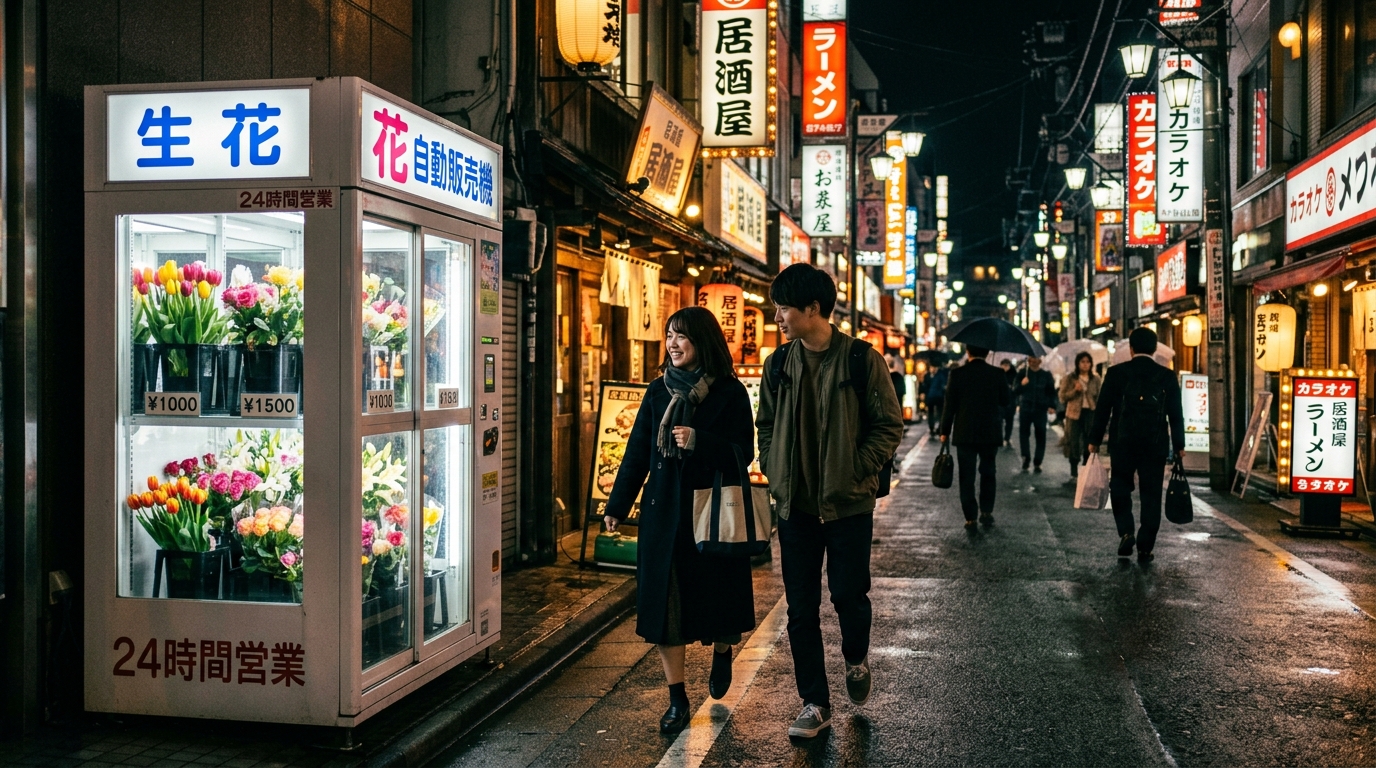
People often confuse vending machines with beverage machines, as if the two terms described the same thing. Yet in Japan, these devices constitute a category all their own, far broader than the simple can of soda or bag of chips familiar in France. It is amusing to note that the Japanese archipelago has pushed the concept in directions few would have imagined. Cut flowers, edible crickets, emergency umbrellas: Japan has transformed a common object into a genuine cultural institution, to the point that you can even find them at the summit of Mount Fuji. How could a simple coin-operated mechanism become so central to Japanese life? The story deserves attention, for it crosses centuries and continents before arriving at its most refined form on the archipelago.
We thought we knew Japanese vending machines: the reality goes far beyond beverages
When people think of Japanese vending machines, the image that comes to mind is rows of hot and cold drinks lined up along the sidewalks of Tokyo. This image isn’t false, but it is exceedingly incomplete. According to David Widjaja, a former industry insider and now owner of Japantogo LLC, a Ishikawa-based company that exports Japanese machines, the reality of this market far surpasses Western imagination.
In Japan, one can buy hot bowls of ramen, farm eggs, bouquets of fresh flowers, or even umbrellas in case of sudden rain, directly from a machine installed in a post office, a train station, or a public park. This diversity illustrates the scale of the vending machine market in Japan.
Hero of Alexandria, the forgotten inventor of the first vending machine
The history of the vending machine does not begin in the twentieth century, nor even in America, but in ancient Egypt, nearly two thousand years ago. It is to Hero of Alexandria, a Greek engineer of the first century AD, that the earliest device of this kind owes its origin. His invention wasn’t commercial: it served to distribute holy water in temples, using a clever counterweight lever activated by the weight of a coin deposited by the devotee.
The principle is remarkably simple: a coin falls, activates a mechanism, and releases a precise quantity of liquid. Surprisingly, this concept disappears for almost eighteen centuries, before resurfacing at the end of the nineteenth century on London’s railway platforms, where coin-operated machines distributed postcards, envelopes, and writing paper to hurried travelers.
From New York gum to the Nippon obsession: an unexpected history
It is ultimately across the Atlantic that the vending machine would truly democratize. As early as 1888, the Thomas Adams Gum Company installed machines dispensing Tutti-Frutti chewing gum along New York’s transit lines. The idea quickly caught on, and the products offered expanded over the decades: cartons of milk, refrigerated sandwiches, and then all kinds of goods tailored to urban lifestyles.
But it was in Japan that the concept would experience its true explosion. After World War II, during the country’s rapid postwar economic recovery, the vending machine became a central element of Japanese culture. According to Widjaja, this massive adoption can be largely explained by a well-identified cultural trait: the Japanese are often pressed for time and prefer to obtain a product instantly rather than waiting four to five minutes in a traditional store. This craving for immediacy created a fertile ground for the proliferation of these machines across the archipelago.
Crickets, fresh flowers, and umbrellas: the world’s most improbable catalog
What truly distinguishes Japanese vending machines is the astonishing diversity of their catalog. Far from being limited to beverages and snacks, they offer products that would surprise any visitor from France. Among the most striking examples:
- Edible crickets, ready to eat
- Fresh flower bouquets, for a last-minute gift
- Hot ramen bowls, served in seconds
- Umbrellas, indispensable in case of sudden rain
- Farm eggs, directly sourced from local farms
These machines are not confined to densely populated urban areas. They are found in parks, post offices, train stations, and even at the summit of Mount Fuji. Technically, each vending machine rests on an embedded computer system featuring a microcontroller—a tiny brain that manages selection, payment, and the distribution of the chosen product.
One machine for 45 inhabitants: what this obsession reveals about Japan
The numbers are staggering. Japan today counts more than 2.6 million vending machines for a population of roughly 122 million inhabitants. That amounts to one machine for about 45 to 50 people, a ratio without parallel elsewhere in the world. To grasp the magnitude, picture this ratio spread across the entire Japanese archipelago.
This exceptional density, according to Widjaja, reflects a lifestyle in which people, often in a hurry, prioritize speed and accessibility over waiting in a traditional shop. The Japanese vending machine has become far more than a simple sales tool: it embodies a distinct concept of efficiency, pushed to its most surprising extremes—whether it’s quenching an urgent craving for hot ramen or offering a bouquet of flowers without detouring through a florist.
From temples in Egypt distributing holy water to Tokyo sidewalks offering crickets and umbrellas, the vending machine has traced a path as long as it has been unlikely. What began as an ingenious mechanism to dispense holy water in temples has, in Japan, become a symbol of a society that has made immediacy a way of life. So, the next time you drop a coin into a coffee machine, perhaps you’ll think of this remarkable story, and of a country where you can find fresh flowers just as readily as a steaming bowl of ramen.
