
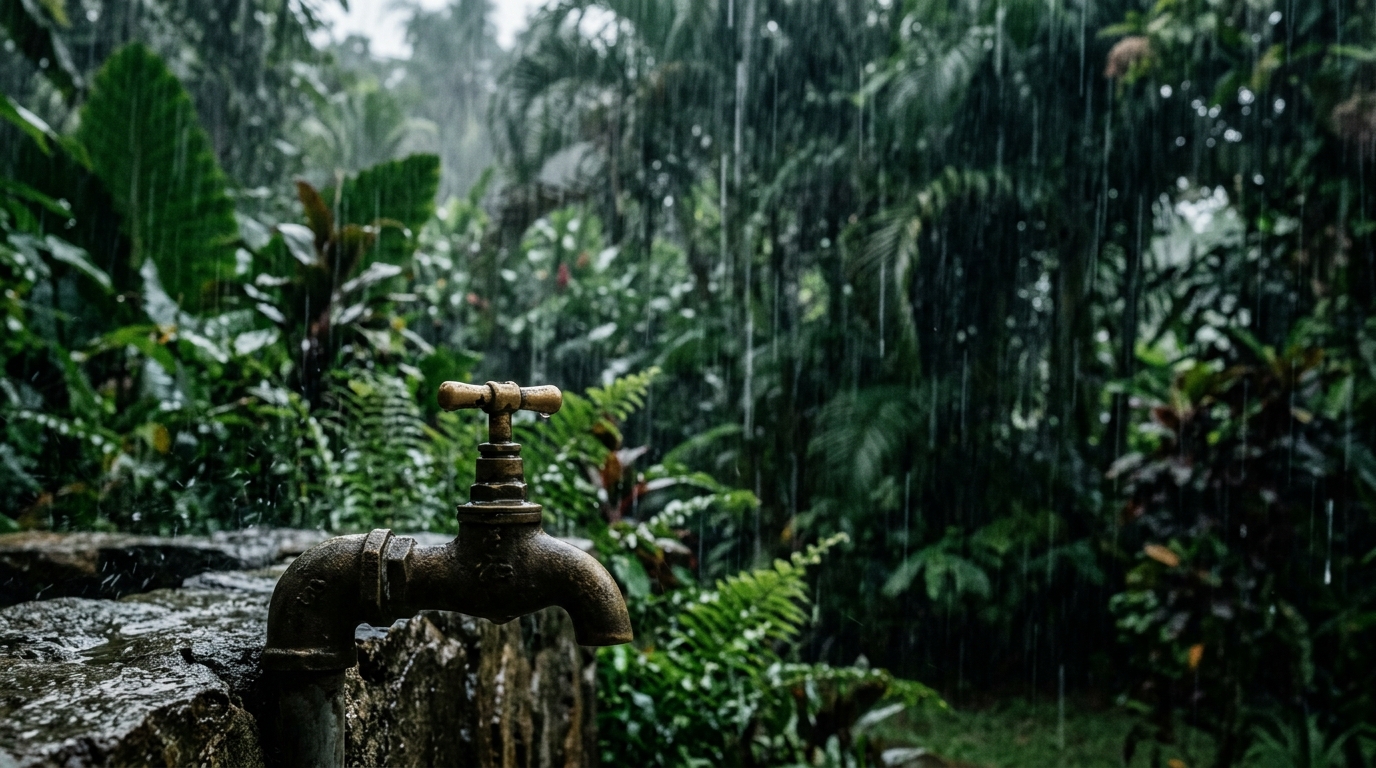
Two meters of rainfall a year, lush vegetation all year round, rivers that rush down the slopes of Mont Pelée: on paper, Martinique should be one of the best endowed territories for fresh water in the Caribbean region. And yet, in late summer 2026, while the island is in its rainy season, thousands of households in the Fort-de-France metropolitan area continue to live to the rhythm of rolling water outages. How can a rain-soaked territory wind up dry? The answer, documented in black and white by the regional chamber of accounts, has nothing to do with the weather. It lies in leaky pipes, accounts that don’t hold up, and a management that the financial magistrates themselves describe as insincere.
In Martinique, rain falls but the tap stays dry
It is a paradox Martiniquans know better than anyone. While the sky pours its downpours characteristic of the wet season, a period running from July to November, entire districts of the Communauté d’agglomération du centre de la Martinique, the CACEM, find themselves without a drop at the tap. Fort-de-France, Le Lamentin, Schœlcher, Saint-Joseph: these communes, nonetheless at the heart of the island the rainiest of the Petite Antilles, have seen rolling outages multiply in recent years, including in the middle of the wet season, making the situation even more puzzling for residents.
These outages are not an isolated phenomenon. Since the start of 2024, alerts have followed one another: dozens of breaks on the network in the first months alone, up to 43 neighborhoods of Saint-Joseph deprived of water simultaneously in January of that year. A prefectural drought alert had even been triggered in spring 2024, even though aquifers and rivers were not empty. And the story repeated itself in the summer of 2026, with the relaunch of rolling outages during a period of network strain, proof that the problem is not purely cyclical.
A tropical paradox: two meters of rain per year and chronic water outages
To measure the absurdity of the situation, one must compare Martinique with other regions of the world. Two meters of annual rainfall is roughly four times what a city like Paris receives. The island has perennial rivers, high-altitude sources, and a climate that hardly ever experiences a prolonged drought in the strict sense. On paper, the supply of drinking water should therefore be one of the least pressing concerns for local authorities.
Except that the abundant resource is useless if it does not reach the tap. This is where the snag lies: between the source and the home, water traverses a complex chain of actors and infrastructures. Production is provided by treatment plants managed by a private operator, while distribution in the central agglomeration falls to the public utility Odyssi, which purchases this water already treated before distributing it to users. An arrangement that, on paper, seems coherent, but has proven to be a fertile ground for financial tensions and technical dysfunctions.
The real culprit isn’t the sky, but century-old pipes
The Martinique regional audit court (Chambre régionale des comptes) issued, at the end of October 2025, a particularly harsh budget advisory against the Odyssi utility. Seized by the prefect of Martinique in May 2025 after a preliminary budget deemed non-compliant, the CRC found that the 2025 accounts were simply not voted in real balance. The verdict is unequivocal: a deficit of €15.7 million for the drinking water budget alone, to which more than €1 million is added for wastewater.
The most troubling aspect of this affair is the way in which this deficit had been camouflaged. According to the financial magistrates, the budget displayed an apparent balance, built on subsidies with no legal basis and revenues that were hypothetical, backed by a dispute that had not even been settled. The CGTM and CDMT unions, as well as the new president of the utility, Daniel Chomet, had refused to vote for this budget as early as April 2025, denouncing the inclusion of a sum of €18 million deemed insincere, corresponding to a CACEM subsidy and an alleged damage related to wholesale water purchases. The CRC even speaks of a utility out of control, a finding made after the departure in December 2024 of the president who had led the institution for nearly twenty years. Poorly understood debt, overstated revenues, weak collection, rising payroll: the portrait drawn is that of a management adrift, far from just climate considerations.
When more than half of drinking water disappears before reaching the tap
Beyond budgetary figures, it is the network itself that poses the problem. A substantial portion of produced water is lost along the way, victims of leaks in aging pipelines laid down several decades ago. On certain sections of the network serving the island’s south, a structural shortfall in supply of 25% had already been measured a few years earlier, illustrating the scale of the silent waste affecting the entire territory.
Daniel Chomet, the current president of the utility, has himself pointed to what he calls water theft, i.e., commercial and technical losses that escape the operator’s control entirely. Added to that is a strained commercial relationship between Odyssi and the water producer, accused of reselling its resource at a price deemed excessive, with yield figures themselves contested. The result: water that costs a lot to produce, that largely disappears into porous pipes, and that ends up in short supply precisely during peak demand, particularly in the summer.
Artificial drought: what the Martiniquan crisis reveals about water in France
The Martiniquan situation is not an isolated case in the national landscape. In early July 2026, the European Commission opened an infringement procedure against France, notably targeting several Martiniquan agglomerations for non-compliance with wastewater treatment. This European action arrives precisely as the regional chamber of accounts had just uncovered a massive budget imbalance, as if the two issues were echoing one another.
The CRC gave the utility one month to adopt a corrective deliberation, a deadline deemed insufficiently respected since a second opinion confirmed the same gaps. In the absence of sufficient correction, the prefect of Martinique now has the option, provided by the Code général des collectivités territoriales, to halt the utility’s budget himself. This prospect illustrates how the crisis goes beyond local concerns to challenge the governance of water in overseas territories, and more broadly how France maintains, or neglects, vital infrastructures.
This Martiniquan case reminds us of a basic truth too often forgotten: the issue of drinking water is never just about the abundance of natural resources. It depends first and foremost on the sturdiness of the infrastructure, on the rigor of financial management, and on the ability of communities to invest in maintaining their networks. While rain continues to fall on Martinique’s hills, the real drought plays out elsewhere, in the pages of a poorly crafted budget and in pipes that leak daily, depriving residents of a precious resource when they need it most. The question remains whether this crisis will finally act as a catalyst to rethink water management sustainably, in Martinique as in other territories facing similar fragilities.
