
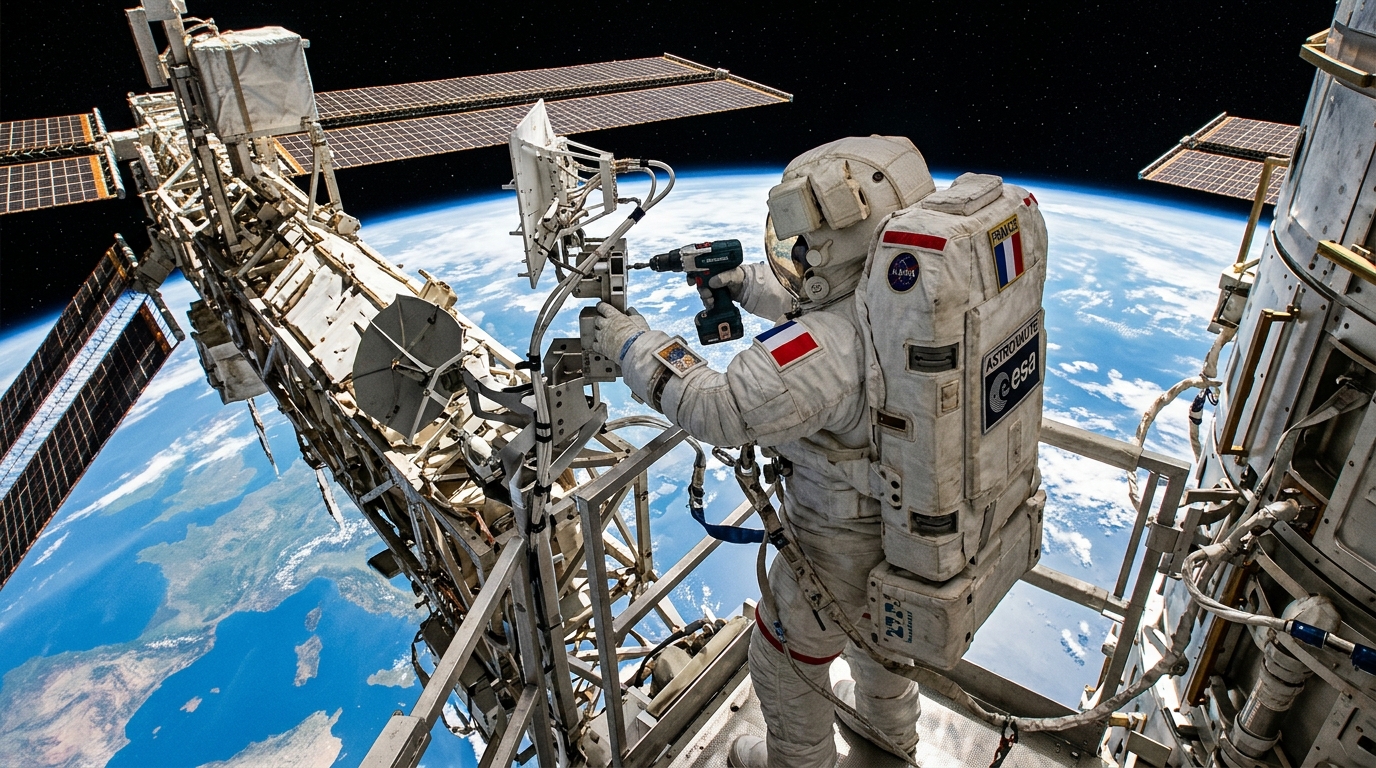
Six hours and twenty-three minutes. That was the time it took for two astronauts to perform a repair outside the International Space Station, suspended in the vacuum more than 400 kilometers above our heads. A remarkable technical feat, but it hides a far less flattering reality: the person who accomplished this feat wore clothing that was never designed for her in the first place. This summer, when one might think space engineering has long since solved the issue of equipment adaptability, a simple clothing detail reminds us that space still preserves blind spots inherited from an era when women did not have a place there.
A six-hour EVA reveals an invisible flaw
This summer, Sophie Adenot became the first Frenchwoman to perform an extravehicular activity, alongside American astronaut Anil Menon. The operation, which began at 14:29 CEST as the suits switched to autonomous life support, stretched to nearly six and a half hours, with the two astronauts leaving the Quest module of the International Space Station to carry out their mission. A performance rightly celebrated, since Sophie Adenot also becomes the second European woman to undertake such an EVA in space.
But behind the feat hides a detail that would have gone unnoticed if one hadn’t paid attention: the suit she wore was not originally sized for a female morphology. A finding that raises questions, at a time when one might assume that every piece of equipment sent into orbit has been calibrated to fit any human body—man or woman. The reality is more nuanced, and this EVA reminds us that the history of space conquest remains marked by old technical choices, difficult to correct once fixed in the hardware.
The spacesuit, a garment designed for a single body
To understand what a spacesuit worn outside the ISS actually is, you must first look beyond a simple reinforced garment. Far from being merely a protective outfit, it acts as its own spacecraft: it provides the oxygen needed for breathing, ensures thermal regulation in an environment of extreme temperature variations, and maintains a vital pressure essential for survival. The life-support architectures developed by NASA are designed to enable spacewalks lasting up to eight hours, with comfortable safety margins, which gives a sense of the complexity of these systems.
The problem is that these suits come in a limited number of sizes, and their initial design heavily relied on standard male templates. The result: when a female astronaut has a slimmer morphology or different proportions, she must contend with equipment that wasn’t conceived for her from the start. It’s not so much a question of comfort as of safety and the efficiency of movement in an environment where every gesture counts.
Why space has long overlooked half of humanity
This issue is far from new. During a March 2019 EVA, NASA had to urgently revise the planned crew composition. Astronaut Anne McClain discovered that the suit size that would best fit her existed in only a single copy aboard the station, initially assigned to her colleague Christina Koch. A logistical hiccup that provoked a public controversy over the insufficient availability of suits adapted to female morphologies on the ISS.
This episode illustrates a broader problem: for decades, space programs were designed by and for men, in a context where women were largely absent from astronaut corps. Technical standards, available sizes, safety protocols—all bore the imprint of an era when including diverse morphologies was rarely considered. It took until women began to join space programs in sizable numbers for these blind spots to begin, timidly, to be corrected.
What this EVA changes for future astronauts
Sophie Adenot’s feat marks a significant symbolic milestone for France, but it is also part of a longer history. Before her, Claudie Haigneré had opened the path for French astronauts, becoming in 1996 the first Frenchwoman to travel into space, aboard the Mir station. Thirty years later, a new generation of French women is stepping into ever more demanding missions, and this extravehicular outing serves as a reminder that every advance comes with its own technical limits inherited from the past.
Such situations, far from being anecdotal, push space agencies to progressively rethink the design of their equipment. One can imagine that future generations of spacesuits, currently being developed for lunar and Martian missions, will take greater account of body diversity from the drawing board, rather than having to cobble things together later with a limited stock. A question that, as women take on a growing share of crews, cannot be treated as a mere logistical detail anymore.
Ultimately, this EVA tells two stories in one: that of an undeniable technical and human achievement, and that of a space industry still catching up on questions of material equality. It remains to be seen how long it will take before wearing a suit that fits becomes, for an astronaut, an everyday certainty rather than an exception.
