
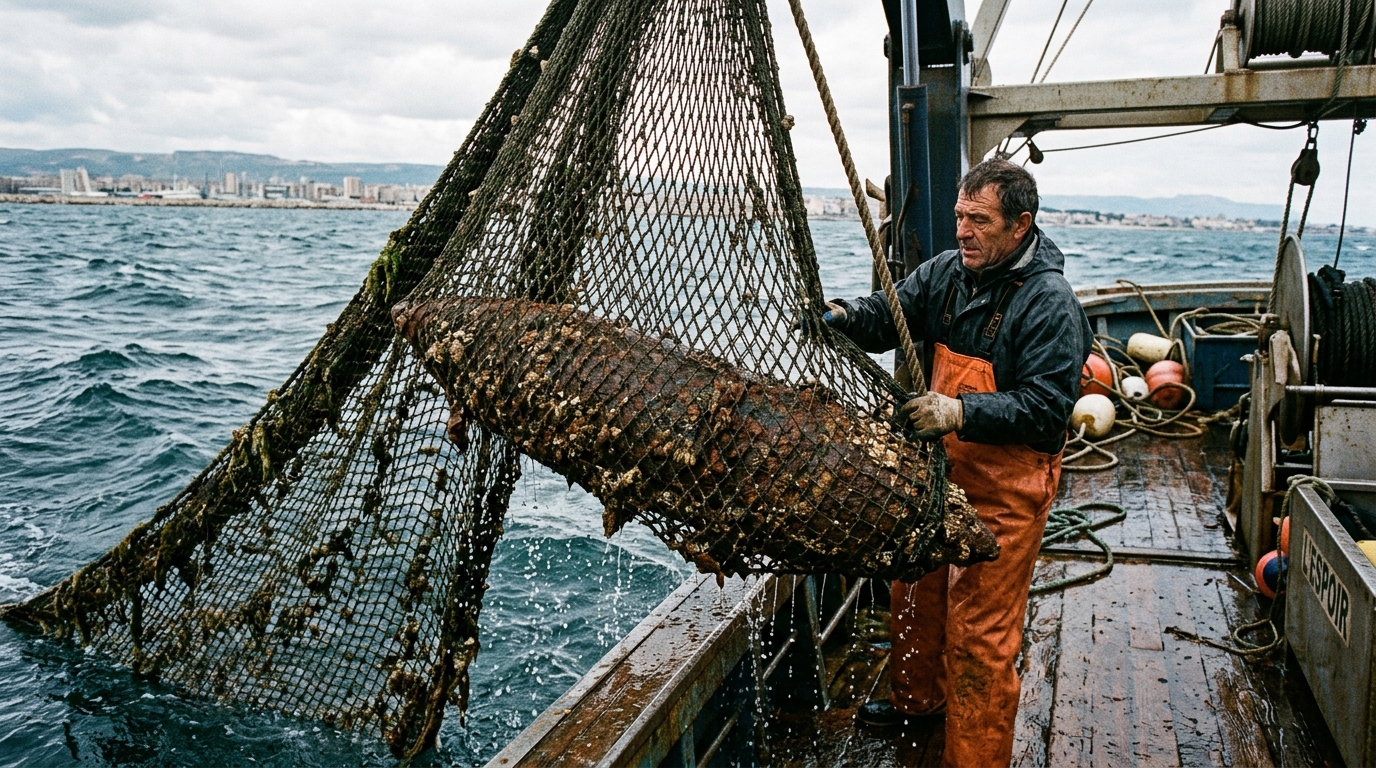
A rusted shell, covered in algae, is slowly hauled up in the meshes of a trawl off the Italian coast. The fisherman who finds it initially sees only old corroded scrap, a piece of debris among others carried by the Adriatic Sea. But a few minutes later, his hands burn as if they had touched acid. This scenario, far from exceptional, has repeated for decades off Bari, where thousands of tonnes of chemical munitions have lain here since the end of World War II. An eighty-year-old military secret, that the sea continues to spit back out patiently, net after net.
A Cemetery of Chemical Weapons That No One Wanted to See
Back to 1943. Bari harbour, then a major strategic hub for Allied forces in the Mediterranean, is struck by a German air raid so violent it will be nicknamed the “Little Pearl Harbor.” Amid the wreckage, doctors discover among the exposed soldiers and civilians injuries they cannot explain: unusual blisters, deep burns that do not correspond to any standard wartime wound. The cause is eventually identified: mustard gas, stored there, discreetly and secretly.
After this episode, and at the end of the conflict in 1945, the Allies are left with massive stockpiles of chemical weapons. Rather than repatriating them or destroying them under controlled conditions, the chosen solution was chillingly simple: to sink them in the sea. Dozens of thousands of tonnes of munitions, of which a large portion were loaded with mustard gas, were dumped overboard off Bari, in a zone that would become, without anyone formally naming it, a vast underwater cemetery of chemical weapons.
The Burn That Resembles No Other
Mustard gas is no discreet poison. It is a vesicant agent, capable of causing severe chemical burns on the skin, eyes, and mucous membranes, even through several layers of clothing. When a fisherman pulls up, unknowingly, a corroded shell in his net, the weakened metal of the shell can crack under handling. The oily liquid that escapes contaminates the water, the ropes, and bare hands that sort the catch.
Victims describe a sensation unlike any ordinary burn: pain can appear belatedly, blisters form gradually, and the lesions heal very slowly, leaving lasting sequelae. This is not an isolated accident confined to Italy. Similar incidents have been documented much farther north, in the Baltic Sea, where Swedish and Polish fishermen have also been burned by mustard gas inadvertently brought back in their nets. The phenomenon is also observed in the Pacific and in certain coastal waters of Japan, evidence that this form of military pollution has never been a merely local anomaly.
Eighty Years Under Water, and the Poison Has Not Disappeared
One might think time would have neutralized this threat. It is quite the opposite. The metal casings of the shells, designed to withstand years of air storage, were never meant to withstand decades of immersion. Salt, pressure, and micro-organisms progressively gnaw at the metal, until corrosion eventually breaches even the oldest munitions. Result: the longer time passes, the greater the risk of leakage, contrary to the intuition that an old danger would fade away.
This slow degradation affects not only humans. Biological anomalies, including tumors, have been observed in some fish living near the most contaminated zones. Congers, in particular, seem regularly exposed to direct contact with corroded munitions lining the seabed, which calls into question the health of an entire ecosystem living in silent contact with this invisible pollution.
A Sea Still Armed, a Risk No One Is Willing to Shoulder
The problem extends far beyond Bari. The European Parliament has itself warned of a similar situation in the Baltic Sea, where at least 50,000 tonnes of chemical and conventional weapons were dumped after World War II, continuing to threaten human health as well as marine ecosystems. The common thread among all these zones is the striking absence of a precise, exhaustive inventory of dumping sites, which greatly complicates informing coastal populations and implementing effective protective measures for fishermen.
In France as well, the issue is beginning to reach the floor of the National Assembly. Recent parliamentary inquiries have pointed to these “time bombs” underwater, reminding that they pose a persistent danger to all sailors who could suffer severe sequelae from mere contact with mustard gas hauled up in nets. At the close of summer, as fishing activity remains steady along the Adriatic coasts, this reminder is far from inconsequential.
Eighty years after the war’s end, the Adriatic Sea has not forgotten what was entrusted to it in a moment of urgency. It continues, season after season, to yield up this buried poison, reminding us with every net hauled that certain decisions made in the rush of a postwar period leave traces far longer than one might imagine. The question remains that transcends Italy: how many similar zones, scattered across the globe, remain to be identified before a future fisherman unknowingly bears the price of a war he did not know?
