
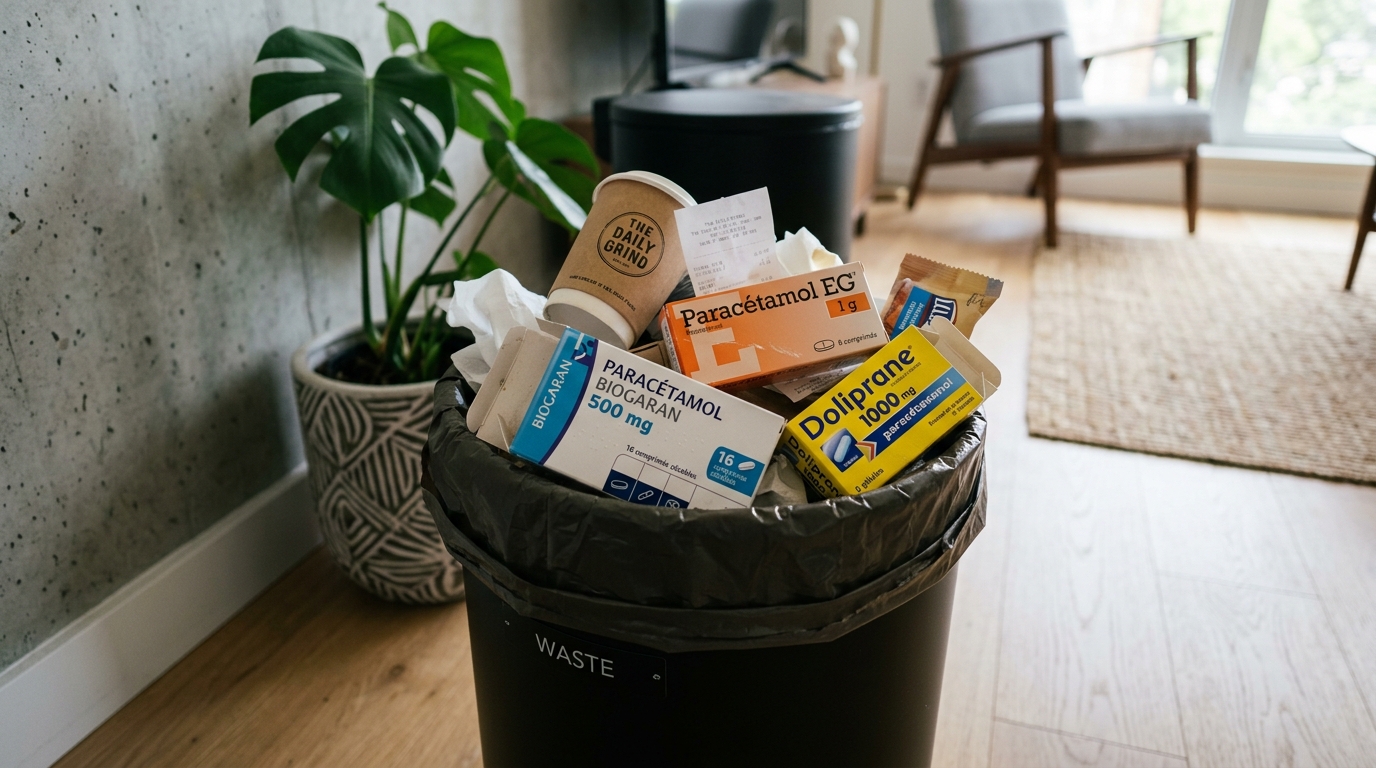
Saving a few euros while avoiding throwing away medicines that are still perfectly effective is a simple gesture that many people still ignore. Each year, tons of boxes of paracetamol, syrups or eye drops end up in the trash, or worse, down the toilet, simply because the date printed on the packaging has expired by a few days. Yet, in pharmacies, some pharmacists keep their own treatments well after this expiration date, without any particular fear. This gap between official guidance and everyday practices deserves attention, especially during back-to-school season when we often reorganize our medicine cabinet.
This date that scares us is not what we think
The expiry date printed on medication boxes is not a danger date, but a guarantee of effectiveness. Pharmaceutical laboratories test the stability of their products over a defined period, often two to three years, and commit only to that period. After this time, it does not mean the medicine becomes toxic overnight, but simply that the manufacturer is no longer legally obligated to guarantee its full effectiveness. In reality, numerous stability studies conducted by health authorities, notably in the United States as part of the military stockpiling program, have shown that some medicines remain active well beyond their stated date, sometimes by several years. This nuance completely changes how we should view the contents of a family medicine cabinet. The fear of “expired medicine equals poison” rests more on a precautionary commercial principle than on a systematic scientific reality.
Nevertheless, two distinct notions must be distinguished: efficacy and safety. An expired medicine can progressively lose efficacy without necessarily becoming dangerous. It is precisely this distinction that health professionals know well, and which explains why some of them adapt their personal practices, while strictly adhering to official recommendations when advising their patients.
Paracetamol, ibuprofen, eye drops: what professionals keep (and why)
In practice, some medicines are considered more resistant to time than others. Paracetamol and ibuprofen, in dry tablet form, are among the most stable treatments. Kept in good conditions, away from moisture and heat, they can retain a large part of their activity for several months, even a few years after the indicated date. They are often the only medicines still found in the cabinets of some health professionals well after their official expiration, knowingly.
Eye drops, however, follow a different logic. Once the bottle is opened, the risk is no longer tied to the active molecule itself, but to a possible bacterial contamination. That is why the date to monitor for these products is not the one printed on the outer packaging, but the one indicated after opening, usually four weeks. An unopened eye drop can remain effective for a long time, but once it comes into contact with the eye, its use should be limited in time to avoid any infectious risk.
Conversely, some treatments do not tolerate any deviation. Syrups, liquid forms, reconstituted antibiotics, or therapies with a narrow therapeutic margin like certain anticoagulants must be discarded on the indicated date, without exception. Their chemical composition evolves more quickly, and a loss of efficacy can have real health consequences, especially for essential chronic treatments.
How to adopt the right reflexes without risking your health
Before reproducing at home the habits of some professionals, a few precautions are in order. The first reflex is to observe the medicine’s appearance: a color change, an unusual smell, a modified texture, or tablets that crumble are all alert signals that should lead to discarding the product, whatever the displayed date. Then, storage conditions play a decisive role. A box left in a damp bathroom or exposed to the heat of a radiator will lose its properties much faster than a medicine kept in a dry, tempered place, away from direct light.
It is also essential to keep in mind that this tolerance applies only to certain simple medicines taken occasionally for mild pain or fever. For any chronic treatment, any prescription related to a serious condition, or any doubt about the product’s state, it is better to rely strictly on the expiry date and seek advice from a pharmacist. In France, pharmacies also have specific collection bins allowing unused or expired medicines to be returned so they can be destroyed in environmentally friendly conditions, rather than being dumped in the trash or down the drain.
- Check the appearance, smell, and texture before taking any medicine
- Store medicines in a dry place, away from light and heat
- Note the opening date on eye drops and syrups
- Return unused medicines to the pharmacy
- Never extend the use of expired chronic treatments
These few steps help strike a balance between excessive caution and reasonable common sense, without ever compromising on treatments that require absolute rigor.
Ultimately, the expiry date is not a universal deadline, but an indication that deserves to be interpreted according to the nature of the medicine involved. Paracetamol, ibuprofen, and unopened eye drops can often wait a few more months in the medicine cabinet, while other treatments demand unwavering vigilance. Before sorting through your boxes this autumn, perhaps it is worth taking a closer look at what this famous printed date really hides, rather than relying solely on habit.
