
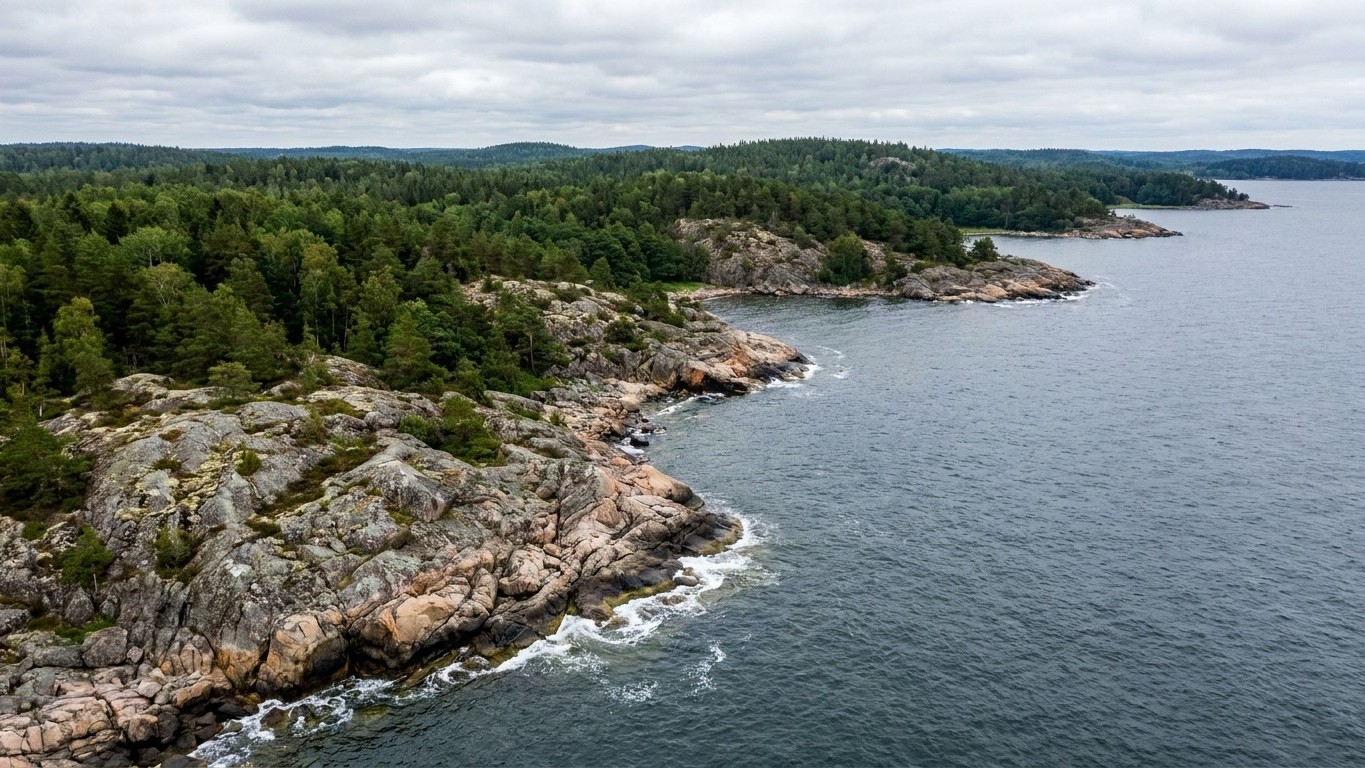
The ground beneath our feet does not move, or so we think. In Scandinavia, that certainty collapses each year by about one centimeter. In the bed of the Gulf of Bothnia, between Sweden and Finland, the Earth’s crust is still rising today, eleven millennia after the enormous ice sheet that pressed it down disappeared. The ocean rises, but in certain parts of northern Sweden and Finland the land rises even faster, with a maximum close to one centimeter per year around the Gulf of Bothnia. Not an image, not an approximation: a movement measured, mapped, and dated to the millimeter.
Key takeaways
- An entire continent moves beneath our feet, but at imperceptible speed
- Whole towns have had to be relocated because of invisible geological movement
- Meanwhile, other regions of Europe are gradually sinking under the sea
A 3,000-Meter Ice Cap That Compressed the Rock
To grasp the scale of the phenomenon, we must go back to the last glacial maximum. Some 20,000 years ago, during the final maximum, the Baltic Sea lay beneath an ice sheet 3,000 meters thick, a weight that pressed the ground down by more than 500 meters. Three kilometers of ice is roughly the height of several copies of the Eiffel Tower stacked one atop another, constantly pressed onto a territory as large as several European countries put together. The Earth’s crust, beneath this colossal mass, behaved like a mattress being pressed at the center: it sank into the viscous mantle that carries it, the asthenosphere.
Then the ice melted, abruptly on the geological scale. The deglaciation unfolded over a few millennia, and the ground, freed from its burden, began to rise. This rebalancing is still not finished. In the heart of Scandinavia, the uplift already accomplished is estimated at 800 meters, and about 200 meters of rebound remain to reach equilibrium. Four-fifths of the journey are completed, one-fifth remains to be done, over several thousand years. The peak of the phenomenon lies along the High Coast of Sweden, where since the final retreat of the glaciers 9,600 years ago the uplift has reached about 285 meters, the largest postglacial isostatic rebound ever observed.
Medieval Ports Left Dry, Islands Appearing
This invisible movement, invisible to the naked eye, has very concrete consequences that Swedes had to confront as far back as the 17th century. Gammelstad, near present-day Luleå, offers the most striking example: it was the main port of Norrbotten in the Middle Ages, until the gradual uplift of the land made its harbor impractical, forcing the town to be relocated closer to the coast in 1649. The original village church, left behind, is today listed as a UNESCO World Heritage site, ten kilometers inland from the sea. A merchant port that became a mere historical curiosity, cut off from the sea by a geological rather than human decision.
Even more striking still: a Stone Age campsite that used to lie at the water’s edge is now 200 kilometers from the Baltic Sea. The shore has literally fled toward the open sea over the centuries, leaving ancient seabeds to become pastures. This process continues to sculpt geography in real time. In the Kvarken Archipelago, between Finland and Sweden, about 700 hectares of new land rise each year from the sea along the coast of the Gulf of Bothnia, a phenomenon particularly visible in this Finnish archipelago. New islands are born, others merge with the coast, and maritime boundaries between neighboring nations must be regularly redrawn to follow this retreat of the sea.
The GPS That Tracks the Millimeter
How do we measure a movement this slow? Through precision geodesy. A network of permanent GPS stations, complemented by absolute gravimetry measurements and tide gauges that have recorded sea level for decades, allows us to monitor the uplift almost in real time. The precise leveling, tide gauges, and continuous GPS stations all provide information on the ongoing postglacial rebound in Fennoscandia, with a reliability generally better than 0.4 mm per year. These measurements converge: the maximum uplift rates in Fennoscandia lie in the Gulf of Bothnia, where current values are on the order of 10 mm per year. A remarkable slowness, but perfectly quantifiable, which also confirms that the pace slows over time: the average was faster several millennia ago than today.
When the North Rises, the South Sinks
What makes the story yet more troubling is its inverse. The weight of the ice did not merely push its center downward: it caused the crust all around to bulge, like a mattress whose edges rise when the middle is pressed. Today, that peripheral bulge is sinking in turn. In Great Britain, a landmark study by Sarah Bradley and colleagues, published in 2009 in the Geophysical Journal International, measured this movement using a network of sixteen GPS stations: the most pronounced uplift occurred in eastern Scotland, reaching 1.07 millimeters per year at Edinburgh, while much of England was sinking, with a maximum rate of 1.20 millimeters per year at Lowestoft. This same bulge that rose sits in the North Sea between Norway and Great Britain, and extends into the northwest of the Netherlands and the north of Germany. Great Britain literally tilts like a board on a fulcrum, with Scotland rising and pulling down the southern part of England, already exposed to coastal flooding.
This European tilt, from the Gulf of Bothnia to the English Fens, reminds us of a simple fact: the ice that disappeared ten millennia ago still writes, every year, a new centimeter of geography. The nautical charts of the Gulf of Bothnia will have to be redrawn several times before the end of the century, while parts of the North Sea coast nibble away at land as the sea rises.
Sources: planet-terre.ens-lyon.fr | je-prepare-mon-voyage.fr
