
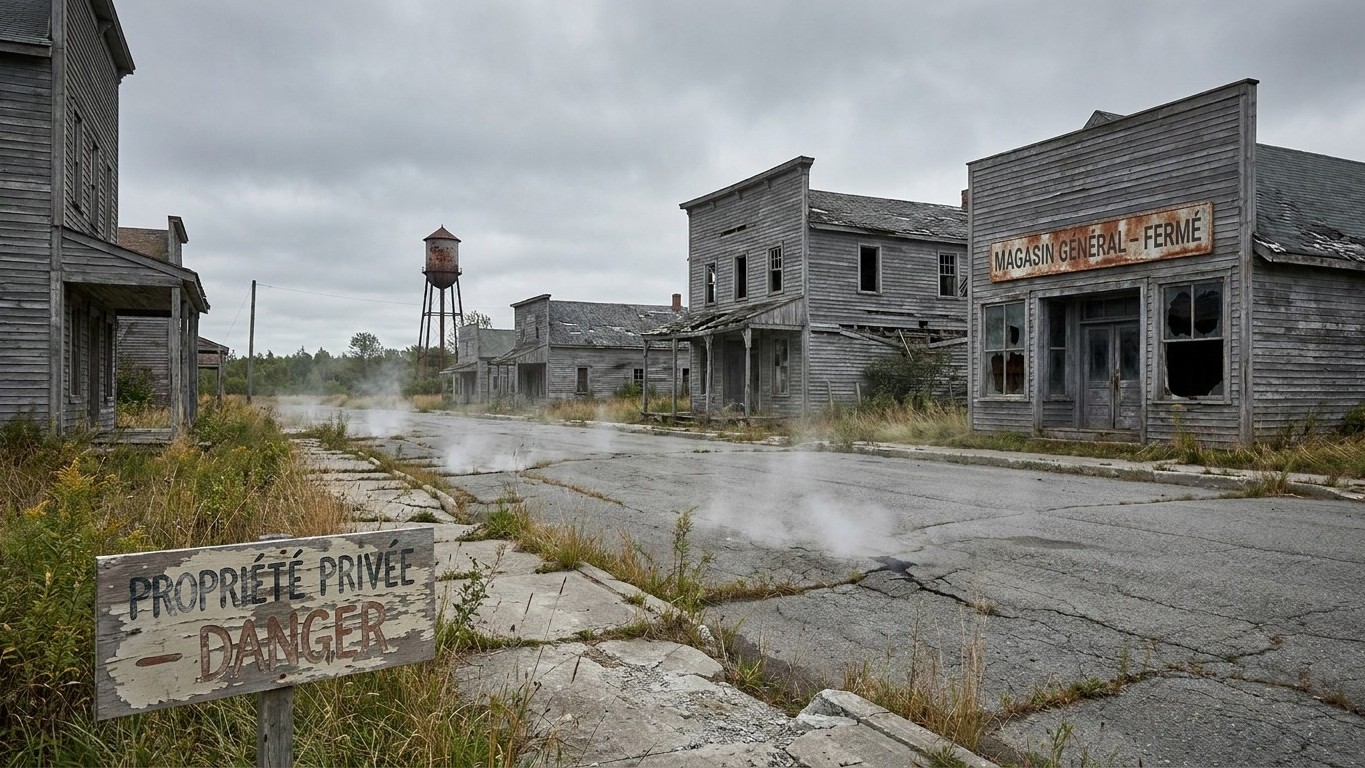
A fifteen-foot hole poorly filled at the bottom of an open-pit dump, a cleanup fire lit before Memorial Day, and that is how an entire town in Pennsylvania was erased from the American postcard. In Centralia, the underground fire that has smoldered since May 1962 was never able to be stopped, neither by water, nor by trenches, nor by the millions of federal dollars poured into the problem. Even today, the ground still fumes in places, and it could keep burning for more than a century.
Key takeaways
- An accidentally lit fire in 1962 spread through a network of mine tunnels and became uncontrollable within days
- For two decades, residents lived with the fire before unseen dangers forced them to leave
- The state spent $42 million to raze the entire town, whose ZIP code was revoked in 2002
A dump cleaned ahead of Memorial Day, a coal seam catches fire
Centralia in 1962 was a peaceful community of about 1,435 residents when, on May 27, with the best intentions, a fire was lit in the town dump by five members of the volunteer fire company hired by the city council. The idea was not unusual: the dump sat next to a cemetery, and with Memorial Day approaching and many visits to graves, they simply wanted to banish the odors and the unsightly view of waste. But that year, everything went wrong.
The problem was that this dump occupied an old open-pit mine. At the bottom, near the north wall, there was a fifteen-foot-wide hole several feet deep, concealed by the refuse and thus never filled with the fire-retardant material required by law. A 1958 Pennsylvania law explicitly prohibited this kind of dump fires precisely because of this risk. The fire crawled through this gap to a coal seam near the surface, and the city council desperately tried to extinguish the underground fire, but after a few days it was already beyond reach.
What made the situation unmanageable was the very subsurface. The network of interconnected galleries beneath Centralia, still rich in anthracite, provided an ideal environment for a mine fire and allowed it to spread rapidly. Authorities tried multiple techniques: the federal Bureau of Mines funded flushing operations, pumping a mix of water, sand and ashes into affected areas, as well as trenching, digging a barrier along the projected path of the fire. None of these worked in the long term: early attempts to suppress failed because the fire had already spread into vast mine tunnels that supplied it with oxygen and routes of propagation, and the numerous trenching and flushing efforts undertaken in the 1960s did not succeed in containing it. Today, the fire burns at depths of up to 90 meters along a 13-kilometer swath, spanning nearly 1,500 hectares.
It isn’t the flame that drove residents away, but its invisible effects
For nearly two decades, the people of Centralia lived with the fire without really fearing it. Some even saw it as a form of comfort: less snow to shovel, tomatoes growing year-round in the warm soil. The turning point occurred in the late 1970s, when surface temperatures, toxic emissions and ground subsidence began affecting residential and commercial areas.
The triggering event remains precise. No one had realized how quickly the situation was deteriorating until 1979, when a gas station attendant named John Coddington plunged a thermometer into his underground fuel tank and discovered that the fuel had reached 78 degrees Celsius. Two years later, the incident that shifted public opinion occurred: a 12-year-old boy, Todd Domboski, was walking through a garden when a sinkhole more than a meter wide and 45 meters deep suddenly opened beneath him. The child escaped, but the image of a ground opening under a teenager’s feet left a lasting impression.
The real danger, in fact, was never the visible flame but the invisible: carbon monoxide seeping into basements, the roadway buckling and smoking under tires on the famous Route 61. A geologist from the Pennsylvania Department of Environmental Protection summarized the threat this way: “the main danger would be the infiltration of the fire gases into the confined space of a residential area. That was true from the start and will remain true even after the fire leaves the area.”
A town bought, demolished, erased from the ZIP code
Facing this diffuse but persistent risk, the state chose the radical solution: buy out and demolish. By the late 1980s, more than 1,000 people had relocated and 500 structures had been demolished under a federal $42 million relocation program. The most symbolic administrative gesture came a little later: in 2002, Centralia’s ZIP code was revoked, erasing the town from the United States Postal Service records.
Not everyone gave in. A few stubborn residents refused to leave, even after their homes were seized by eminent domain in the early 1990s, arguing that their portion of the town was not threatened by the fire and even filing a federal lawsuit to block eviction. An agreement eventually allowed them to stay for life, though without the possibility of passing on occupancy rights. Today, only a handful of inhabitants remain, protected by life-occupancy arrangements, while the rest of the town has disappeared, its streets deserted and houses razed.
How long will the coal keep burning?
The question that has haunted geologists for decades has no definitive answer, only a projection. At current rates, the blaze could burn for more than 250 years. A figure that can be dizzying: most buildings that will ever stand on the site of Centralia do not exist today, and yet the coal that smolders there now may precede them all.
It isn’t an isolated case, even though Centralia remains the best known. Similar fires ravage coal seams in China, Australia, India, or elsewhere in the United States, often invisible, rarely tallied with precision on a global scale. The difference at Centralia is that an entire town had to fade away to make room for the fire, a scenario that risk-management experts in mining dread repeating elsewhere, where old mines still border homes.
Sources: pabook.libraries.psu.edu | files.dep.state.pa.us | wynninghistory.com
