
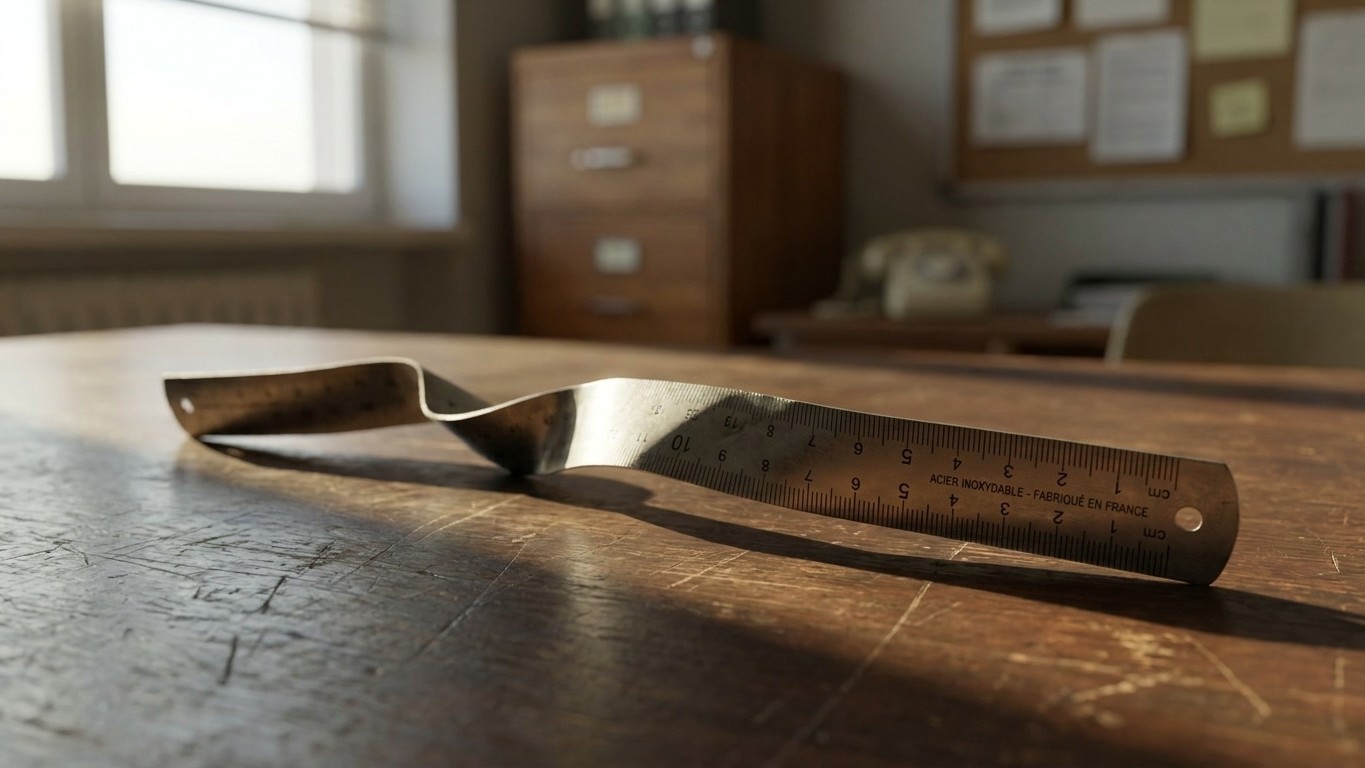
A folded metal ruler, bent in two and hidden behind a partition, was enough to topple one of the most high-profile scams of the Fifth Republic. Between 1975 and 1979, the public petroleum company Elf Aquitaine spent almost a billion francs on technology supposedly capable of locating oil from an aircraft, never suspecting that what appeared on the screen was only a pre-recorded image, projected at the right moment by two men who hadn’t invented anything at all.
Key takeaways
- Why a broken metal ruler was enough to expose one of the largest state frauds of the Fifth Republic
- How two men managed to fool the highest echelons of the French state for four years
- Which political secret was kept for more than four years after the fraud was uncovered
A Providential Invention During the Oil Crisis
It all began in the feverish backdrop of the first oil shock. France, dependent on imports and destabilized by soaring prices, was desperate for a remedy. It was in this climate that Elf Aquitaine was approached in 1975 by con artists who claimed to have invented a technology enabling reconnaissance aircraft to detect oil deposits. The two men behind the project formed an unlikely duo: Aldo Bonassoli, an Italian, self-taught farmer, and Alain De Villegas, a wealthy aristocrat living in Belgium. The first presented himself as a versatile physics enthusiast; the second leveraged his network within political circles.
Their sales pitch rested on a single line: a device capable of “seeing” thousands of meters beneath the earth and thus detecting gas, oil, and certain rare minerals, pompously dubbed the Delta and Omega processes. The affair quickly climbed to the very top of the state. On June 2, 1976, Antoine Pinay and Pierre Guillaumat, Elf’s chief, were received by President Valéry Giscard d’Estaing to present this opportunity that France, exhausted and hungry for solutions, could not afford to ignore. A confidential note revealed much later showed that the head of state already doubted the system’s reliability, yet did not stop the machinery from moving forward.
The Magic Trick Behind the Screen
Concretely, how did this supposed technical feat operate? At each demonstration, the inventors followed a well-rehearsed ritual: place a metal object behind a partition and watch it appear on the control screen. A trick that worked every time, and for a simple reason. It was only in 1979, when doubts grew too strong, that the director of the Institute of Fundamental Research at the Commissariat à l’énergie atomique was dispatched by the minister of Industry to verify the invention’s legitimacy. This physicist, Jules Horowitz, would literally crack the game open.
The trap was incredibly simple. Horowitz proposed using the standard ruler, having beforehand bent the metal ruler, without Bonassoli and Villegas realizing it. On the control screen, however, the object appeared—perfectly straight. Impossible, since the actual ruler was bent. The deception was laid bare. When technicians disassembled the device, they discovered a multitude of tricks, including a photocopy of the straight metal ruler, and understood that during flight tests, the experts were only witness to a pre-recorded projection on a screen of geology maps.
Facing this evidence, Bonassoli persisted in his rhetoric. He claimed he had done it on purpose to avoid bringing his devices back and thus prevent others from stealing his technology. A lie too many. The fraud’s mechanism emerged in its rustic simplicity: through a hidden image manipulation inside the machine, he managed to conjure up shapes of oil-bearing formations and other features he had drawn in advance, succeeding in showing what France expected to see—oil. No radar, no sophisticated sensor, no revolutionary physics. Just a rigged black box and a country so starved for solutions that it preferred to believe the impossible rather than demand proof.
Four Years of Silence Before the Scandal
What strikes most about this story is not so much the initial naivety as the length of the subsequent cover-up. Horowitz’s damning demonstration dates from May 1979. The general public would only learn of this state fraud on December 21, 1983, when Le Canard enchaîné revealed part of the affair under the headline “The Sniffer Aircraft Affair.” More than four years of institutional silence, during which an audit by the Cour des comptes was simply erased from official archives.
This very report precisely quantified the financial disaster. It revealed financial manipulations within Elf-Erap resulting in direct and accrued losses of more than 750 million francs and pointed the finger at the laxity of public authorities. But the document offended too many people in high places. Raymond Barre insisted on being the sole recipient of the two copies of the report, and the original was destroyed in November 1982 by Bernard Beck, the president of the Cour des comptes. The destruction of an official document, once revealed, provoked an even broader political shock than the fraud itself. The day after the Canard’s revelation, Henri Emmanuelli, then Secretary of State for the Budget, called the destruction of the final copy of the report a “forfaiture.”
The judicial outcome, meanwhile, left a bitter aftertaste. Faced with the enormity of the fraud, a parliamentary inquiry commission was established; its final report exonerated the former president but reproached Raymond Barre. As for the two inventors, their post-scandal trajectories were notable: far from grand hotels and courtrooms, they ended up ruined, one dead, the other returned to repairing televisions, years away from the Doppler-effect lasers they claimed to command. A reminder that no miracle technology deserves to be believed blindly, especially when it promises exactly what one wants to hear.
Sources: usinenouvelle.com | lalibre.be | fr.wikipedia.org
