
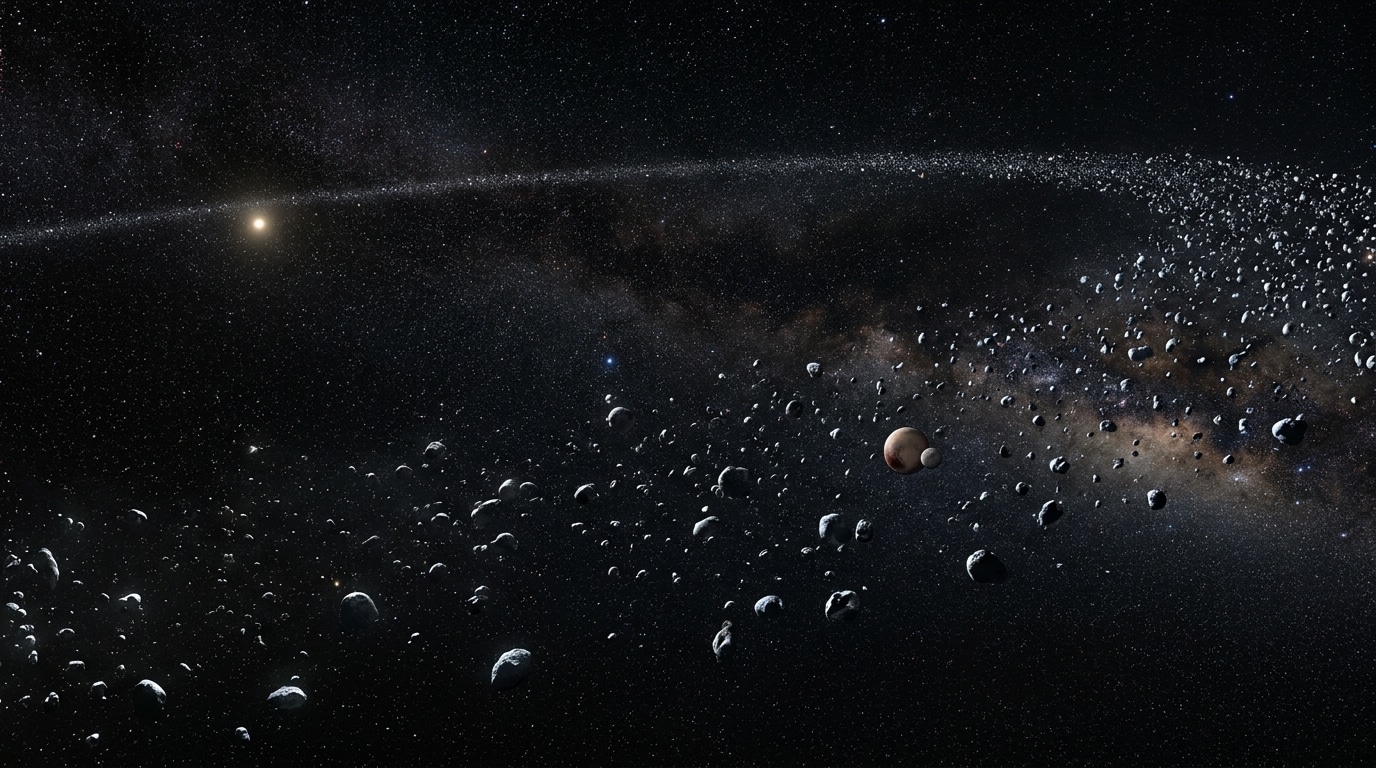
Imagine being able to infer the presence of a planet without ever having seen it, simply by watching the waltz of distant objects. That is precisely the challenge astronomers have tackled for more than a decade. At the icy edges of the Solar System, some orbits behave as if an invisible mass were quietly tugging on the strings. An investigation into an unresolved mystery.
It all began with a hunch voiced in 2014 by two Caltech researchers, Michael Brown and Konstantin Batygin. Scanning the far corners of the Solar System, they noticed that several distant bodies seemed to coordinate their movements. A bit as if an unseen hand kept them in line. From this arose the captivating hypothesis of a hidden ninth planet.
When the distant orbits refuse to rotate randomly
Far beyond Neptune lies a discreet population: extreme trans-Neptunian objects, or ETNOs. These bodies pursue enormous, enormously elongated orbits, spending most of their lives in total darkness, at staggering distances from the Sun.
Yet these objects exhibit a peculiarity. Their orbits do not point in random directions. They appear clustered, oriented in the same direction, like clock hands frozen at the same hour. Statistically, such alignment is almost unimaginable.
This phenomenon notably concerns their perihelia, the points of their paths closest to the Sun. These perihelia cluster in a manner that intrigues. For Brown and Batygin, one explanation stands out: a massive planet, lurking in the shadows, would shape this cosmic ballet by nothing but its gravity.
These dizzying inclinations that should never have existed
The clustering is not the only unsettling clue. A second detail strengthens the mystery. Some objects display orbits inclined by roughly 90 degrees relative to the plane in which the known planets move.
To grasp the anomaly, imagine a dance floor where everyone spins horizontally. Then, suddenly, a few dancers begin to move vertically, perpendicular to the rest. That is precisely what these celestial bodies do, and nothing known readily explains it.
These nearly perpendicular trajectories are so strange that they become a strong argument. The presence of an invisible, massive, distant planet would offer a natural mechanism to straighten these orbits. Without it, these extreme inclinations remain an almost insoluble mystery.
The revealing void: where objects are missing
There exists a third clue, even subtler still. It is not the presence of objects that catches the eye, but their absence. At certain precisely defined orbital distances, astronomers observe a troubling deficit: where one would expect to find bodies, there is almost nothing.
This void is not trivial. A massive planet, sweeping the space over billions of years, could have cleared certain zones, ejecting or capturing objects that strayed there. The result? Bare corridors, like furrows carved into a field.
The mass of this hypothetical body would be substantial: on the order of five to ten times the mass of Earth, on an orbit at least ten times farther from the Sun than Neptune. Enough to sculpt, across immense timescales, the invisible geography at the edge of the Solar System.
A phantom planet or a statistical illusion: what we really know
Despite all these clues, one truth remains: no one has ever seen Planet Nine. It remains a hypothesis, alluring but unconfirmed. All arguments rest on indirect effects, never on a direct image of the supposed object.
The debate has grown thornier recently. The discovery of the sednoid 2023 KQ14, nicknamed Ammonite, by the Subaru telescope, has stirred the pot. Its misaligned orbit weakens the initial argument of clustering, reminding us that statistics can sometimes mislead. Some researchers wonder if all of this is merely an illusion born from too small a sample.
But hope is far from extinguished. The Vera C. Rubin Observatory, which began issuing alerts earlier this year, is hailed as the ultimate tiebreaker. According to the most optimistic estimates, it would have around 70 to 80 percent chances of spotting the planet if it truly exists. This summer, all eyes turn toward its first data releases.
Clustering of orbits, impossible inclinations, unexplained voids: three pieces of the same cosmic puzzle pointing toward a massive, invisible intruder. The question remains whether this gravitational phantom is real, or whether our calculations are playing tricks on us. The answer may already lie in the data piling up. And you, do you lean toward the hidden planet, or toward the statistical mirage?
