
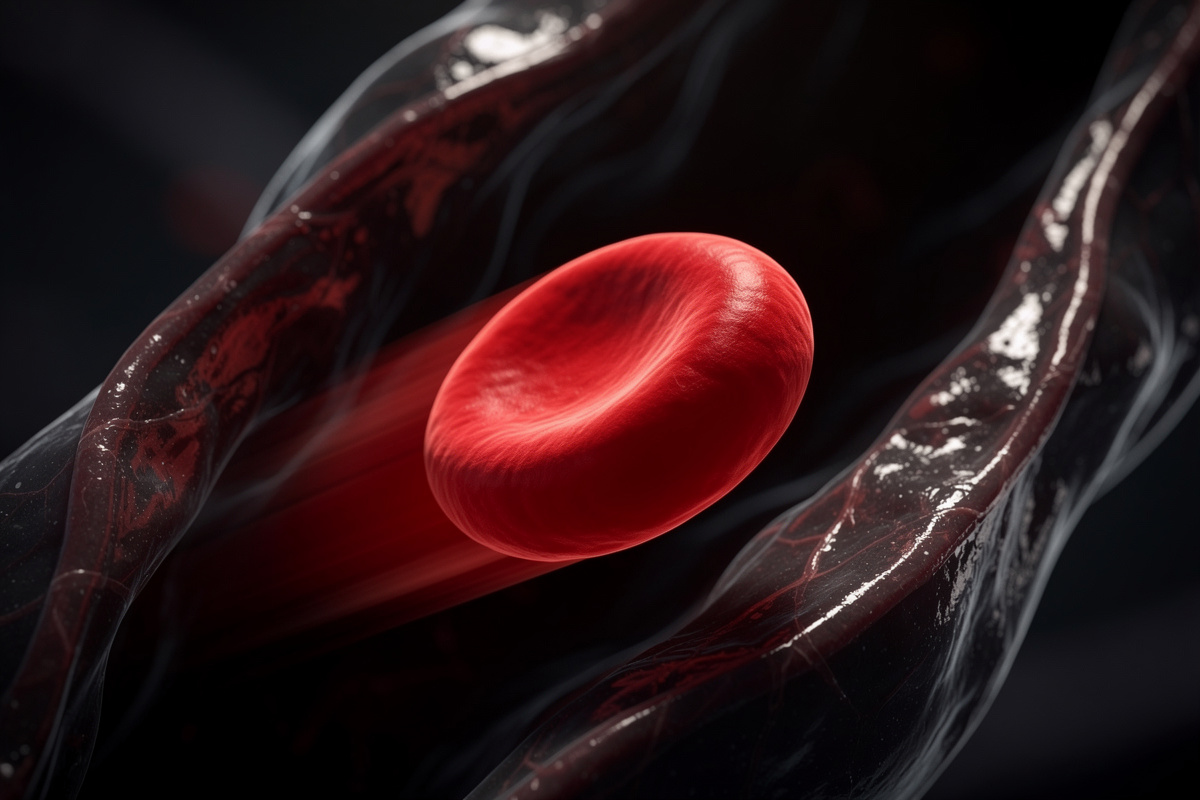
A cell without a nucleus, unable to repair itself, racing through the human body in record time before ending its life in a specific organ: that is a summary that could almost belong to science fiction. Yet this description fits perfectly with one of the most ordinary yet essential components of our body, the one we encounter at every blood test without really paying attention. The red blood cell, for that is what it is, leads a life as brief as it is intense, punctuated by frantic journeys through our vessels and a programmed death whose countdown begins at birth. A look back at the fascinating destiny of this cell unlike any other, which says a lot about the ingenuity of the human body.
A cell that has renounced its nucleus to circulate more freely
Unlike the vast majority of cells in the human body, the red blood cell, also called an erythrocyte, stands out for a fairly radical trait: it has no nucleus. This evolutionary choice, far from being a handicap, is in fact a formidable advantage. By shedding its nucleus as well as most of its organelles during its formation, the cell gains space and flexibility, allowing it to load up on as much hemoglobin as possible, the molecule responsible for transporting oxygen to tissues. This extreme stripping literally turns the red blood cell into a kind of biconcave sac optimized for a single mission: to circulate quickly and far.
But this absence of a nucleus comes at a price. Without it, the cell loses any capacity to reproduce or repair itself. In other words, each red blood cell is born with a fixed and non-negotiable lifespan, with no possibility of internal regeneration. It’s a bit like sending a long-distance runner on a race without any way to repair their shoes along the way: they will go as far as possible, then stop abruptly once wear becomes too great.
A tour around the body in under 60 seconds: the mechanics of a perpetual sprint
Once released into the bloodstream, the red blood cell hardly has time to loiter. It makes a full circuit of the body in under a minute, driven by the heart’s tireless beats which act as an indefatigable pump. At several cycles per minute, this tiny cell crosses arteries, veins, and capillaries at a dizzying pace, delivering oxygen to the organs before heading back to the lungs to recharge.
Over its entire life, this frantic rhythm adds up to an impressive total: each red blood cell travels an average of nearly 1,200 kilometers, the equivalent of a journey from Paris to Marseille several times. This trek is accompanied by about 350,000 round trips between the lungs and the body’s various organs, a repetition that illustrates how this cell lives its short existence at a sustained pace, never truly resting.
120 days of service before the fatal wear
This perpetual marathon inevitably leaves its mark. After roughly 120 days of faithful service, the red blood cell begins to show clear signs of fatigue. Its membrane, once soft and malleable, gradually becomes stiffer, making its passage through the narrowest capillaries of the body more difficult. This loss of flexibility is not trivial: it literally signals the programmed death of the cell.
To compensate for this ongoing wear, the human body proves to be remarkably efficient. Every second, between 2 and 3 million new red blood cells are produced in the bone marrow, via a process called erythropoiesis. This production, regulated by a specific hormone named erythropoietin, allows about 1 % of the total stock of red blood cells to be renewed each day, thereby maintaining a constant balance despite the constant destruction of cells that have reached the end of their life.
The spleen, that quiet cemetery that recycles everything
This is where the organ that gives this article its title comes into play: the spleen. Often little known and tucked behind more-talked-about organs like the heart or lungs, the spleen nonetheless performs an indispensable filtering role. Nestled beneath the left ribs, it primarily intercepts red blood cells that have become too rigid or damaged, before sending them to its macrophages, cells specialized in the destruction and recycling of cellular waste.
The spleen doesn’t merely eliminate aging cells. It also tracks down red blood cells rendered unusable by certain pathologies, such as those infected by malaria, coated with antibodies in autoimmune hemolytic anemia, or deformed by abnormal hemoglobin in cases of thalassemia. Each day, about 1 % of red blood cells thus meets this fate, filtered and destroyed in the red pulp of this discreet yet ruthlessly efficient organ.
But nothing is truly lost in this story. Once the red blood cell is destroyed, its hemoglobin is transformed into bilirubin, then excreted via bile, while the iron it contains is meticulously recovered to participate in the fabrication of new hemoglobin molecules. The loop is closed: the raw material of a cell that has just died is immediately used to create another, in a perpetual recycling cycle that testifies to the astonishing economy of resources implemented by our body.
Behind this continuous ballet of births and destructions lies a mechanism of remarkable precision, where each cell plays a fleeting yet crucial role. The next time a blood test is required, it may be difficult not to think back to these millions of red blood cells, tireless sprinters whose swift journey inevitably ends in the discreet nets of the spleen.
