
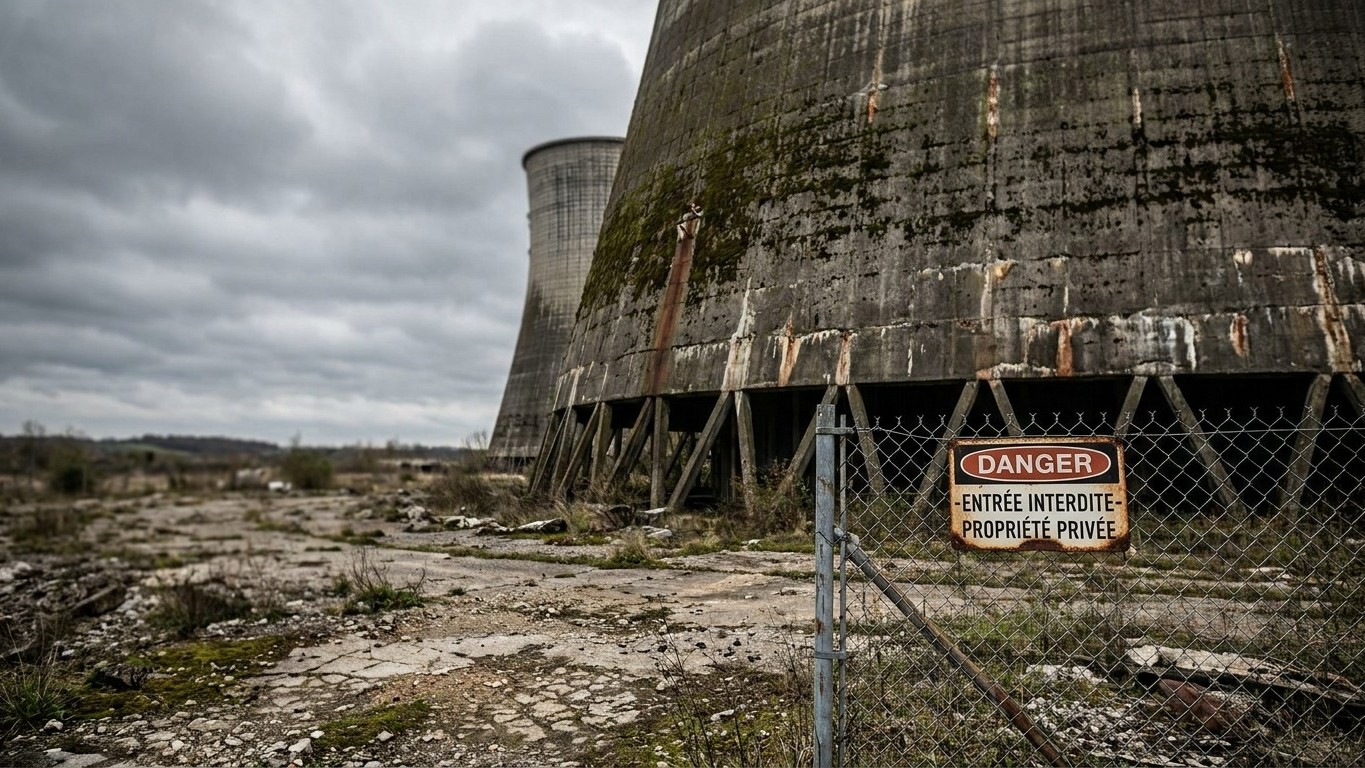
Two billion three hundred million dollars. That is the amount the Philippines spent to build a nuclear power plant that never lit a single bulb. For more than twenty years the country paid down this colossal debt, until the mid-2000s, for a site that had been left frozen since its completion in 1984. The story of the Bataan nuclear power plant remains one of the most stubborn symbols of the financial drift of Ferdinand Marcos’s regime.
It all began after the 1973 oil shock. The Philippines, then heavily dependent on imported hydrocarbons, sought to secure its energy supply. The Marcos regime decided to build a nuclear plant on the Bataan peninsula, about a hundred kilometers from Manila. Marcos ignored the recommendations of his own advisers and of the National Power Corporation, the state-owned electricity company, to award the contract to Westinghouse Electric rather than to General Electric, whose bid had been cheaper.
The consequences did not take long to show. Costs exploded. By March 1975, Westinghouse’s estimate climbed to $1.2 billion with no clear explanation, for a final bill of $2.2 billion for a single reactor, producing only half of the originally planned capacity. Other sources place the starting point even lower: the project, initially estimated at around $500 million, saw its final cost soar to roughly $2.3 billion. These overruns, financed almost entirely by external borrowings, weighed heavily on the country’s debt.
To remember
- A project launched without any checks and balances: how a political decision cost $2.3 billion to a nation
- The continuing interest: $350,000 in daily charges for a plant that was completely shut down
- Forty years on, the site remains frozen in time, kept alive at steady cost, a symbol of unaddressed corruption
A Completed Plant, Never Started
Construction stretched over nearly a decade and was finished in 1984. The 620-megawatt plant, built on a government-owned 357-hectare reserve at Napot Point, in the province of Bataan, was supposed to go into commercial operation in June 1985. It would never. Two events, almost simultaneous, sealed its fate.
First, Marcos’s fall in February 1986, supplanted by Corazon Aquino. Then, two months later, the Chernobyl disaster shocked global opinion. On April 30, 1986, President Aquino ordered the project placed in cold storage due to safety concerns and irregularities in financing. Inspections revealed the scale of the problem: a safety audit uncovered more than 4,000 defects, including the fact that the plant had been built near a major geological fault and close to Mount Pinatubo, then regarded as dormant. A volcano that, five years later, in 1991, would prove that it was far from extinguished by erupting spectacularly.
Corruption further filled the picture. The name Herminio Disini, a close associate of Marcos, repeatedly surfaced in investigations into the kickbacks tied to the Westinghouse contract. In April, the Sandiganbayan anti-corruption court ordered him to restore to the State a total of $50,562,500 in commissions earned around the BNPP project. A figure that gives a sense of the sums circulating around this pharaonic undertaking.
Twenty Years of Repayment for Nothing
Here lies the paradox that makes this story as absurd as it is instructive. A plant kept completely shut down, yet a debt that continued to accrue with interest. Financed by a $1.2 billion loan arranged by a syndicate led by the American Export-Import Bank, Citicorp, and Swiss and Japanese banks, the plant generated interest of up to $350,000 per day, about $240 million per year, and the service of this debt lasted more than thirty years, only concluding in 2007.
Other calculations, including principal and interest over the entire period, offer an even starker picture of the total bill. The government paid a total of 64.7 billion pesos, of which 43.5 billion went to repayment of the principal and 21.2 billion to interest, for a nuclear plant that never produced a single watt of electricity. Converted into dollars, the bill aligns with the initial $2.3 billion borrowed for the BNPP’s construction; the debt was fully repaid in 2007, the original loan amount around $1.9 billion, plus roughly $400 million in interest.
This financial albatross bore an unwelcome title for a long time. The Bataan plant was regarded as the Philippines’ largest single debt obligation, according to a report by the National Institute of Geological Sciences at the University of the Philippines. For more than two decades, every Filipino taxpayer contributed, often unknowingly, to a site that remained inert. It is hard to find a more vivid illustration of what a project can cost when it proceeds without proper counterweights.
A Carcass Maintained, Sometimes Visited
Repayment being settled did not end the expenses. Even shut down, a nuclear plant cannot simply be abandoned without oversight. Even after 2007, the government continued to shoulder maintenance costs for the nuclear installation, amounting to about 50 million pesos per year according to officials from the National Power Corporation. More recent estimates peg the annual bill at close to half a million dollars to keep the site in a state of readiness.
A small technical team continues to maintain the equipment, and the site has, over the years, become a curiosity for visitors: one can tour the concrete corridors, the security airlocks, and the control room frozen in time, a relic of an analog technology never energised. Plans to reactivate the plant resurface in the Philippine public debate, notably championed by Ferdinand Marcos Jr., the president’s son who initiated the project, who has mentioned talks with South Korea to bring the installation up to standard. A rehabilitation project would cost around a billion dollars more and would take several years. It would add a new chapter to a saga that, forty years after its completion, has yet to produce a single kilowatt-hour.
Sources : techno-science.net | fides.org | lapresse.ca
