
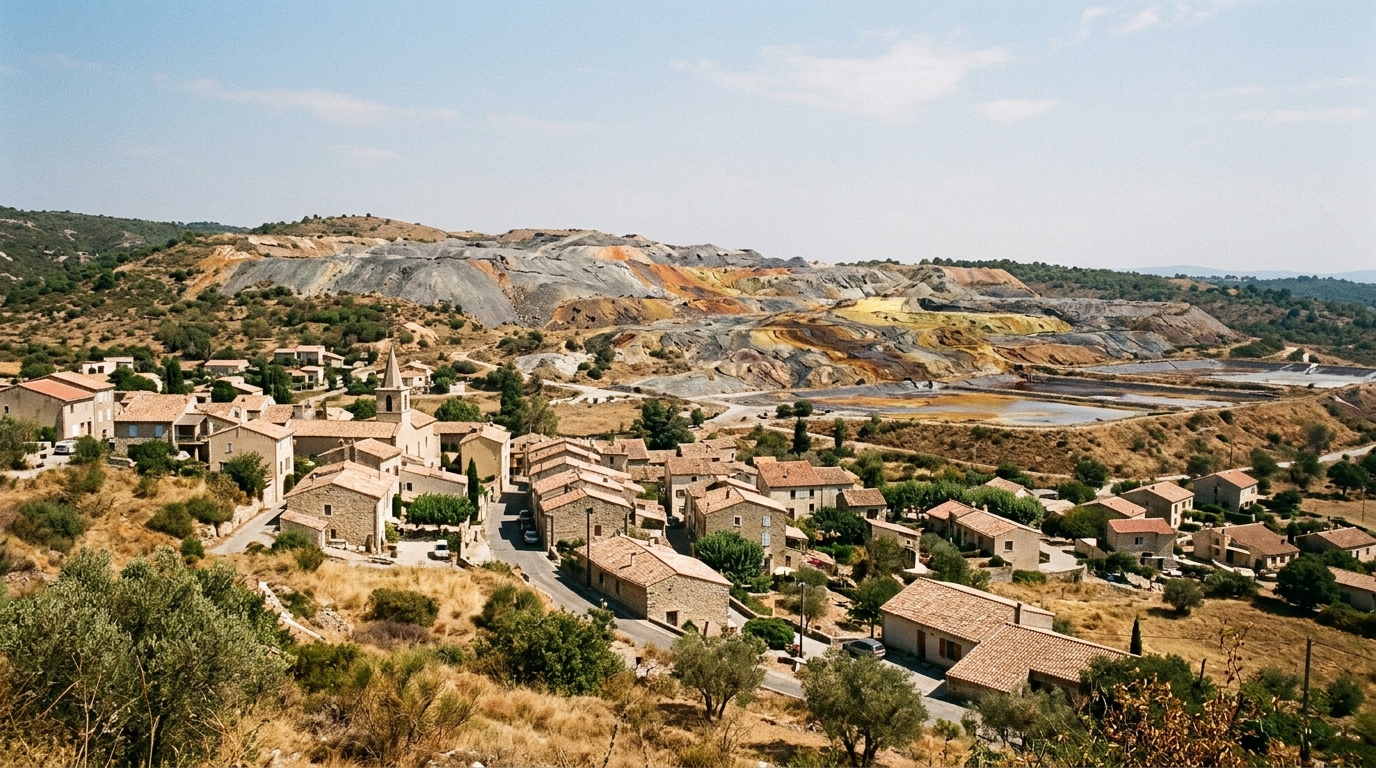
Drinking water from one’s own well, growing one’s own vegetables, letting children paddle in the river: small, almost poetic gestures that the inhabitants of the Orbiel valley have not been allowed to perform for nearly thirty years. The reason is a single word, mineral and formidable: the arsenic. Under the hills that overlook the village of Salsigne, in the Aude department, vast quantities of toxic residues have slept since the mine closed in 2004. Neither the operator nor the State has ever made them disappear. A judicial dispute that has resumed recently thrusts this time bomb back into the spotlight and invites us to consider the little-known history of one of France’s most contaminated sites.
A Century of Extraction, a Toxic Heritage Buried Openly
For more than a century, Salsigne stood for the region’s mineral wealth. The site was the largest gold mine in Western Europe, but above all, unbeknownst to many, it was one of the world’s major producers of arsenic. At its peak, the operation represented up to 25 % of worldwide production of this highly toxic metalloid, extracted as a by-product of the gold ore. An intense industrial activity that shaped the landscape as much as it poisoned it.
When the mine closed in 2004, it did not carry its waste away with it. The site of the Combe du Saut is today covered by nearly 70 meters of rubble, containing about 4,750 tonnes of arsenic boxed in big bags. In addition, there are more than 10.5 million tonnes of spoil, containing around 5% arsenic, dumped into basins upstream of the Orbiel. A colossal stockpile, lying there like a lid on a pot that has never stopped leaking.
The Arsenic That Still Flows in the Orbiel Waters
Twenty years after the site’s closure, the Orbiel has not forgotten. This river winding at the foot of the former mining installations continues to carry worrying amounts of arsenic. The BRGM estimates that 3 tonnes of this poison are transported annually by the river, while a study led by residents puts the figure almost three times higher, around 8 tonnes per year. A discrepancy that alone illustrates the difficulty in precisely assessing the scale of contamination.
Analyses carried out in the sediments near the Gué de Lassac revealed arsenic levels up to 74 times the region’s natural geochemical background, a figure that climbs to 1,000 times in the Grésillou tributary. The extreme runoff of October 2018 offered a stark snapshot of this pollution: the sediments carried that day showed concentrations close to 900 micrograms of arsenic per gram, compared to just 44 micrograms per gram under normal conditions. Each episode of heavy rainfall acts as a brutal reminder: the poison is not stationary; it moves, year after year, with the weather.
Residents Living for Decades Next to a Chemical Time Bomb
For the valley’s inhabitants, contamination is not an abstract scientific concept but a daily reality bounded by strict prohibitions. Since 1997, it has been formally forbidden to eat locally grown vegetables, to use private well water, or to swim in the Orbiel and its tributaries. These restrictions, nearly thirty years later, have not been lifted, proof that the pollution has never truly diminished.
A biosurveillance study conducted in 1997, following the 1996 floods, already indicated a slight overexposure to arsenic among residents. But it was the more recent discovery of alarmingly high arsenic levels in the urine of several dozen children living in the valley that truly rekindled the controversy. Growing up beside Salsigne means living with a risk that is invisible, without odor or color, yet real in the blood and tissues of an entire generation.
Why No One Has Really Cleaned Up Salsigne
The question that has haunted riverside residents for years finally began to receive a legal foothold. In July 2025, the Montpellier Administrative Court recognized an ecological damage and ruled that the State had erred: it did not require a sufficiently reduced pollutant load during the mine’s operation, nor did it take the necessary measures after the site closed. A decision that, for the first time, explicitly assigns responsibility for this silent environmental catastrophe to public authorities.
But the story does not end there. Rather than accepting this judgment and launching large-scale remediation, the State appealed its own defeat. A decision that raises fears of years more litigation, during which the millions of tonnes of residues will remain exactly where they are, just a few hundred meters from homes, continuing to leach slowly into the Orbiel’s waters whenever the rain falls a little too heavily.
At the end of summer, as the rivers of Aude run low and the prospect of autumn floods already weighs on residents, the Salsigne case recalls a disconcerting truth: some industrial pollutions do not fade with time, they simply wait. Between the slow pace of legal proceedings and the enormity of the cleanup required, the Orbiel valley continues to live with a poisoned heritage that, until now, no one has had either the courage or the means to confront head-on. How much longer will it take for this Aude village to turn the page on its mining past?
