
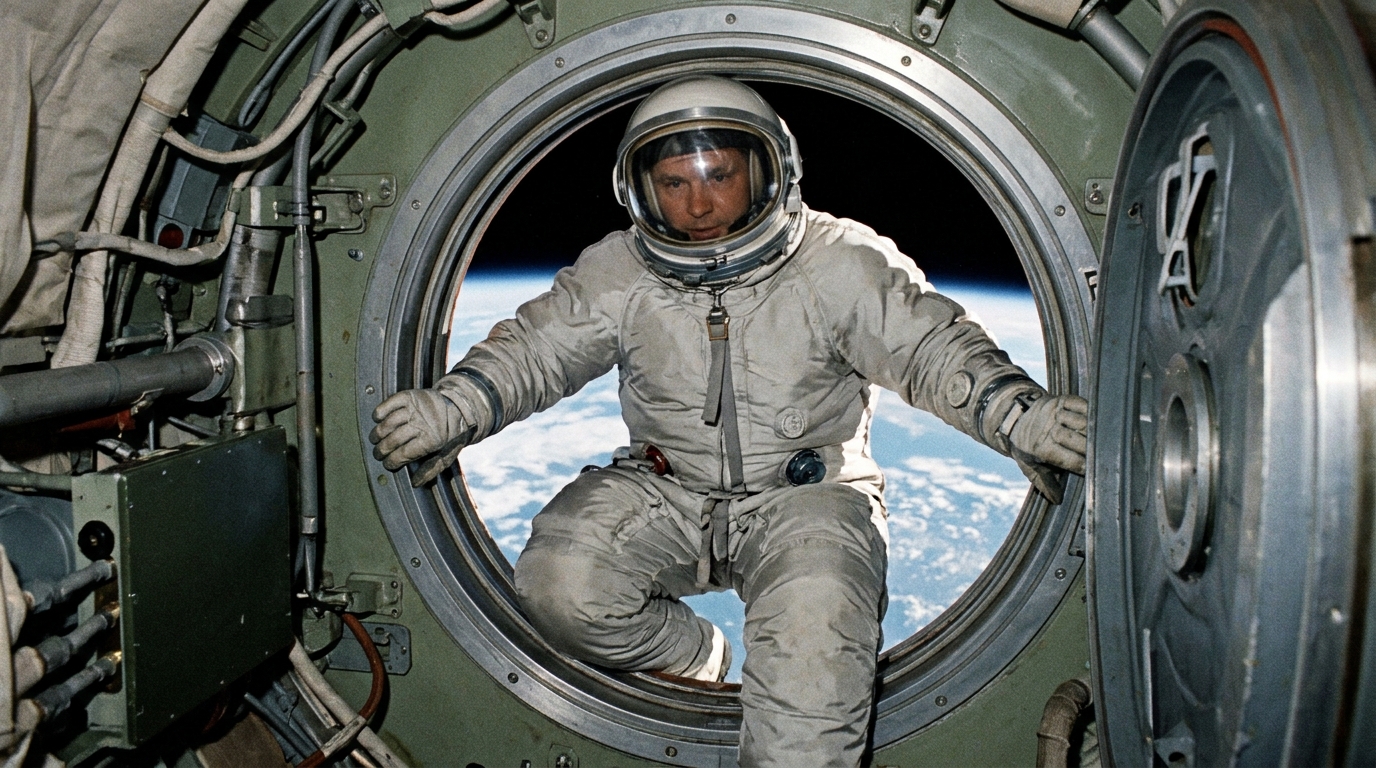
Over 500 kilometers above the Earth, a man drifts in the vacuum of space, tethered to his spacecraft by a simple line. Twelve minutes later, he discovers he can no longer return home. This scene, which might have been lifted from a science fiction thriller, actually occurred during the height of the Cold War, when the Soviet Union sought to outrun the Americans in the space race at any cost, even at the expense of the safety of its cosmonauts.
When the Vacuum of Space Transforms a Spacesuit into an Inflatable Trap
On March 18, 1965, the mission Voskhod 2 blasted off from the Baikonur Cosmodrome with two men aboard, Pavel Beliaïev and Alexei Leonov. Their historic objective was to perform the very first extravehicular activity in space. Shortly after entering the orbit around Earth, Leonov slid into an inflatable airlock, voided the air, and then opened the hatch after he had secured himself to the spacecraft with a 5.35-meter umbilical cord and a tether.
What the cosmonaut experienced then exceeded anything engineers had anticipated on Earth. Exposed to the absolute vacuum, his suit began to react in completely unexpected ways. The pressure difference between the inside of the suit and the void outside caused a spectacular swelling of the fabric, which became rigid like armor. His hands and limbs found themselves literally floating inside, with no precise contact with the walls meant to guide them. Yet, amid this perilous situation, Leonov retained in memory a nearly poetic moment: while gazing at our planet from that unique vantage point, he says, he truly understood that the Earth is round.
The Extreme Decision That No One Had Anticipated
After spending a little more than twelve minutes in the vacuum of space, Leonov was logically preparing to rejoin the vessel. It is at that precise moment that the trap closes: his spacesuit, now too bulky, can no longer pass through the airlock hatch. The cosmonaut then faced a vertiginous dilemma, alone in the vast blackness, with an oxygen reserve that gave him little time to think.
No official procedure had anticipated such a scenario. Alexei Leonov therefore had to improvise a maneuver as risky as it was unprecedented: intentionally purge the air from his spacesuit to reduce its volume, risking his life in the process. By dropping the internal pressure of his suit below the recommended safety thresholds, he exposed himself to a serious decompression risk. But it was the only option available to him to become slim enough to slip back through the airlock. The gamble paid off, and the cosmonaut ultimately managed to re-enter the spacecraft, exhausted and sweating, after a EVA lasting exactly twelve minutes and nine seconds.
A Secret Hidden by the USSR for More Than Twenty Years
If the feat of the first spacewalk was immediately celebrated by Soviet propaganda, the most terrifying details of the mission were kept carefully hidden. Officially, everything proceeded without major hiccups. In reality, the problems did not end there: on the way back, the cabin’s oxygen level rose dangerously, creating a risk of explosion from any spark produced by the engines. Fortunately, no spark occurred, and the crew escaped catastrophe a second time.
These cascading incidents, as revealing of the era’s technological limits as of the two men’s courage, would not be publicly revealed until long later, in the accounts that Leonov himself would share over the following decades. For more than twenty years, the general public would not know that a man nearly remained stranded in space, saved by his own composure rather than by meticulously planned ground operations.
What Leonov’s Failed Feat Changed Forever in Space Exploration
Far from being merely an anecdotal mishap, this misadventure profoundly influenced how engineers now design spacesuits. Modern spacesuits incorporate far more sophisticated pressure-regulation systems, capable of anticipating this kind of unforeseen expansion. Every EVA performed today, whether from the International Space Station or in the context of future lunar missions, owes a portion of its safety to this nearly tragic experience from 1965.
Leonov’s story also underscores a fundamental truth of space exploration: behind every spectacular advance lie moments of pure improvisation, where the outcome depends more on the astronauts’ cool-headedness than on the perfection of the technologies employed. A lesson that remains strikingly relevant today as space agencies prepare increasingly ambitious missions toward the Moon and Mars.
More than six decades after a space sortie that could have turned into a disaster, the episode continues to fascinate as much as it provokes questions. How many shadows still linger in the official narratives of great space missions, between glorified feats and dangers carefully hushed from the public?
