
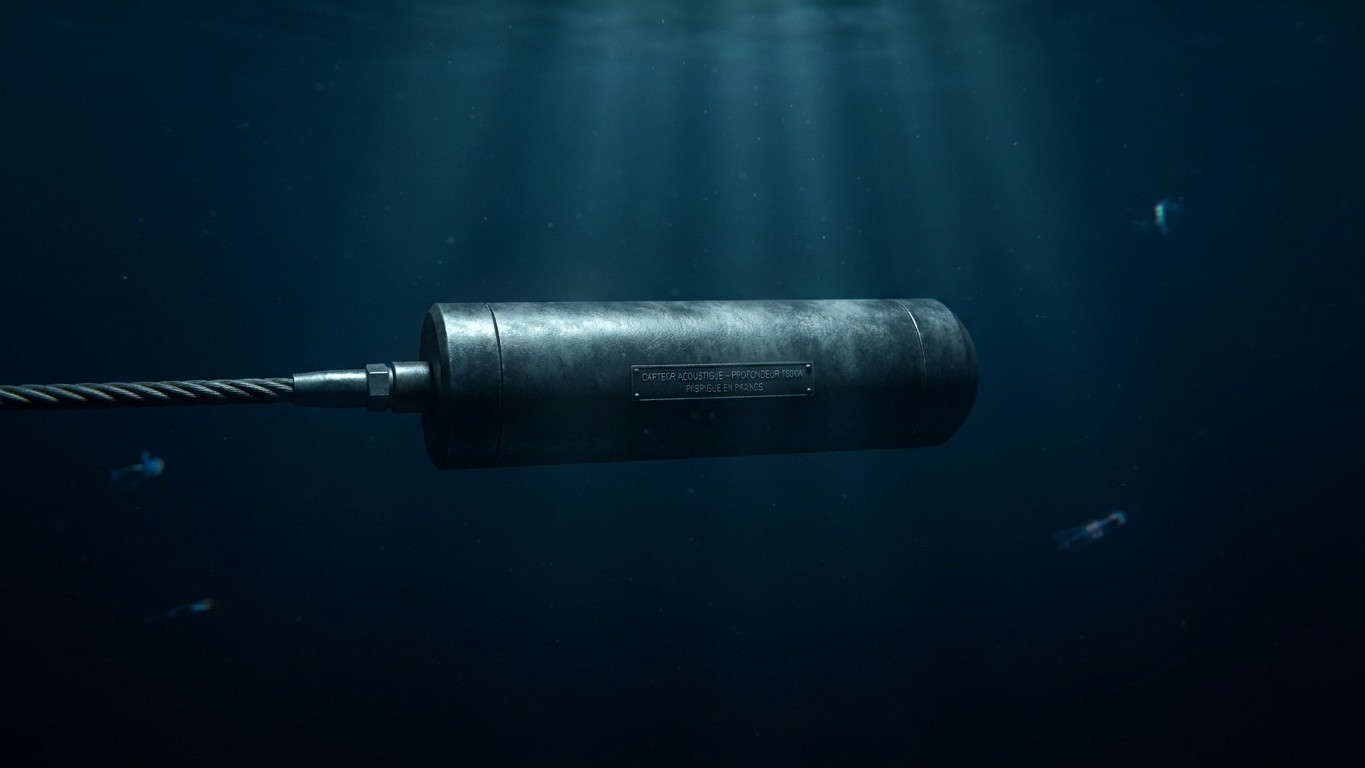
A thousand meters beneath the surface of the Atlantic and the Pacific, submerged metal cables dating from 1954 granted the United States Navy a sense of hearing that no army had possessed before: the ability to hear an enemy submarine traverse an ocean. The network was named SOSUS, for Sound Surveillance System, and it rested on a physical principle as simple as it is formidable: a layer of water somewhere near 1,000 meters deep traps sound and carries it across thousands of kilometers without letting it fade.
Key takeaways
- What allows sound waves to travel across an ocean without fading?
- How does a military system for detecting Soviet submarines observe volcanic eruptions today?
- Do blue whales and nuclear missiles share the same acoustic secret?
A Secret Project Born in the Cold War
Everything begins in the utmost secrecy, at the end of 1950. The Office of Naval Research funds the American Telephone and Telegraph Company (AT&T) and its industrial arm, Western Electric, to develop a submarine surveillance system designed to detect and track Soviet submarines by exploiting the SOFAR channel. The initial code name, Jezebel, hides a monumental ambition for the era: to listen, from shore, to machines roaring at the other side of an ocean.
Initial trials are modest. A test string of six hydrophones is laid in the Bahamas in 1951, followed the next year by a fully operational network of a thousand feet equipped with forty hydrophones. The results exceed expectations. By 1954, the Navy moves up a gear: the order adds three Atlantic stations and extends toward the Pacific, with six stations on the West Coast and one in Hawaii. Submarine cables connect each hydrophone line to coastal listening stations, the famous NAVFACs, officially presented as oceanographic research centers. A non-classified cover name, Project Caesar, is used to conceal the system’s installation. The deception will hold for nearly forty years.
The Physics of an Ear That Traverses the Oceans
Why 1,000 meters, and not 500 or 3,000? The answer lies in a phenomenon discovered a few years earlier by Woods Hole oceanographers. The SOFAR channel is a horizontal layer of the ocean where sound travels at its slowest speed, allowing low frequencies, such as the rumble of a diesel engine, to travel hundreds of kilometers before fading. The mechanism is explained by water temperature: in the warmer surface waters, the speed of sound is relatively high, while at greater depths, where the water cools, this speed decreases until it reaches a minimum. This zone of minimum speed acts like a natural acoustic pipe: sound remains trapped there, bouncing along the corridor rather than dispersing toward the surface or the abyss.
The result seemed almost like science fiction at the time. Test explosions conducted as early as 1944 by scientists Maurice Ewing and Joseph Worzel had already shown the way: a ship dropped two-kilogram charges programmed to explode at depth, at distances up to 900 miles from the receiver. A decade later, the Navy transforms this scientific curiosity into an operational weapon. The most dramatic proof of its effectiveness arrives in 1962, when a Soviet nuclear submarine crossing the Greenland–Iceland–United Kingdom gap is detected, identified, and reported by an antenna leading to the Barbados station, thousands of kilometers away.
From the Secret Weapon to the Scientific Tool
The fall of the Berlin Wall changes everything. Commands and personnel operated under “oceanographic” cover until 1991, the year the mission was officially declassified. Ironically, the lie invented to hide a military network becomes reality. As early as October 1990, the Navy grants NOAA access to SOSUS antennas in the North Pacific to monitor oceanic phenomena of environmental or scientific interest, and the data-collection systems developed by NOAA’s VENTS program come online in August 1991.
The PMEL laboratory in Newport, Oregon, then becomes a permanent geological sentinel. The acoustic signals of the North Pacific are monitored and recorded there continuously, making it the country’s leading installation for real-time detection of low-magnitude seismicity and volcanic activity along the mid-ocean ridge. The Juan de Fuca Ridge off Oregon becomes its preferred subject of study: the system demonstrates its ability to listen to eruptions occurring on the Juan de Fuca and Gorda ridges thanks to SOSUS. An antenna designed to track Soviet submarines finds itself mapping submarine eruptions that no one had ever observed directly before.
Whale Songs in the Same Acoustic Channel
The SOFAR channel doesn’t carry only engine noises or planetary rumbles. The data are also used to study the distribution of baleen whales in the open ocean, a tracking effort that would otherwise be very costly. Blue whales and fin whales emit very low-frequency vocalizations that travel through exactly the same acoustic corridor once used to detect Soviet submarines. The quirks of physics mean that the deep pitches of the world’s largest animals propagate under the same laws as those of military machinery.
The network today continues to provide unexpected services: in 1994, two NOAA systems installed alongside military equipment collected beam-forming outputs directed toward the Juan de Fuca Ridge for real-time monitoring, supplemented by an acoustic beacon at 260 Hz installed on a submarine mast to correct travel-time measurements. A device designed for nuclear deterrence thus ends its life as a chronometer for submarine earthquakes, proof that some military technologies find a second life far from the battlefield for which they were invented.
Sources: archive.navalsubleague.org | researchgate.net
