
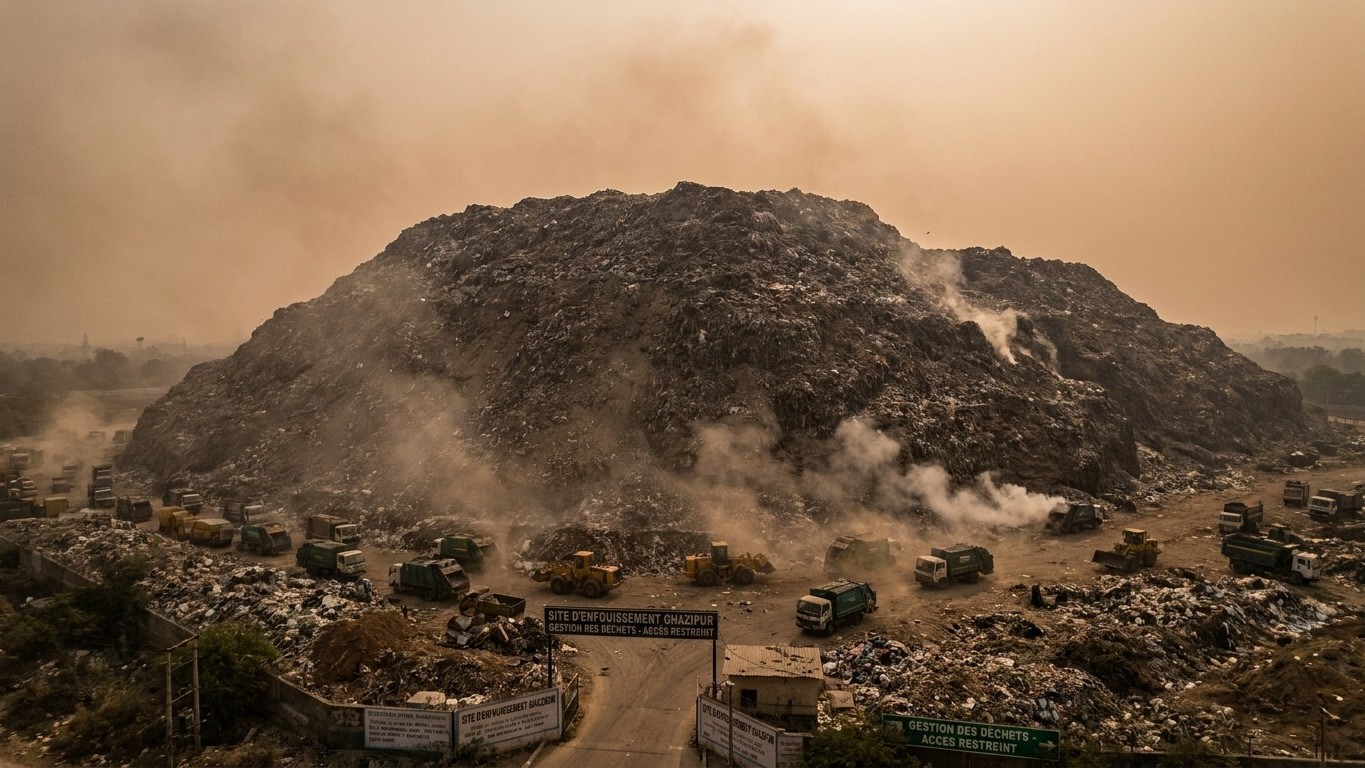
Two deaths, vehicles carried into a canal, a road strewn with debris: that was the toll on September 1, 2017, when a whole section of the Ghazipur landfill detached and crashed onto the roadway. On that day India learned with dread that its capital housed, in the open air, a mountain of garbage capable of killing.
Yet the site isn’t a one-off accident. The Ghazipur dump was established in 1984 and sits in a village in the eastern district of Delhi. At the time, the city had only a fraction of its current population, and no one could have imagined that a simple neighborhood tip would, four decades later, become one of the most toxic hotspots of the megacity.
Key takeaways
- Why did a simple neighborhood dump transform into a 65‑meter mountain capable of killing?
- How does a site meant to close in 2002 continue to receive hundreds of trucks daily?
- What triggered the catastrophic slide of September 1, 2017?
A dump supposed to close in 2002, never halted since
The numbers are staggering: the dump reached its capacity in 2002, yet it continues to receive Delhi’s solid waste. Twenty-four years of de facto permission for a site that should have been shut long ago. Every day, hundreds of trucks come to unload their cargo, with no credible alternative offered by the municipal authorities.
The result is a perpetual pile of trash that keeps climbing. The site covers about 70 acres, or 28 hectares, and according to a 2019 census it towers 65 metres high. To put that in perspective: it is barely eight metres shorter than the Qutub Minar, the 12th‑century minaret that remains one of India’s most visited monuments. The comparison circulated in the Indian press, almost as a macabre running gag, because it succinctly captures the absurdity of the situation.
At the time, a source spoke of a vertiginous rise: the site occupies more than 40 football pitches and gains nearly 10 metres in height every year, with no sign of this nauseating growth slowing. At that rate, some observers calculated it would soon exceed the Taj Mahal’s height of 73 metres—a paradox for a country that houses one of the Seven Wonders of the Modern World.
The day when the mountain collapsed
September 1, 2017 brought rain and chaos. Torrents soaked the slope of the dump, already weakened by the weight accumulated over more than thirty years. A confluence of heavy rains, fires, and a lack of space caused the site to give way. A whole section detached and crashed onto the adjacent road.
The toll was heavy: a large portion of the dump toppled, burying a road and killing two people. Vehicles traveling at the wrong moment were swept toward the neighboring canal, according to several contemporary accounts. The political shock followed immediately. The National Green Tribunal questioned the Delhi government and the East Delhi Municipal Corporation about the site’s catastrophic mismanagement. Authorities temporarily halted new dumping, but the measure lasted only a few days, due to the lack of a credible alternative for waste treatment. In the immediate wake, the tragedy did little to change the fundamentals.
What stands out is that Ghazipur was not designed to reach such heights. Delhi hosts other unregulated dumps, like Okhla and Bhalaswa, which experts refuse to even call “landfill sites,” preferring the term mere “dumps,” for lacking any adherence to the simplest technical norms. The regulatory height limit, by contrast, was set much lower: the dump exceeded the prescribed 20 metres by 45 metres, topping out at more than three times the permitted height.
Methane, fires and sacrificed residents
Under the surface, the dump breathes—or rather, it ferments. The decomposition of organic matter continually generates methane, a highly flammable gas that escapes in pockets and can ignite with heat. The fires that follow are not incidental: Ghazipur recorded three fire incidents in 2022, including one on March 28 that took more than 50 hours to extinguish. Two days and two nights of black smoke hung over East Delhi.
A parallel economy grew up around the dump. Entire families survive by scavenging for recyclable items among the rubbish, daily exposed to toxic fumes and the threat of collapse. The stench is felt well beyond the site’s perimeter, extending to several kilometres according to residents interviewed by the local press over the years.
Reduction efforts, but a structural problem
In response to the catastrophe, authorities eventually took action, albeit belatedly. Trommels, a kind of sorting machinery, were deployed to treat the so‑called “historic waste,” the oldest layers of the dump. These efforts, coupled with repeated meetings with authorities and parliamentary funding, managed to shave 12 metres off the summit height. It’s a start, but far from a definitive solution: shaving twelve metres after decades of buildup amounts to a bandage on a wound opened in 1984.
Another avenue was explored: reusing treated waste as a road-building material. The municipality signed an agreement to use Ghazipur’s waste to construct a 74-kilometre stretch of the Delhi–Meerut highway, but the national highways authority ultimately used the material on only 2 kilometres as a test, dashing hopes of a rapid reduction of the mountain. Today, despite these occasional attempts, Ghazipur continues to receive tons of fresh waste each day, a clear sign that a site designed for a capital expanding in the 1980s cannot simply absorb the needs of a megacity of more than 30 million residents without a large-scale alternative for treatment.
Sources: ibtimes.co.in | businesstoday.in | newslaundry.com
