
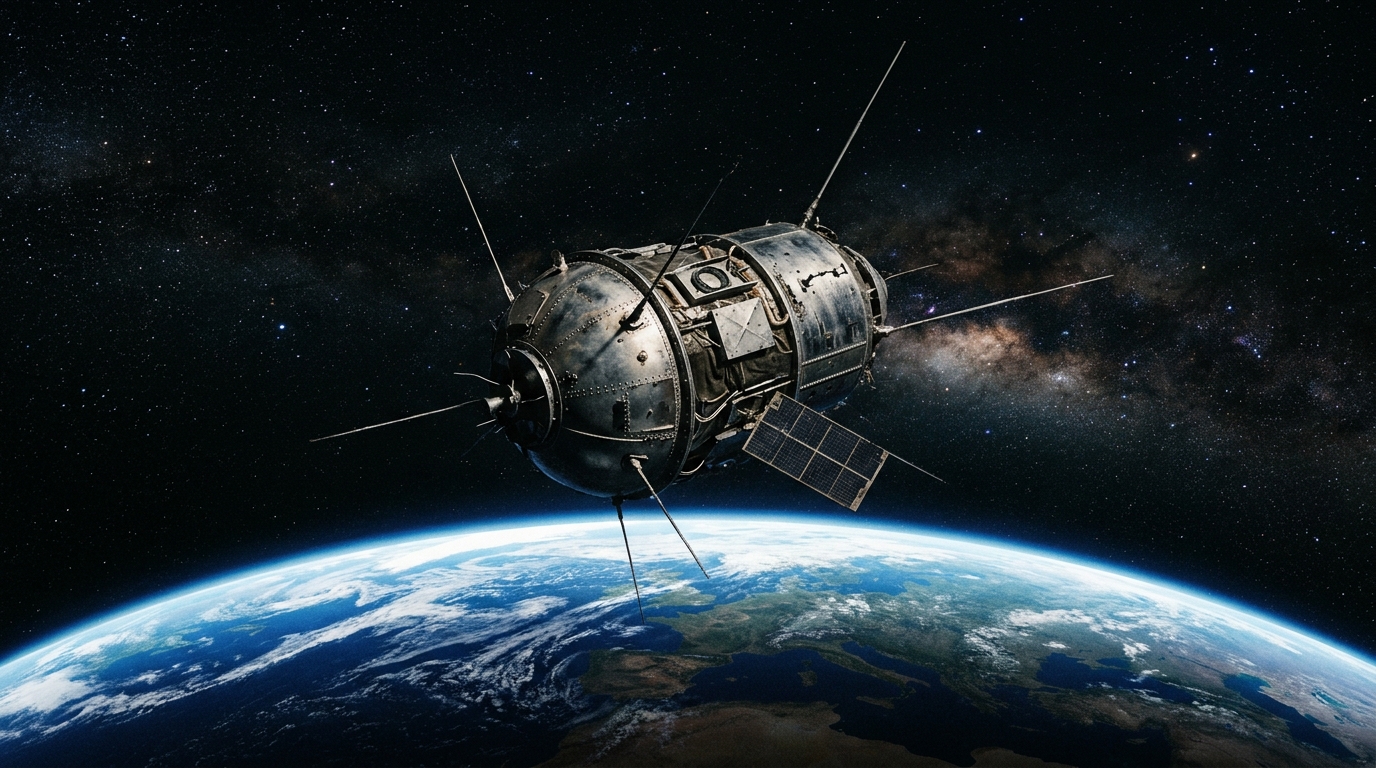
Raise your eyes to the sky on a warm summer evening, far from the glow of city lights, and you might just glimpse a solitary spark streaking silently among the stars. It would be indistinguishable at first glance from any other satellite, and yet it could be the oldest artificial witness to humanity’s foray into space. A tiny object, barely larger than a citrus fruit, that keeps circling our planet with tireless persistence even as no one has spoken to it for decades. Its story, as unassuming as it is fascinating, deserves a closer look.
A Grapefruit Satellite That Changed the History of Space Exploration
We are in 1958. The Cold War is raging and the space race has just begun between the United States and the Soviet Union. Against this tense backdrop, Vanguard 1 lifts off from Cape Canaveral, propelled by a three-stage rocket. Its mission: to reach Earth orbit and prove that America could compete among the giants as well.
What immediately stands out is the spacecraft’s minuscule size. With a diameter of 16.3 centimeters and a featherlight mass of 1.5 kilograms, this aluminum satellite could literally fit in the palm of a hand. In fact, Nikita Khrushchev himself ridiculed the American achievement by nicknaming it the “grapefruit satellite”. A witty dig that nevertheless failed to stop this small craft from entering the annals of history.
Thus Vanguard 1 became the fourth artificial satellite to achieve orbit, following the Soviet Spoutnik 1 and 2 and the American Explorer 1. But more importantly, it signified a genuine technological revolution: it was the very first satellite to operate thanks to solar cells, a breakthrough that would shape the future of space exploration for decades to come.
Radio Silence Since 1964: What Happened Up There?
For years, Vanguard 1 faithfully transmitted data from its orbital perch, helping scientists refine their understanding of the upper atmosphere and Earth’s gravitational field. But every great venture eventually ends. In May 1964, the satellite’s radio transmitters finally died. The last signal was captured by a tracking station located in Quito, Ecuador, before the silence became permanent.
Since then, nothing. No signal, no data, no sign of electronic life. And yet, contrary to what one might imagine, this failure never prevented Vanguard 1 from continuing its wild arc around the planet. The satellite has become a technological phantom, a lifeless shell that keeps tracing its path without ever again communicating with anyone. It is precisely this duality—tangible presence and complete absence of contact—that makes the object so unsettling.
Why No One Can Retrieve It
One might reasonably wonder why no one has ever attempted to recover this precious slice of history. The answer lies in a single word: orbit. Vanguard 1 moves along a specially shaped elliptical path, with a perigee of roughly 650 kilometers and an apogee approaching 4,000 kilometers. This region lies well beyond the low Earth orbit that hosts most satellites and the International Space Station.
That altitude, far from being a handicap, paradoxically offers the best protection for the satellite. The air is so thin there that it does not significantly slow it down, unlike objects closer to Earth that eventually tumble back into the atmosphere and burn up. According to NASA estimates, Vanguard 1’s orbital lifetime would hover around 240 years, delaying its re-entry to the late 22nd century. In other words, our very distant descendants may have a chance to witness its fall, but not us.
Attempting a recovery would therefore be an exceptionally complex and costly mission with little immediate scientific payoff beyond the object’s patrimonial value. Nevertheless, a team of aerospace engineers, historians, and writers has recently explored concrete proposals to observe Vanguard 1 up close, and perhaps someday retrieve this unique relic of the space conquest. Projects are still in their early stages, yet they demonstrate the enduring interest sparked by this forgotten little satellite.
The Cumbersome Legacy of a Cosmic Ancestor
Even today, as late summer nights invite quiet stargazing, Vanguard 1 persists in its unflagging circuit. The satellite has already completed roughly a quarter of a million orbits around Earth, covering an astonishing distance of more than 7 billion kilometers along the way. A staggering figure for something that could easily fit in a pocket.
That extraordinary longevity makes it more than mere space debris: Vanguard 1 is now recognized as the oldest human-made object still in orbit around Earth. All of its predecessors and contemporaries have long since vanished, either burned up in the atmosphere or fallen to the ground. Only Vanguard 1 endures, functioning as an involuntary time capsule that quietly preserves the memory of humanity’s earliest steps toward the stars.
A heritage that is both precious and burdensome, for it also highlights the growing problem of orbital debris around our planet. Vanguard 1 may not pose a direct danger due to its small size, but it embodies the challenge posed by orbital junk as Earth’s near-space environment becomes ever more crowded with new machines.
It’s hard not to feel a touch of emotion when thinking of this tiny piece of aluminum, silent for more than six decades, continuing its quiet voyage high above us. Vanguard 1 reminds us that space sometimes preserves memory better than Earth itself. And if, one day, an expedition truly managed to bring it back down to solid ground, what would it feel like to hold this silent witness to the very first chapter of humanity’s voyage into the cosmos?
