
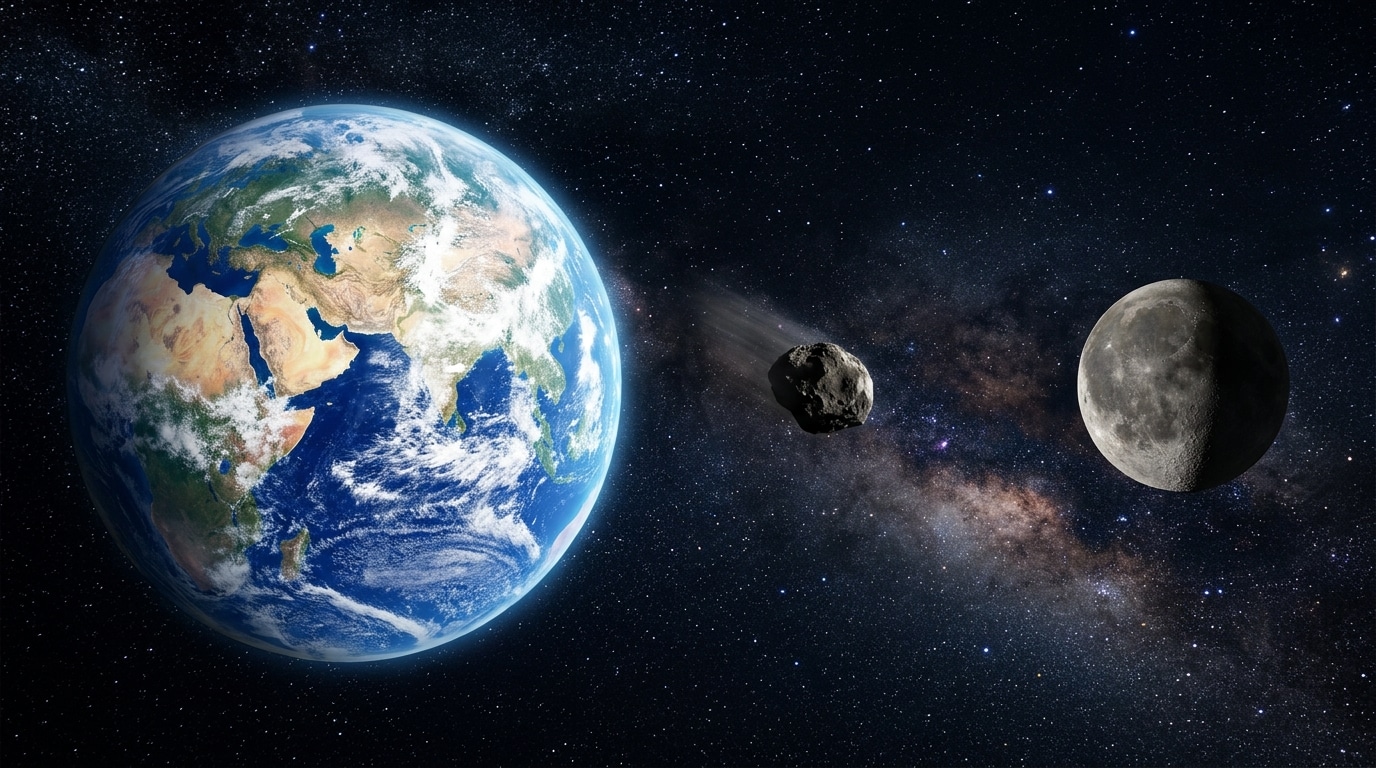
An asteroid is a rocky fragment that orbits the Sun, a relic from the formation of our solar system about 4.6 billion years ago. Most spend their lives far from us, in the belt that lies between Mars and Jupiter. But some, more curious, regularly cross our planet’s path. Among them, a name has kept recurring for years in the mouths of astronomers: Apophis. This celestial rock, measuring 340 meters in diameter, is about to perform a cosmic feat no one before us has ever witnessed. On April 13, 2029, it will skim Earth so closely that it will become visible to the naked eye from our own gardens. A rendezvous that is far from a threat, and everything about a historic spectacle. Here’s why this event will leave a lasting mark on our generation.
Apophis, this space traveler humanity has never seen so close
Its name already sends chills down the spine: Apophis, drawn from the Egyptian deity of chaos and darkness. Discovered in the early 2000s, this asteroid has long ranked among the most monitored objects in the sky. With a diameter of 340 meters, it could easily cover several football fields laid end to end. Imagine a mountain floating in the void, streaking at tens of thousands of kilometers per hour. That is what this mineral giant looks like.
What makes Apophis so remarkable is the trajectory it is about to take. Never before has an asteroid of this size passed so close to Earth while remaining perfectly visible. Our ancestors witnessed comets, shooting stars, meteor showers. But a rocky body of this scale, sliding beneath our satellites and discernible with the naked eye, has not happened to any human generation before ours.
At 32,000 kilometers from our heads: what makes this flyby absolutely extraordinary
To grasp the magnitude of this event, one must consider distance. Apophis will pass at roughly 32,000 kilometers from the Earth’s surface. That may sound vast, but on a cosmic scale, it’s a mere hair’s breadth. For comparison, the Moon orbits at nearly 384,000 kilometers from us: Apophis will come about ten times closer than our natural satellite.
Even more striking: it will pass below the altitude of our geostationary satellites, those devices that orbit at around 36,000 kilometers to keep our communications and weather forecasts running. In other words, this 340-meter rock will thread between the Earth and a portion of our space infrastructure. A brush with dizzying precision, guided by nothing but the laws of gravity.
Rendez-vous dans le ciel : quand, où et comment lever les yeux ce soir-là
The good news is that this display will not be reserved for astronomers armed with expensive gear. On the night of the flyby, Apophis will appear as a bright dot moving across the sky, like a star that decided to travel. Billions of people will be able to follow it with the naked eye, without binoculars or a telescope.
The best viewing conditions should concern the eastern hemisphere, notably certain regions of Europe, Africa, and Asia. To maximize your chances, it’s wise to avoid the light pollution of cities and favor a clear sky, well away from street lamps. A simple blanket, a patch of countryside, and a bit of patience will be enough to engrave this moment in your memory. No need to be an expert: you’ll simply need to look up at the right moment.
What Apophis could reveal and why Earth can sleep peacefully
Rest assured from the outset: there is no collision risk to fear. Trajectory calculations now reach remarkable precision, and Apophis will continue on its path after greeting us. This flyby isn’t a rerun of a disaster movie, but a golden opportunity for science.
Seeing an asteroid pass so closely allows scientists to study its composition, its shape, its rotation, and how Earth’s gravity might subtly alter its surface. These observations will help us better understand these near-Earth objects and, above all, to refine our ability to anticipate potential future threats. Apophis thus becomes a natural laboratory provided by the cosmos, a unique chance to learn how to better protect our planet.
This cosmic encounter reminds us how fragile and fascinating our place in the Universe is. The passage of Apophis will be neither doom nor a mere astronomical news item: it will be a moment of planetary communion, where billions of eyes will converge on the same bright point. And you, will you be able to find the clear sky needed to miss nothing of this spectacle that future generations may well envy us for?
