
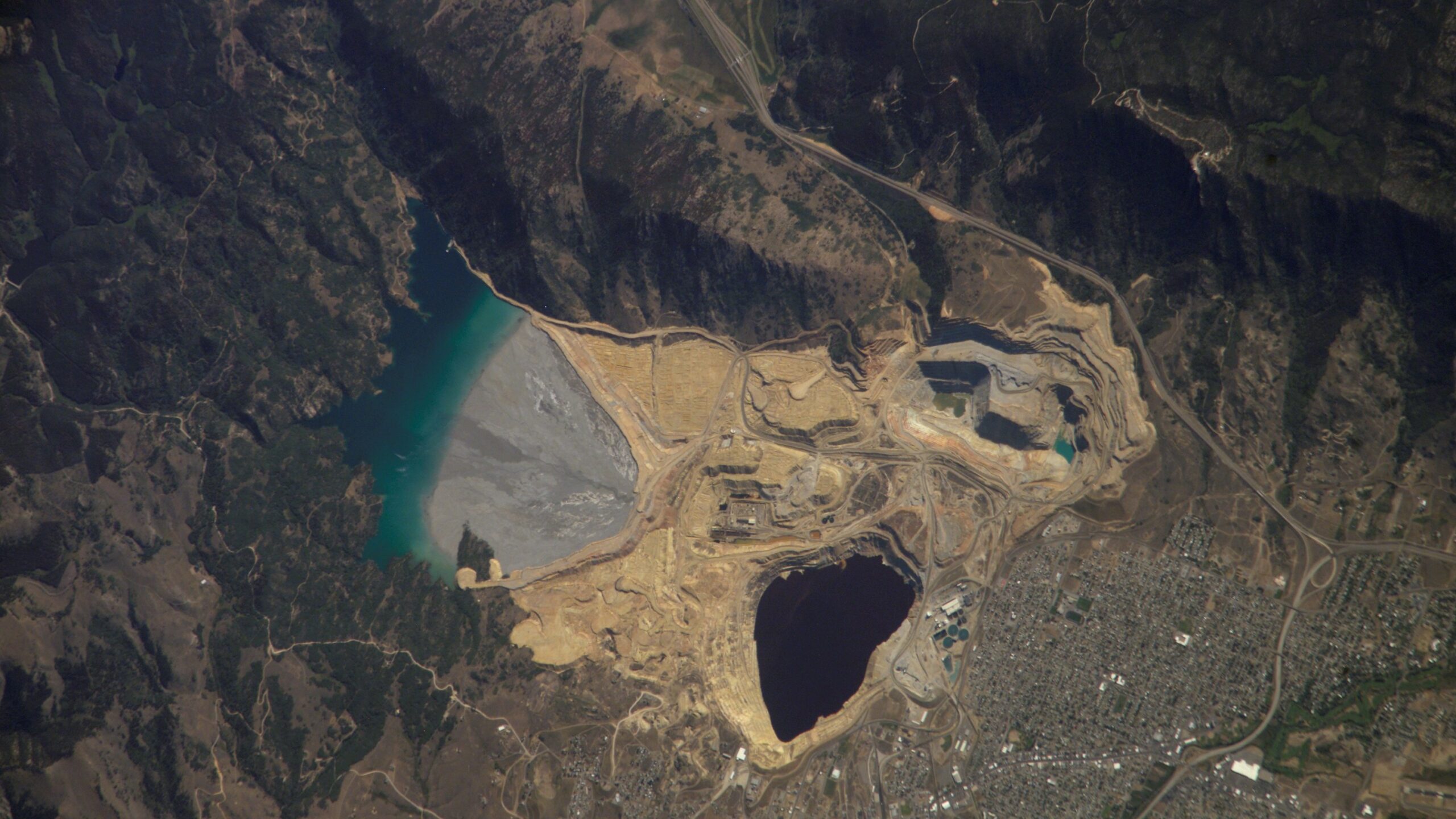
A “rusted, still river” in the heart of Montana: that is how some visitors describe today the Berkeley Pit, in Butte. Since the pumping stopped in 1982, this former open-pit copper mine has been inexorably filling with water laden with heavy metals and sulfuric acid. In November 2016, this liquid trap claimed the lives of thousands of snow geese, forced to land on its shores during a snowstorm.
À retenir
- Why did 60,000 snow geese rush to the mine pit that night?
- A pH of 2.5: what really lies behind the pit’s 40 billion liters of water
- Did the engineers truly anticipate what happened on November 28, 2016?
An industrial wound that has been filling for 44 years
Butte has not earned its nickname of the “richest hill on Earth.” For almost thirty years, the Berkeley Pit was among the largest open-pit copper mines operated in the United States. The operations, which began in 1955 and continued until 1982, carved out a vast cavity more than 1.5 miles long, 1 mile wide and 1,600 feet deep.
The turning point came down to an administrative decision. When the Berkeley Pit ceased operations in 1982, the pumps at the neighboring Kelley mine were shut off for the first time in more than a hundred years. Without this constant pumping, the groundwater asserted itself again. Pumps were stopped in 1982 and since then, groundwater has returned, flooding the underground tunnels and gradually accumulating in the Berkeley Pit.
The problem is that this water traverses hundreds of millions of tons of sulfur-bearing rocks laid bare by a century of drilling. The result? A formidable chemical cocktail. The Berkeley Pit receives groundwater that passes through the surrounding rock and acts as a “terminal pit,” a sink for this water loaded with heavy metals, which can be as corrosive as battery acid. The pH hovers around 2.5, comparable to human stomach acid, enabling enormous concentrations of copper, zinc, arsenic and iron to remain dissolved in the water. A staggering figure: the pit today contains about 40 billion liters of water, a volume that continues to rise.
November 28, 2016, the night the sky fell on the pit
That evening, the residents of Butte did not need to step outside to sense something unusual was unfolding. Local inhabitants heard the unmistakable racket of about 60,000 snow geese circling Berkeley Pit, a mine now flooded with toxic water. A snowstorm struck that night after an unusually mild autumn, and the geese, caught mid-route from Canada toward California, were compelled to drop from the sky.
Fortune favored the weather conditions to misalign. The migration of snow geese shifted later as temperatures rose, and when they reached Montana on November 28, their usual stopover, Freezeout Lake, was largely iced over, as was another nearby landing site the birds frequently used. When a winter storm struck, the birds settled on the region’s only free water: Berkeley Pit. From the ground, the scene looked almost magical: according to a Montana Resources official, witnesses said the pit resembled “700 acres of white birds” on November 28.
The toll took several days to settle. In the night of November 28, 2016, thousands of snow geese landed on the toxic waters of Berkeley Pit. Thousands took flight again, but between 3,000 and 4,000 died after drinking the water. The day after the incident, almost nothing remained to be saved: the company reported that up to 50 snow geese were still alive on Monday on Berkeley Pit, but all the birds were dead by Tuesday.
The story, unfortunately, was not new. Twenty-one years earlier, a similar scenario had already captured people’s attention: a comparable episode occurred 21 years earlier, when 342 snow geese landing in the pit died as the dissolved metallic salts in the water stained their white plumage with rust. Autopsies revealed that ingesting this metal-laden mix burned their throats and damaged their kidneys. This time, the scale of the disaster surpassed all expectations of the site’s operators.
After the tragedy, the race to deploy bird deterrents
The 1995 incident had nonetheless pushed the authorities to act. After that event, a federally approved mitigation plan for aquatic birds was put in place, involving gunfire and the use of “Phoenix Wailers,” devices emitting predator sounds. This harassment program had been broadly effective: from 2010 to 2014, a total of 17,865 birds were recorded on the pit, with only 14 deaths.
It was these same devices that showed their limits in the face of the massive influx in 2016. These measures were extremely effective: among thousands of ducks, geese, swans, grebes and other birds that briefly landed during spring and autumn migrations, nearly all of them left again. But the 2016 episode revealed what engineers had overlooked: animal behavior. They did not know why or when birds might alight, let alone how to anticipate another chance event, a risk that grows with climate change.
Financially, the affair could have cost the operators dearly. Despite the fact that there was really no way to prevent this, Montana Resources and ARCO could have faced significant federal fines of up to $5,000 per dead bird. Yet, contrary to what one might have expected, ARCO and Montana Resources were never sanctioned for this carnage, but in 2017 they began investing in designing an entire arsenal of new tools to prevent a recurrence.
Today, monitoring continues day by day, and the water level remains the obsession of all site experts. According to data published on the Pitwatch.org tracking platform, the level steadily rises year after year toward a critical threshold beyond which the contaminated water could seep into surrounding aquifers and escape containment. Berkeley Pit is thus not merely a costly tourist curiosity to visit from a viewing platform at the edge of Butte: it is an open-air pollution-remediation site with no announced end date, where each new snowstorm rekindles the same question—will the bird-deterrent devices hold up against the next unforeseen flight?
Sources: thingscope.cs.columbia.edu | earthobservatory.nasa.gov | pitwatch.org
