
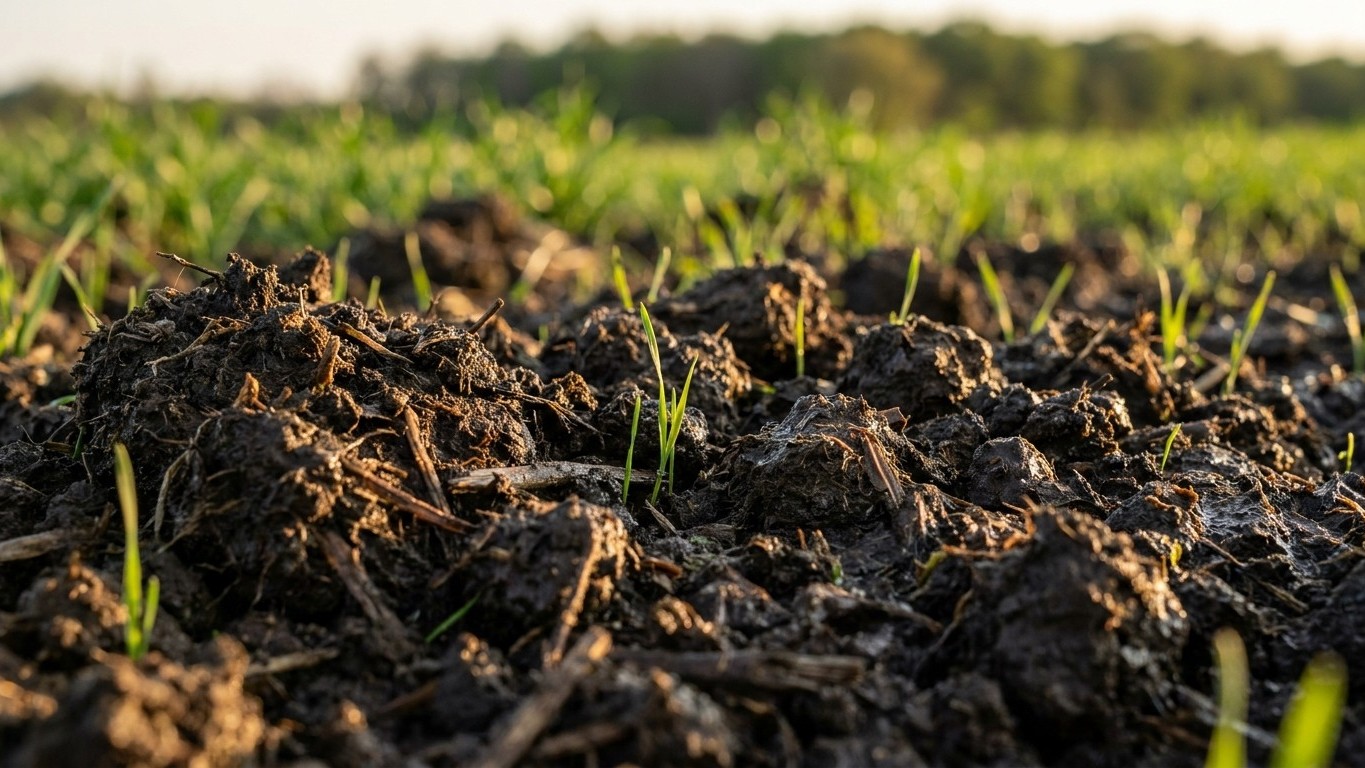
Every year, thousands of tons of phosphate rocks depart from mines in Morocco and Algeria to reach European fertilizer plants. These rocks naturally contain cadmium, a toxic heavy metal that, once spread on fields, never leaves. For decades it has quietly accumulated in the arable topsoil across the cereal-growing regions of the continent, before making its way back into the wheat and potatoes we consume.
The phenomenon is not a case of accidental pollution. It is a direct and well-known consequence of phosphorus fertilization, essential to feed crops. The French fertilizer industry had been concerned about a European regulatory project because the phosphate rocks they rely on come mainly from Europe, Morocco, or Algeria, and these contain more cadmium than rocks sourced from Russia. North African geology imposes its chemical constraint on European agriculture, with little that can be done on the mining side.
Key takeaways
- An invisible toxic metal has been accumulating in European soils for generations with no way to remove it
- Current regulations are deemed insufficient by health experts in France and the EU
- A tighter regulatory trajectory is already planned, but it will come with costs for the farming sector
A European ceiling set in 2019, but already deemed insufficient
In response to this situation, Brussels eventually legislated. Regulation (EU) 2019/1009 establishes a limit of 60 mg/kg P2O5 for certain phosphatic fertilizers, marking a first attempt at continental harmonization. This text creates harmonization rules for EU fertilizers and, for the first time at the Union level, sets maximum contaminant levels for harmonized products. The threshold is intended as a compromise: strict enough to curb inputs, yet flexible enough not to cripple an industry dependent on North African imports.
France, for its part, had long tolerated a higher standard. CE-labeled phosphatic fertilizers must contain no more than 60 mg/kg P2O5, and phosphatic fertilizers produced for the domestic market must contain no more than 90 mg/kg P2O5. This regulatory gap eventually irritated stakeholders, reaching the Senate where a petition recently called for the immediate and strict application of the 60 mg of cadmium per kilogram of P2O5 threshold for all mineral phosphate fertilizers sold in France, thereby removing the national tolerance of 90 mg/kg.
The soil does not purge itself: a stock that only grows
Here lies the core of the problem, and it is almost counterintuitive: even by drastically cutting today’s inputs, the cadmium already present in soils remains there. This metal, naturally present in certain phosphate rocks, does not easily disappear once added to soils and can be absorbed by certain crops. Unlike a pesticide that degrades within months, cadmium is not biodegradable. It accumulates, end of story.
A researcher at INRAe, Thibault Sterckeman, nonetheless puts things into perspective: the incoming cadmium flux into soils, ranging from 0.5 to 1 gram per hectare per year, represents only about 0.1% of the total cadmium stock in the soil. A figure that blinks: it means that the bulk of the cadmium currently present in our fields originates from cumulative inputs over generations of farming, long before the health issue even surfaced in public debate.
The concrete result on our plates? Cereals and potatoes exhibit lower cadmium concentrations than some foods, but because they are consumed in large amounts, they contribute more to the population’s exposure to cadmium. It is not the dose per bite that worries toxicologists, but the daily repetition, year after year, of bread or mashed potatoes that might seem harmless.
Towards tighter regulation, between 2027 and 2032
The issue has gained momentum in recent months. The release of a new ANSES expert assessment in March revived the debate: according to the agency, a significant portion of the population across age groups exceeds health-based reference values, and ANSES recommends lowering the maximum cadmium content allowed in mineral phosphatic fertilizers to 20 mg/kg. A study published in January 2026 underscores this: it shows increased cadmium body burden in the French population, the agency pointing to diet as a major exposure source, accounting for up to 98% of exposure in non-smokers.
In terms of timing, the Ministry of Agriculture has sketched a gradual trajectory: moving to 60 mg/kg in 2027, 40 mg/kg in 2030, and 20 mg/kg after a favorable impact assessment and before 2038. At the European level, Article 49 of Regulation (EU) 2019/1009 provides for a review of limit values no later than 16 July 2026, which should lead to a new European threshold of 40 mg/kg P2O5 in 2027, before reaching a limit of 20 mg/kg P2O5 by 2032. The tightening is thus not hypothetical: it is already spelled out in the texts; only the pace of implementation remains to be decided.
This shift will not be free. Industrial decadmation processes exist to purify fertilizers at the source, but they may raise fertilizer prices by roughly €100 per ton, representing an extra cost of about €2 per hectare for a crop such as wheat. A trivial amount per hectare, yet multiplied across millions of hectares of cereals grown in France each year, it weighs heavily on the books of an already strained sector.
One avenue that few people discuss yet remains: recycling phosphorus rather than importing more. Reducing dependence on mineral fertilizers by reclaiming phosphorus from livestock effluents, sewage sludge, source-separated human urine, or calcined bones would limit soil accumulation, and these organic alternatives generally contain less cadmium. A solution that exists at small scale already, but which requires a fundamental rethink of European agricultural logistics, far beyond merely lowering a threshold on a fertilizer label.
Sources: petitions.senat.fr | pleinchamp.com
