
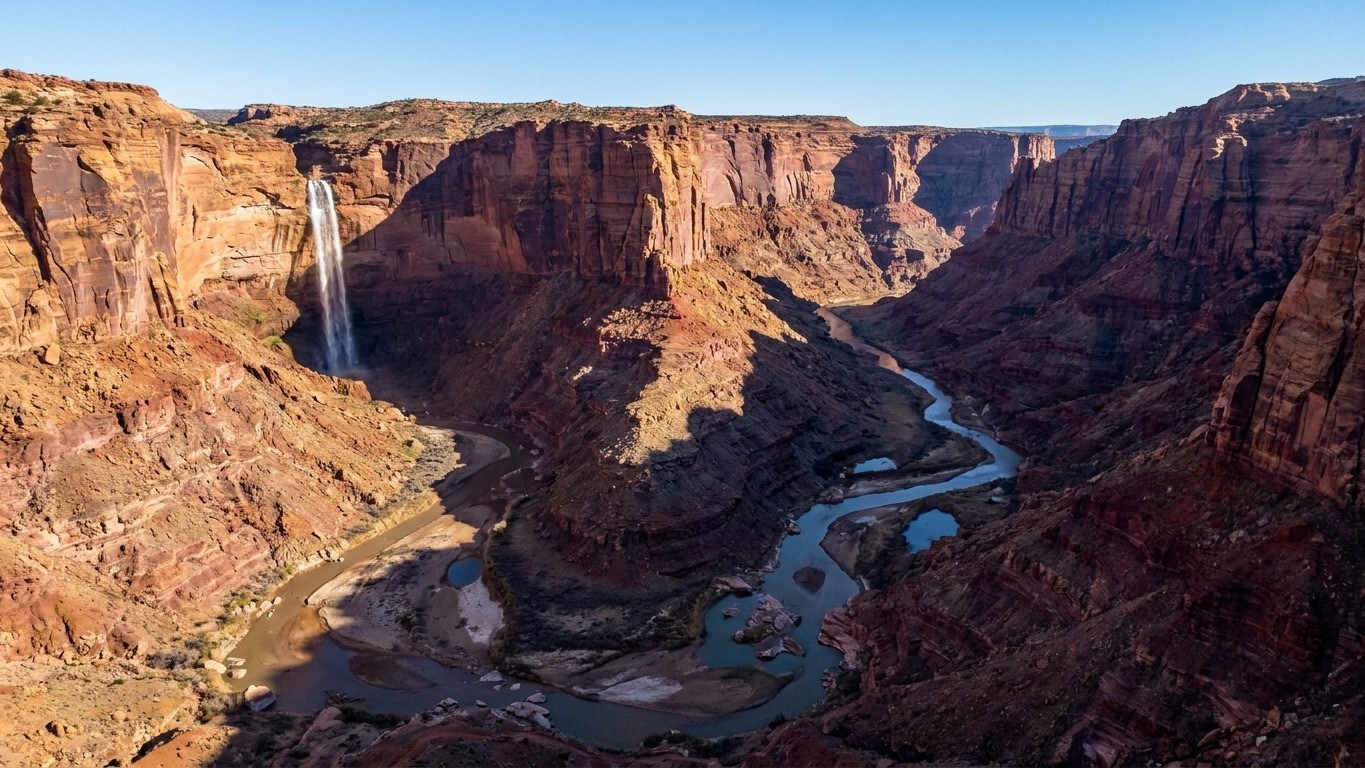
The canyon was called Glen Canyon before a concrete dam swallowed it. Today, as Lake Powell recedes toward levels never seen since it was filled, entire gorges reemerge after more than sixty years beneath the water, with their waterfalls, sandstone caves, and sometimes even relics left by the last visitors before the inundation.
Key takeaways
- A dam built in 1963 drowned 125 major canyons: which one will surface first?
- Life is reasserting itself in the dried-out zones: what are scientists discovering?
- Lake Powell nears a critical threshold: what will happen when the turbines stop?
A dam completed in 1963, a landscape submerged in two decades
It all began with the construction of the Glen Canyon Dam, whose impoundment started in 1963. The Bureau of Reclamation began filling Lake Powell in 1963, submerging narrow canyons once so lush with cottonwoods that John Wesley Powell had named the region Glen Canyon. The name now resonates with irony: what the 19th‑century explorer described as a sandstone garden ended up beneath tens, even hundreds, of meters of water.
In 1963, the Glen Canyon Dam caused the flooding of 186 miles of the Colorado River’s main channel, resulting in the loss of 125 major side canyons of Glen Canyon, including the famed Cathedral in the Desert, a sandstone cathedral carved by water that David Brower, then head of the Sierra Club, described as nothing short of the country’s most regrettable environmental mistake. The rising waters did not merely drown rock: they swallowed sacred places for several tribes, including the Diné, Hopi, Pueblo, and Paiute, prompting Daryl Vigil, co-director of the Water & Tribes Initiative, to remind that there are thousands of years of prayers there. It did not take long for the reservoir to completely alter its face. It took nearly twenty years for Lake Powell to reach its full pool at 3,700 feet above sea level, a level that lasted only two decades before drought linked to climate change and overuse began reducing flows from the Colorado, the San Juan, and other contributing rivers. The last full fill dates back to 1983: since then the curve has only declined, with a few spikes along the way.
2026, the year the lake revealed its bottom
The figures this summer are dizzying. By mid-July, Lake Powell stood at 3,524 feet and Lake Mead just below 1,043 feet, a level not seen since 1957, when the Glen Canyon Dam was still under construction and Powell Lake simply did not exist. The reservoir is approaching a point where, historically, there was no reservoir at all. It’s a stark snapshot of sixty years of water management in the American West.
The absolute low-water record, set in April 2023 at 3,519.92 feet, nearly fell this summer. Powell’s elevation registered at 3,522.78 feet according to the Bureau of Reclamation, approaching the previous record of 3,519.92 feet reached in April 2023 and the critical level required for the reservoir to generate hydropower. Some experts even anticipated a new floor by August. The reservoir, which remains the second largest in the United States, stood at about 23% of its capacity by the end of July 2026, a share expected to continue to drop as the Bureau of Reclamation projects in its July study that Lake Powell will finish the 2026 hydrological year at roughly 22% of its capacity, compared with a historical full level last reached in 1983. Jack Schmidt, director of the Center for Colorado River Studies at Utah State University, leaves little doubt about the trend: for the rest of 2026, each day will see Powell reach a new annual low.
Waterfalls, beavers, and cottonwoods: the rebirth of Glen Canyon
What makes the story fascinating is what happens as the water withdraws. On the ground, teams from the Glen Canyon Institute document an unexpected phenomenon: life is reclaiming the dried-out canyons. During a spring 2026 expedition into Davis Gulch, observers were surprised to encounter a beaver dam in full operation, along with tadpoles and a budding stream. “We’re entering beaver territory!” exclaimed Zanna Stutz as she stepped through the slippery mud and water up to her ankles, toward a small dam built by nature’s engineers, while a Woodhouse toad began to croak. A little farther in the same canyon, a nearly comical detail reminds us how long these places had been out of the world: a Pepsi can from the 1970s simply lay on the canyon floor.
The most emblematic case remains Cathedral in the Desert, this sandstone alcove with its cascading waterfall that no one had been able to admire since the 1960s. After years when the reservoir hovered around half of its capacity, the water level began a dramatic fall starting in 2019, reaching in 2023 a historic floor of 3,520 feet compared with 3,600 feet in 2019, allowing the cathedral to begin its comeback in earnest. The site is not new to revival: after the lake filled, it had already been deemed lost before reappearing in 2005 due to the lowering water level. But this time the phenomenon extends to dozens of other adjacent canyons, from the Escalante arm to the San Juan arm, revealing red cliff walls striped with calcite traces that tell, meter by meter, the story of the retreat.
A balance suspended on the Rockies’ snowpack
This renaissance comes at a price, and it directly concerns millions of water and electricity users in the American West. The threshold of the “minimum energy pool,” below which water can no longer drive the dam’s hydroelectric turbines, sits at 3,490 feet above sea level, a little over 30 feet below the current level. The dead pool proper, below which water can no longer flow by gravity through the dam’s outlet works, sits at 3,370 feet, a threshold far lower and, according to several researchers, unlikely to be reached in the near term. A July Bureau of Reclamation report even contemplates the possibility that Powell could drop low enough by spring 2027 to reach this “minimum energy pool,” meaning the dam would no longer be able to generate hydropower. To gain time, federal authorities are relying on water releases from upstream reservoirs, such as Flaming Gorge, a stopgap acknowledged as such by the hydrologists themselves.
Yet there is a crucial nuance that few articles relay: even in the worst-case scenario, Powell would not vanish entirely. According to calculations presented at a Colorado conference hosted by the University of Colorado, even if Powell reached the dead pool, it would still stretch upstream for about a hundred miles into Glen Canyon with millions of acre-feet of water, and at 3,500 feet it would extend over more than 120 miles. Glen Canyon before 1963 will never fully return to its former self, but what the desert is reclaiming today with water likely has more surprises in store for geologists, biologists, and tribes who never relinquished this submerged memory.
Sources: blogs.darden.virginia.edu | usbr.gov | nps.gov
