
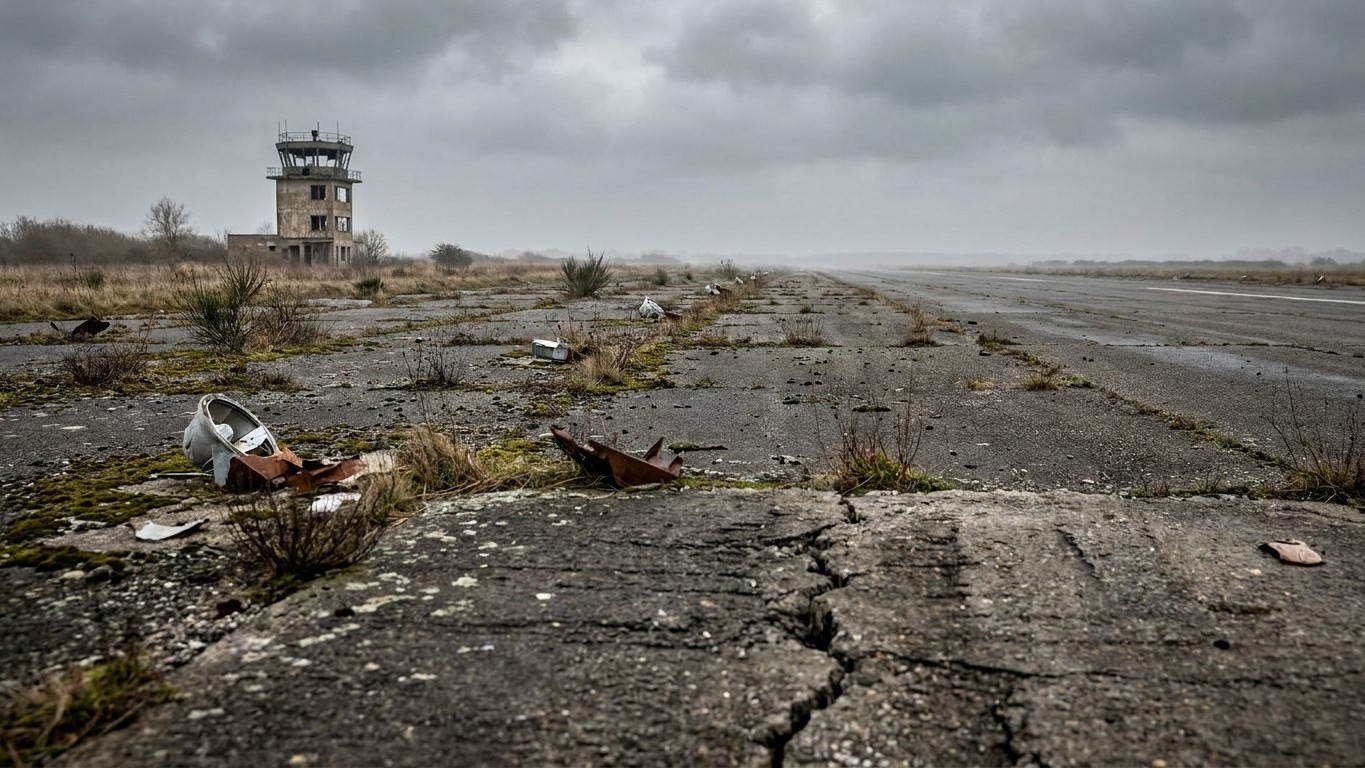
On this 4,100-meter runway lost in the Castile-La Mancha plain, no airliner has taken off since 2012. Yet everything had been planned for very heavy traffic: opened in December 2008, the airport’s construction cost was 1.1 billion euros and it included a runway over 4,000 meters long and 60 meters wide, one of the longest in Europe, capable of hosting an Airbus A380. The stated objective was to relieve Madrid by capturing a portion of its traffic, while serving the Andalusian coast. Result? A pristine asphalt desert, closed after barely three years.
À retenir
- A 4,100-meter runway built to host an A380: who would actually use it?
- Launched during the Spanish property bubble, the project anticipated 7 million passengers a year
- Sold for barely 56 million euros in 2016: where did the 1.1 billion go?
A Crazy Bet Launched During the Spanish Real Estate Bubble
The Central-Ciudad Real airport isn’t just any public project. It was the first international airport in Spain to be financed entirely by the private sector. The idea took root in the early 2000s, driven by local investors and a regional savings bank, in a setting where Spain was building pharaonic infrastructures financed on credit. The city of Ciudad Real, however, has only tens of thousands of inhabitants and lies far from major tourist flows, a detail that apparently did not dampen the project’s ambitions.
On paper, the scale was wildly oversized. It was originally planned to handle 2.5 million passengers a year, a figure that was to rise to 7 million in due course. Some Spanish sources even mention a theoretical ceiling much higher once terminal expansion modules were added, up to ten million annual travelers according to the most optimistic projections. The runway, for its part, was sized to accommodate any large commercial aircraft, including the A380, which at the time made it one of the longest in Europe.
As for the cost, the figures vary considerably depending on the sources and the scope chosen. Most Spanish and international media put it at around 1.1 billion euros, a figure that appears in several reports dating from the time of the bankruptcy. Other assessments put it slightly higher, around 1.19 billion euros, while some articles from the period mention a broader range that included borrowing costs and ancillary infrastructures, such as the jet bridge meant to connect the terminal to the Madrid–Seville high-speed line. A linking project that was also abandoned, never completed, symbolizing a plan halted at full tilt.
Three Years of Flights, Then Silence
The airport opened its doors in late 2008, during the global financial crisis, a timing catastrophically misaligned with a project betting on the explosive growth of low-cost air traffic. Airlines never really crowded in. Operations on the site lasted three years until April 2012, when its former management company filed for bankruptcy and was placed in receivership after the last operator, the low-cost carrier Vueling, pulled its final route from the airport. The last commercial flight, a one-way to Barcelona, took off in late October 2011 with barely forty passengers aboard, on an aircraft that had been expected to carry many more.
The fall was dizzying. The bankruptcy of the airport’s manager did not come without consequences for the regional banking system: Caja Castilla-La Mancha, which had injected tens of millions of euros into the project, collapsed as well and became the first Spanish financial institution bailed out by the state after the crisis began. The airport then became, in the international press, the archetype of the “ghost airport”—oversized Spanish infrastructures built on credit and deserted overnight.
A Repeated Fire Sale
Once closed, the airport did not attract buyers easily. In 2013, the judicial administrators launched the first auction. They put the aerodrome up for sale in December 2013 for 100 million euros, less than 10% of its cost. No buyer showed up. Two years later, in 2015, the saga repeated itself: a Chinese investment group, Tzaneen International, made a single bid, derisively low compared with the initial investment. Costing some 1.1 billion euros to build, the buyer’s offer: 10,000 euros. The Spanish court ultimately rejected this proposal, deeming it too low even for an abandoned asset.
It would take until 2016 for a real transaction to come to fruition. The airport was finally sold in 2016 to CRIA (CR International Airport SL) for 56.2 million euros. Because of financial and bureaucratic difficulties, the sale only became effective in 2018. A figure that, once again, was far from the 1.1 billion euros spent to build it a decade earlier.
From the Ghost Airport to a Cinema Backdrop
While awaiting a new owner, the site became an unexpected playground for the audiovisual industry. In September 2012, the airport hosted for six days the filming crew of Pedro Almodóvar’s film I’m So Excited, with a recreated Airbus A340. A segment of the car show Top Gear was filmed in 2013. The eerie emptiness of the runways and terminal, supposedly teeming with travelers, made a perfect backdrop for productions seeking a post-apocalyptic atmosphere.
Serious reconversion finally arrived in 2019. The airport platform was reopened in September 2019 and soon after, the Irish company Direct Aero Services set up a maintenance base there. The Spanish company Jet Aircraft Services also opened a aircraft dismantling base in December 2019. The airport never returned to becoming a hub for travelers, but found an industrial utility: maintenance, long-term storage, and the scrapping of aging aircraft, a use far more modest than the initial ambition. In 2020, amid the pandemic, cargo flights landed again at the airport as part of a freight bridge from Guangzhou to deliver medical equipment.
From the dream airport for millions of tourists to a simple aircraft dismantling base, Ciudad Real’s trajectory shows how an oversized infrastructure can become a burden rather than an economic engine. Other Spanish airports built around the same period, such as Castellón, faced a similarly chaotic fate before finding, themselves, a second-rate use far from the original plan.
Sources: airport-technology.com | reporterre.net | francesoir.fr
