
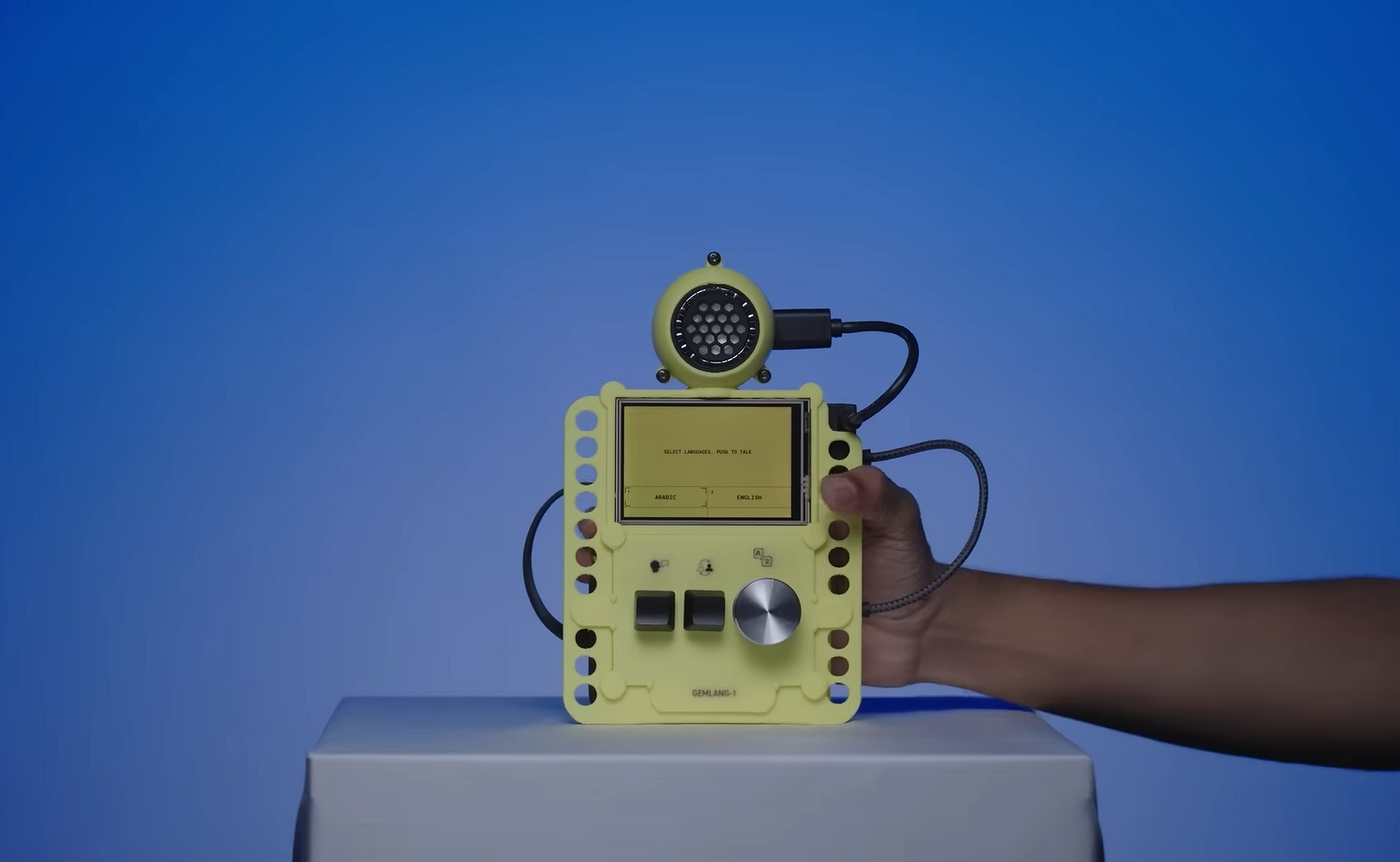
Google recently published all the instructions for building a portable offline voice translation device. It is the Gemma Translator, a physical handheld device embedding an open-source AI model designed for translation. What should be known about this project?
A compact pocket translator that works offline
In January 2026, Google unveiled the TranslateGemma suite built on the latest generation of Gemma open models. However, unlike traditional cloud tools such as the standard Google Translate API, this suite is calibrated for Edge AI, i.e. AI that runs directly on the user’s device. The key features of this suite include support for 55 languages and the analysis and translation of text within images, without relying on third-party Optical Character Recognition (OCR) software.
Several months later, specifically on August 6, 2026, Google officially published the Gemma Translator project on GitHub. In practice, it is a Do It Yourself (DIY) and open-source project in the form of a portable translation device, whose main feature is to function entirely without an internet connection.
So this is a compact autonomous pocket translator, equipped with a display and a microphone. The precise list of components the user must acquire for the build includes a Raspberry Pi 5 single-board computer, a small kiosk-style touchscreen, a USB microphone, a tiny speaker, a standard power bank, and finally a retro-looking case to be self-fabricated using 3D printing files.
How it works and its advantages
From the software side, the device runs Linux (Raspberry Pi OS) and combines several technologies, notably LiteRT-LM. It is an ultra-lightweight inference solution for running AI models on the processor. Thus, the optimized Gemma 4 E2B model for the Raspberry Pi 5 processor displays a tiny memory footprint of just 1432 MB and is capable of decoding text in real time. Also worth noting is the Moonshine speech recognition. This very fast subsystem listens to human speech and instantly converts it into text before feeding it to TranslateGemma. Next comes the user interface generated in Python / JavaScript, a local web application that automatically launches in full-screen mode at startup.
In practice, the Gemma Translator device offers a dual “corridor” interface – one lane for each speaker – inviting the user to select the two languages. It is simply a matter of holding down the button and speaking, before the device displays the translation on screen while speaking it aloud. This is therefore possible rapidly without any network cable or SIM card.
What are the advantages of this project? One of the main attractions of the Gemma Translator is, unsurprisingly, its privacy aspect. Indeed, audio streams and texts never transit through the servers of a multinational corporation, which could reasonably appeal to certain governments and other sensitive entities, particularly in the medical field. Next comes the benefit in terms of autonomy and resilience. There is a strong likelihood that browsers and other travelers in isolated areas, even humanitarian workers in crisis zones, may find the device very useful.
Here is Google’s presentation video for the project:
